
Wheat stem sawfly
Trachelus
Description
How to identify
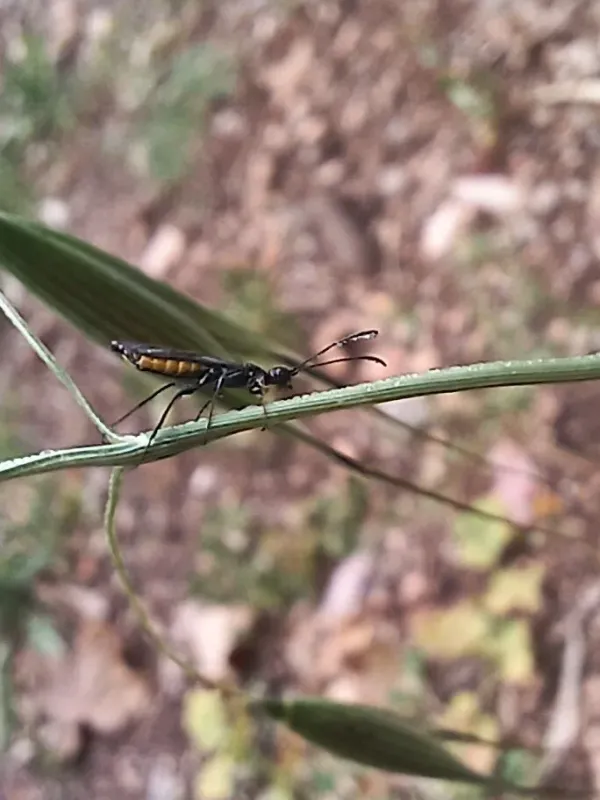
The wheat stem sawfly (Trachelus spp.) is a member of the Cephidae family. The adult insect is a slender, wasp-like creature with a shiny black body, usually about 8–10 mm in length.
The larvae are creamy-white, S-shaped, and lack legs. They are exclusively internal feeders, spending their entire larval stage inside the culms of various grass species.
The lifecycle begins with adult emergence in late spring or early summer, coinciding with the jointing stage of wheat crops. Females use their ovipositors to insert eggs into the host stems.
After hatching, the larvae consume the inner pith of the stems, moving from internode to internode. They continue to grow and feed until the crop approaches maturity.
By late summer, the mature larva moves to the base of the stem and prepares an overwintering chamber. It remains in this dormant state through the winter until pupation in the spring.
What it damages
The primary hosts for this pest include wheat, rye, and barley. Wheat is particularly susceptible to infestation, leading to significant physiological stress.
Larval feeding destroys the vascular tissue within the stem, disrupting the transport of nutrients and water to the head. This results in reduced grain filling.
The most severe damage occurs when the larva girdles the stem from the inside near the base. This weakens the plant's structural integrity, causing it to lodge.
Lodging makes the crop difficult to harvest, leading to significant grain losses. Farmers may lose a substantial portion of their yield if the infestation is not managed.
Even without lodging, the reduction in grain weight due to impaired nutrient flow results in lower yields and poorer quality grain at the time of delivery.
Signs of infestation
The most visible sign of an infestation is the presence of premature whiteheads. These heads stand out in the field as they fail to fill properly due to internal stem damage.
If you inspect the base of the wheat stubble, you will often find circular notches or cuts made by the larvae. These cuts are a classic indicator of stem sawfly presence.
Searching inside the hollow stems of fallen plants will reveal the S-shaped larvae or the fine, sawdust-like frass that they leave behind in their tunnels.
An uneven, lodged appearance in the field shortly before harvest is a strong indicator that the crop has been affected by this specific pest.
Stems that are easily broken by hand at the base are usually indicative of the weakening effect caused by the internal girdling activity of the larvae.
Control measures
Deep tillage or plowing is an effective way to bury the overwintering larvae in the stubble, preventing the adults from emerging in the next season.
Crop rotation remains a fundamental practice. By planting non-host crops like legumes or oilseeds, the lifecycle of the pest is effectively disrupted.
Selecting varieties with solid or semi-solid stems can significantly reduce the larvae's ability to tunnel, making the plants less suitable for development.
Chemical control is challenging because the larvae are protected inside the stem. Insecticide applications are most effective when timed precisely to catch the adults before egg-laying.
- Timely harvesting to reduce exposure time.
- Destroying volunteer wheat and grassy weeds.
- Monitoring fields during the booting and heading stages.
Taxonomy
- Latin name
- Trachelus
- Order
- Hymenoptera
- Family
- Cephidae
- EPPO code
- TCHLSP
Discussion
No discussions yet — be the first.