
Pear shoot sawfly
Janus piri
Description
How to identify
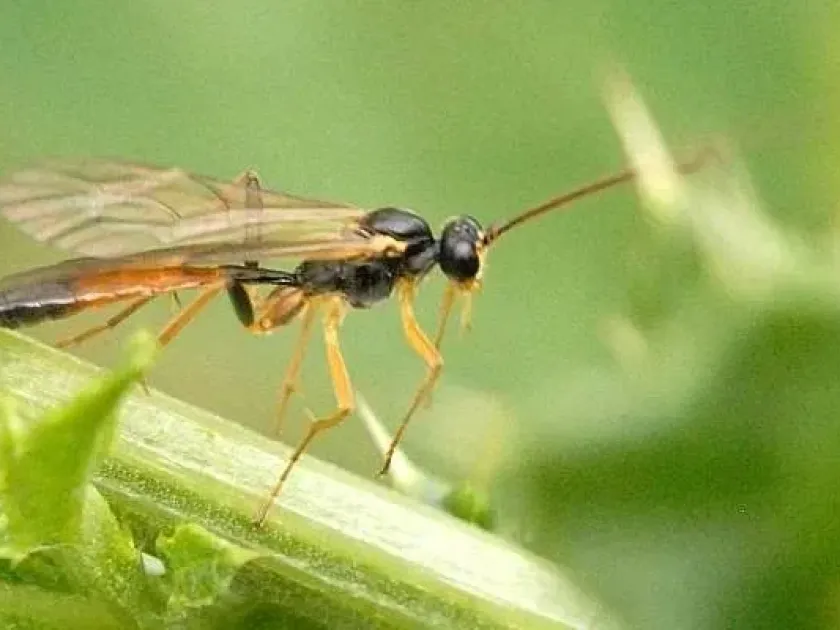
The Pear shoot sawfly (Janus piri) is a member of the Cephidae family, known for causing damage to young pear shoots. The adult is a small, slender insect with a shiny black body, measuring about 4–5 mm in length.
Females use their specialized saw-like ovipositor to cut into the tissues of new growth, where they deposit a single egg. This activity is a signature of their presence on the tree during the early growing season.
The larvae are legless, creamy-white in color, and grow up to 10 mm. They spend their entire developmental phase inside the host plant's stem, shielded from the external environment.
The pest overwinters as a larva within the hollowed-out shoots. Pupation occurs in the spring, leading to the emergence of adults that repeat the annual lifecycle of the species.
Adult activity typically aligns with the bloom period of pear trees, which coincides with the rapid expansion of young, tender shoots that are highly susceptible to infestation.
What it damages
The primary damage is caused by the larvae, which tunnel through the pith of the shoots. This boring action severs the vascular pathways, effectively cutting off the nutrient and water supply to the upper portion of the branch.
Young trees, particularly in nurseries or newly established orchards, are the most vulnerable. The growth of infested shoots is severely stunted, and they often become brittle and break.
Chronic infestation leads to significant canopy deformation. Because the apical buds are often destroyed, the tree is forced to produce secondary lateral shoots, resulting in an unmanageable and weak structure.
While the pest does not attack the fruit directly, the loss of photosynthetic area and the stress induced by the infestation reduce the tree's vigor and overall fruit-bearing capacity.
High infestation rates can lead to a substantial loss of the current year's growth, which is critical for the development of young pear trees in their formative years.
Signs of infestation
The most distinctive sign is the wilting of the shoot tips, which often bend into a "shepherd’s crook" shape. This wilting typically occurs in late spring or early summer as the larvae actively feed.
Examination of the shoot below the wilted section reveals characteristic spiral puncture marks on the bark, created by the female during the oviposition process.
If an infested shoot is split longitudinally, a central gallery filled with frass (larval excrement) is clearly visible, often with the larva found towards the base of the damaged section.
Leaves on the affected tips turn yellow, then brown, and eventually wither as the shoot itself loses structural integrity and starts to dry out.
- Wilting and drooping of new shoot tips.
- Distinctive spiral egg-laying scars on the stems.
- Darkening and necrosis of the shoot apex.
- Internal tunneling filled with larval debris.
Control measures
Sanitation is the most effective cultural practice. Gardeners should prune and remove infested shoots as soon as the wilting symptoms appear, cutting well below the lowest point of the internal damage.
All removed material must be destroyed—burned or deeply buried—to ensure that larvae cannot complete their development and emerge to start a new cycle.
Chemical control can be implemented during the adult flight period. Systemic insecticides are generally effective as they translocate within the plant and protect the new growth from larval feeding.
Monitoring for adult activity using traps or regular inspections allows for targeted pesticide applications, which reduces the total volume of chemicals used in the orchard.
Maintaining healthy orchard conditions and conducting thorough winter inspections of the canopy help reduce the initial population size and prevent widespread infestation.
Taxonomy
- Latin name
- Janus piri
- Order
- Hymenoptera
- Family
- Cephidae
- EPPO code
- JANUPI
Discussion
No discussions yet — be the first.