
Pear shoot sawfly
Janus luteipes
Description
How to identify
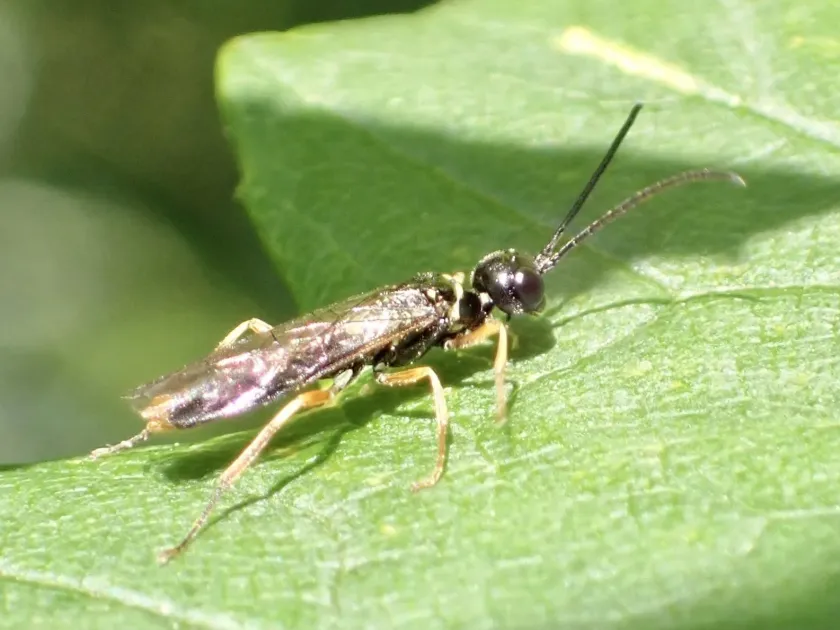
The pear shoot sawfly, scientifically known as Janus luteipes, belongs to the family Cephidae. The adult insect is a slender, black, shiny wasp about 5–7 mm in length. Its legs are distinctively yellowish-orange, providing a key identifying characteristic for field diagnostics.
The larva is a pale, legless grub with a well-developed head capsule, adapted for boring into plant tissues. Due to its internal feeding habits, the larva remains hidden from view for most of its life cycle, which makes early detection difficult without close inspection of the shoots.
What it damages
This pest primarily targets pear trees, causing significant damage to young shoots in nurseries and young orchards. The larvae bore into the centers of succulent green stems, disrupting the vascular system and preventing the flow of nutrients to the tip of the branch.
As a result, the damaged shoots lose their vigor and stop growing. In cases of high infestation, the cumulative damage can stunt the development of young trees, cause severe deformation of the canopy, and create entry points for secondary fungal or bacterial infections.
When it appears
Adult sawflies emerge in the spring, coinciding with the pear bud burst and early flowering period. During this time, the female uses her saw-like ovipositor to create incisions in young shoots, depositing eggs directly into the plant tissues.
The larvae feed throughout the late spring and summer months, progressively boring downward through the shoot. By the end of the season, mature larvae move to the base of the stem or into the soil to overwinter, where they pupate and prepare for the next generation's emergence.
Signs of infestation
The most visible symptom of infestation is the sudden wilting and drooping of shoot tips, often referred to as "flagging." The affected shoots eventually turn brown or black, dry out, and curl at the tip, making them easily distinguishable from healthy branches.
Upon closer examination, one can observe external scarring where the egg was laid. When a wilted shoot is split open, a clear tunnel filled with frass (insect excrement) is revealed, with the larva usually positioned at the lower end of the bored gallery.
Control measures
Integrated Pest Management (IPM) for this species relies heavily on sanitation. Pruning and destroying infested shoots shortly after the first signs of wilting appear is the most effective method to reduce the local population before the larvae reach maturity.
In commercial orchards, systemic insecticides may be applied if infestation rates exceed economic thresholds. Applications must be timed precisely during the adult flight period to interrupt the egg-laying process, ensuring that the chemical reaches the target before the larvae enter the shoots.
Taxonomy
- Latin name
- Janus luteipes
- Order
- Hymenoptera
- Family
- Cephidae
- EPPO code
- JANULU
Discussion
No discussions yet — be the first.