
Pear shoot sawfly
Janus kashivorus
Description
How to identify
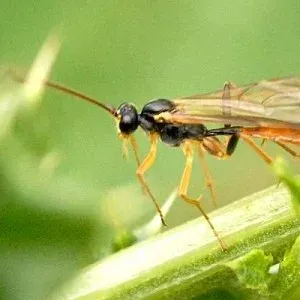
The pear shoot sawfly (Janus kashivorus) belongs to the order Hymenoptera and the family Cephidae. It is a slender, dark-colored insect with a metallic luster, commonly identified by its specific host preference.
Adult sawflies have clear wings with a characteristic venation pattern. They are small and often difficult to spot in the orchard environment due to their rapid flight patterns during the mating season.
The larvae are typically pale or creamy white with a distinct head capsule. They are exclusively stem-boring insects, completing their development within the young shoots of pear trees.
Identification is most reliably achieved by observing the specific damage patterns on pear shoots, as the insect's life cycle is tightly linked to the succulent growth of the host.
Microscopic examination of the adult's wing venation and body shape confirms the species classification, distinguishing it from other closely related stem-boring sawflies.
What it damages
The primary damage is caused by the larvae boring into the current season's shoots. This activity disrupts the transport of water and nutrients, leading to the wilting of the shoot tip.
In young orchards and nurseries, the infestation of central leaders or main scaffold branches can lead to permanent structural deformities and stunted tree growth.
Affected shoots become brittle and often snap off due to the structural compromise caused by the internal larval tunnels, which are filled with frass.
Repeated annual damage can significantly reduce the photosynthetic capacity of the tree, resulting in lower fruit yields and reduced vigor of the entire canopy.
Young trees are particularly vulnerable, as the loss of terminal buds forces the tree to produce lateral growth, which may interfere with the intended pruning and training program.
When it appears
The emergence of adult sawflies occurs in early spring, synchronized with the bud burst and the development of new, succulent pear shoots.
Female sawflies deposit their eggs inside the young stems, which provides immediate protection and an accessible food source for the hatching larvae.
Larval feeding is most intensive throughout the late spring and early summer, taking advantage of the period when shoot growth is at its most rapid stage.
By late summer, the larvae finish their development and prepare for diapause. They remain safely inside the stems, where they overwinter protected from cold temperatures.
The life cycle is univoltine, meaning there is typically one generation per year, making the timing of spring monitoring critical for effective management.
Signs of infestation
The most prominent sign is the sudden wilting and drooping of the terminal leaves on young shoots, often described as a "withered tip" appearance.
A careful inspection near the base of the wilted section often reveals a small puncture or a slight circular scar where the egg was inserted by the female.
When an infested shoot is split longitudinally, the internal gallery can be clearly seen, usually packed with dark larval excrement alongside the white larva.
As the season progresses, the withered shoots turn brown, creating a stark contrast against the healthy foliage of the pear tree canopy.
The stems may show localized swelling or darkening at the site of the larval boring, which further confirms the presence of the pest within the wood.
Control measures
Sanitation is the most effective management strategy; pruning and destroying infested shoots prevents the larvae from completing their life cycle and lowers future populations.
- Regular monitoring during spring for early signs of wilting
- Sanitary pruning of infested stems below the larval tunnel
- Timely application of systemic insecticides during egg-laying
- Proper orchard nutrition to promote vigorous growth and recovery
- Using yellow sticky traps to detect adult activity
Systemic insecticides are effective when applied at the correct developmental stage of the pest, specifically during the adult flight period to prevent egg-laying.
Integrated pest management (IPM) practices, including the preservation of natural predators and parasitoids, can help suppress sawfly populations in larger orchard systems.
All pruned materials from infested trees must be removed from the orchard and destroyed to ensure that no larvae emerge in the following spring season.
Taxonomy
- Latin name
- Janus kashivorus
- Order
- Hymenoptera
- Family
- Cephidae
- EPPO code
- JANUKA
Discussion
No discussions yet — be the first.