
Poplar shoot sawfly
Janus femoratus
Description
How to identify
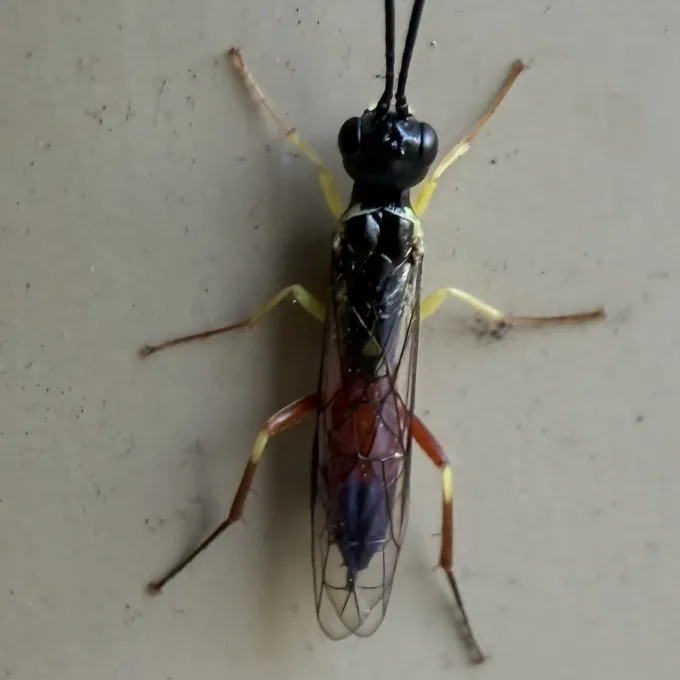
The Poplar shoot sawfly (Janus femoratus) belongs to the order Hymenoptera and the family Cephidae. Adult insects are slender, measuring 7–10 mm in length, typically featuring a black body with a metallic sheen.
Females possess a robust ovipositor, which they use to incise young shoots and deposit eggs. This adaptation allows the sawfly to secure its offspring within the nourishing tissues of the host plant.
The larvae are pale, legless, and possess a distinct dark-brown head capsule. Unlike many other sawfly species, they are specialized borers that spend their developmental stage inside plant stems.
The life cycle involves a complete metamorphosis, moving from egg to larva, pupa, and finally to the adult stage. The species is highly specialized, primarily targeting members of the Populus genus.
Recognition of this pest is largely based on the specific damage pattern they leave behind, as the adults themselves are rarely seen by non-specialists due to their secretive behavior.
What it damages
The primary hosts of the Poplar shoot sawfly are poplar (Populus) species and occasionally willow trees. They represent a significant threat to young plantations and nurseries.
The larvae cause damage by tunneling into the pith of succulent young shoots. This feeding behavior disrupts the transport of water and nutrients, leading to the decline of the shoot tip.
Young trees, particularly those aged 1 to 7 years, are most susceptible to infestation. Repeated damage can cause significant growth stunting and, in severe cases, the death of young seedlings.
Secondary infections by pathogens can occur through the exit holes or the tunnels created by the larvae, further weakening the structural integrity of the saplings.
In forest nurseries, this pest can be a limiting factor in the successful cultivation of high-quality poplar stock, requiring persistent management efforts.
When it appears
Adult flight activity typically occurs in late spring and early summer, coinciding with the rapid vegetative growth of poplar shoots. This is the period when mating and egg-laying occur.
Larval development proceeds throughout the summer months as they feed down the stem. This hidden development cycle makes it difficult to implement direct chemical control after the initial egg-laying phase.
The larvae overwinter inside the stems, having prepared a hibernating chamber in the lower section of the damaged branch or shoot. They remain dormant through the winter months.
Pupation takes place inside the stem in early spring, leading to the emergence of the next generation of adults as soon as weather conditions are favorable.
Understanding this seasonal timing is critical for pest management, as intervention must be timed correctly to address the most vulnerable stages of the sawfly's life cycle.
Signs of infestation
The most prominent sign of an infestation is the sudden wilting and drooping of the tender top shoots, often described as "flagging." This occurs shortly after the female lays her eggs and the larvae begin feeding.
A distinctive circular incision on the bark, created by the female during oviposition, is a key diagnostic indicator found just below the wilted portion of the shoot.
Upon splitting a damaged stem longitudinally, one will observe a central tunnel packed with brownish frass, which is clear evidence of larval activity.
Over time, the affected shoot tips dry out, turn dark, and eventually break off, causing damage to the tree's form and vertical development.
- Wilting of terminal shoots in spring and early summer.
- Circular oviposition scars around the stem.
- Internal larval tunnels filled with frass.
- Brittle and dead shoot tips breaking in the wind.
Control measures
Sanitation pruning is the most effective manual method of control. Removing and destroying infested shoots before the emergence of adults helps to break the pest's reproductive cycle.
Pruning should be performed well below the site of the damage to ensure that the larva, which may have moved deeper into the shoot, is successfully removed.
Chemical control can be implemented using systemic insecticides, applied during the peak adult flight period to prevent egg-laying on the vulnerable new growth.
Monitoring for initial signs of wilting is essential in nurseries. Early detection allows for immediate localized action, reducing the need for broad-spectrum insecticide applications.
Maintaining healthy, vigorous trees through proper fertilization and watering can improve the trees' ability to tolerate minor damage from occasional sawfly infestations.
Taxonomy
- Latin name
- Janus femoratus
- Order
- Hymenoptera
- Family
- Cephidae
- EPPO code
- JANUFE
Discussion
No discussions yet — be the first.