
Pear shoot sawfly
Janus compressus
Description
How to identify
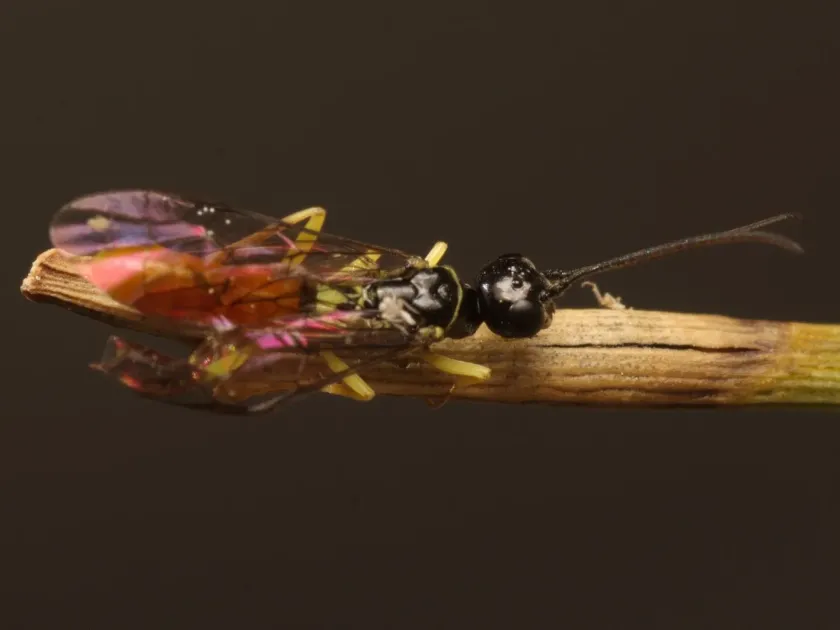
The pear shoot sawfly (Janus compressus) is a member of the Cephidae family (stem sawflies). Adult insects are slender, black wasps measuring approximately 6–8 mm in length.
The female is equipped with a saw-like ovipositor that allows her to incise the tissue of young shoots to deposit eggs securely inside the stem.
The larvae are legless, white-bodied insects with a distinct brownish head, specifically adapted for living and feeding within the pith of host plants.
This pest is highly host-specific, primarily targeting species within the genus Pyrus (pears), which dictates its distribution in commercial and home orchards.
The insect relies on the nutritional content of succulent spring growth, making it a critical threat during the early stages of the growing season.
What it damages
The primary hosts of this pest are pear trees, with young trees in nurseries and newly established orchards being the most susceptible to infestation.
Damage is localized to current-season shoots. Once the larva tunnels into the center of the stem, it disrupts the vascular system, preventing nutrient and water transport.
The immediate consequence for the tree is the wilting and subsequent necrosis of the shoot tip, which effectively halts any further upward growth of that branch.
Persistent infestation can lead to structural damage, causing the crown to become deformed as the tree attempts to compensate by growing lateral shoots.
In cases of high infestation rates, the overall vigor and cold hardiness of the young trees can be significantly compromised, leading to long-term growth retardation.
When it appears
Adult sawflies emerge in early spring, synchronized with the bud-burst and the rapid elongation of new shoots on pear trees.
Egg-laying occurs as females navigate the canopy, selecting succulent terminals to insert their eggs, typically over a several-week period in spring.
Upon hatching, larvae immediately burrow into the pith of the shoot, creating a longitudinal tunnel as they feed and progress downward through the stem.
The larval stage is completed by early summer, at which point they prepare for diapause within the hollowed-out section of the shoot.
The insect overwinters as a mature larva inside the dried remains of the infested shoot, waiting until the following spring to pupate.
Signs of infestation
The most diagnostic sign of a pear shoot sawfly presence is the sudden wilting and drooping of the shoot tip, often appearing as a shepherd's crook.
- Shoot tips turn brown, wither, and eventually break off or die completely.
- Small, puncture-like scars may be visible on the stem, indicating where the female inserted her ovipositor.
- Splitting the infested shoot reveals a hollowed pith, often packed with dark-colored frass or larval excrement.
- The presence of a legless, whitish larva within the central tunnel is definitive proof of the pest.
- Abnormal branching patterns near the site of the original injury are common as the tree reacts to the trauma.
Control measures
The primary and most effective control method is the physical removal and destruction of infested shoots as soon as wilting is observed.
Pruning cuts must be made well below the tunnel entry point to ensure the larva is removed along with the infested section of the branch.
All removed material must be collected and incinerated to eliminate the next generation of sawflies and prevent the cycle from continuing.
Chemical control, if necessary, involves applying systemic insecticides during the peak flight period of the adults to prevent egg-laying.
Maintaining healthy trees through proper irrigation and fertilization helps the plant withstand stress and recover more efficiently after pruning interventions.
Taxonomy
- Latin name
- Janus compressus
- Order
- Hymenoptera
- Family
- Cephidae
- EPPO code
- JANUCO
Discussion
No discussions yet — be the first.