
Poplar shoot sawfly
Janus abbreviatus
Description
How to identify
The poplar shoot sawfly (Janus abbreviatus) belongs to the family Cephidae of the order Hymenoptera. The adult insect is a slender, black-colored wasp-like creature measuring approximately 7 to 9 mm in length.
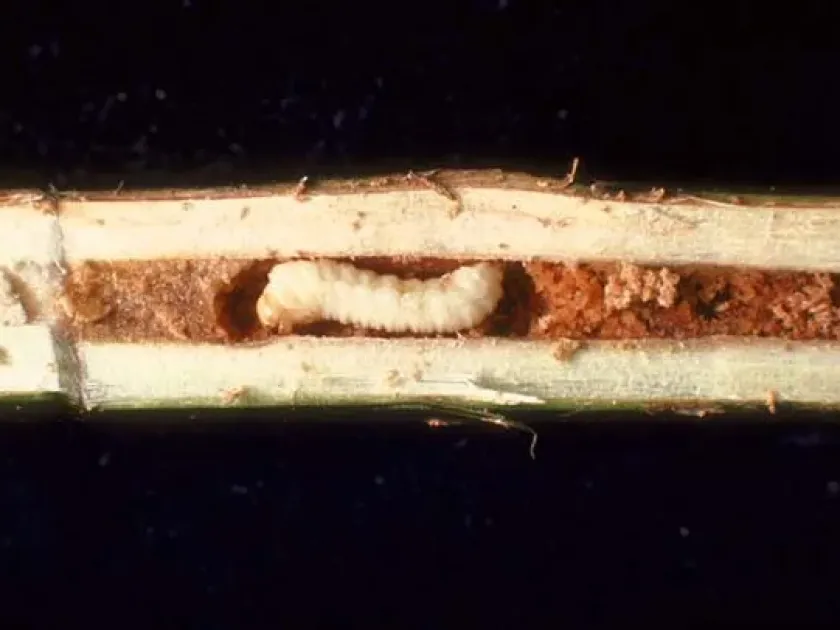
The larva of this species is creamy-white with a cylindrical body and a distinct head capsule. It lives exclusively inside the plant tissue, making it a hidden but destructive pest for young tree shoots.
What it damages
The primary hosts for Janus abbreviatus are various species of poplar (Populus). It is particularly harmful to young trees in nurseries and young forest plantations, where it targets tender apical shoots.
Severe infestations can lead to stunted growth and structural deformation of the tree. The loss of terminal shoots forces the tree to develop lateral branches, ruining its natural apical dominance and aesthetic value.
When it appears
Adult sawflies emerge in late spring, typically in May or June, to coincide with the rapid growth phase of host trees. During this time, the females use their ovipositors to insert eggs into the succulent new growth.
The life cycle is univoltine, meaning there is one generation per year. After hatching, the larva bores into the shoot and remains there throughout the summer, preparing for hibernation in the wood over the winter months.
Signs of infestation
The most visible symptom is the sudden wilting and drooping of shoot tips. Close inspection reveals a series of puncture marks or a spiral-like incision where the female laid the egg, causing the shoot to die.
If the stem is split, you will see internal galleries filled with larval excrement known as frass. Damaged shoots become brittle and frequently snap during windy weather, leading to further physical damage to the tree canopy.
Control measures
Sanitation is the most effective control method. Pruning and destroying infested shoots, ensuring cuts are made well below the entry hole, is vital to removing the larvae before they complete their life cycle.
Chemical control with systemic insecticides can be applied during the adult flight period to prevent egg-laying. Integrated pest management practices should focus on maintaining tree vigor and prompt removal of dead wood.
Taxonomy
- Latin name
- Janus abbreviatus
- Order
- Hymenoptera
- Family
- Cephidae
- EPPO code
- JANUAB
Discussion
No discussions yet — be the first.