
Wheat stem sawfly
Cephus
Description
How to identify
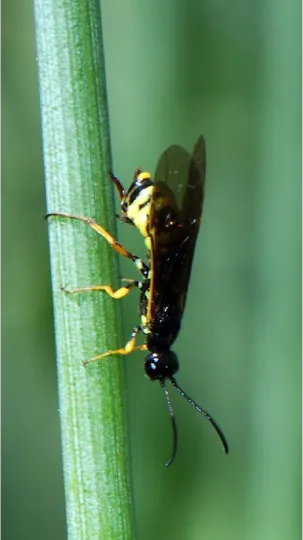
The wheat stem sawfly Cephus pygmaus is a member of the Hymenoptera order, specifically the Cephidae family. Adults are small, slender insects measuring about 8–10 mm with shiny black bodies and yellow abdominal bands.
The larva is S-shaped, pale yellow with a brown head, reaching 10–12 mm in length. It is specifically adapted to living within the narrow stems of various grass species.
Females possess a specialized ovipositor designed to cut into the plant stem and deposit single eggs. The eggs are small, oval-shaped, and milky white, hidden away from natural predators.
Throughout their developmental cycle, larvae remain inside the plant stem, continuously consuming inner tissues while moving downward toward the crown of the plant.
Adult sawflies are diurnal, preferring warm and sunny conditions. During cold or overcast weather, they tend to remain stationary deep within the crop canopy to conserve energy.
What it damages
This pest targets cereal crops, primarily winter and spring wheat, barley, and rye. It can also infest wild grasses, which may serve as a secondary host for local populations.
Damage occurs when the larva feeds on the stem's inner parenchyma. This disrupts the plant's nutrient transport, resulting in shriveled grains and significantly lower thousand-grain weight.
As the larva grows, it weakens the stem structure. During the maturation phase, the stems become brittle, leading to severe lodging, especially when exposed to strong winds or heavy rain.
Lodging causes significant mechanical harvesting losses, as combines are often unable to pick up the fallen stems, leaving a portion of the yield on the field.
In addition to direct yield loss, the infestation complicates field management and uniformity of crop ripening, which can negatively impact overall grain quality standards.
When it appears
The wheat stem sawfly completes one generation per year. They overwinter as mature larvae inside a silk-lined cocoon located within the base of the stubble, often below the soil line.
Pupation occurs in early spring as soil temperatures rise. The emergence of adults typically coincides with the booting and heading stages of the cereal crops.
Adult flight lasts about 2 to 3 weeks. During this brief window, mating occurs, and females immediately seek out the most suitable stems to lay their eggs.
The embryonic development stage lasts between one and two weeks depending on thermal accumulation. Newly hatched larvae begin feeding immediately upon emergence.
Feeding concludes by the late dough stage of the grain. At this point, the larva moves to the base of the stem to prepare the overwintering chamber for the winter season.
Signs of infestation
The primary symptom of an infestation is the premature yellowing and whitening of the heads, which appear bleached compared to the healthy surrounding plants.
Upon closer inspection of the stems, entry holes made by the female ovipositor can be identified, often accompanied by brown frass indicating larval activity inside.
Splitting the stem during the vegetative or grain-filling stage will reveal larval tunnels filled with sawdust-like excrement and sometimes the larva itself.
Pre-harvest lodging is the most distinct sign of high infestation levels, where patches of the crop fall over due to the stem being weakened at the base.
Stubble examination after harvest often shows stems that are easily detached or broken at the root level due to the internal structural damage caused by the larvae.
Control measures
Effective cultural control involves immediate post-harvest stubble disking and deep moldboard plowing to bury overwintering larvae, preventing successful emergence.
Crop rotation and maintaining distance between new cereal fields and last year’s infested fields help reduce the immigration of adult sawflies.
Selecting cereal varieties with thicker, sturdier stems can provide a level of host resistance, as larvae struggle to develop efficiently in these structural conditions.
Chemical control is advised during the peak adult flight period if economic thresholds are exceeded, typically using systemic or contact insecticides.
Consistent field scouting using sweep nets is critical for detecting the onset of adult activity, allowing agronomists to make informed decisions regarding insecticide application timing.
Taxonomy
- Latin name
- Cephus
- Order
- Hymenoptera
- Family
- Cephidae
- EPPO code
- CEPHSP
Discussion
No discussions yet — be the first.