
Anystis baccarum
Anystis baccarum
Description
How to identify
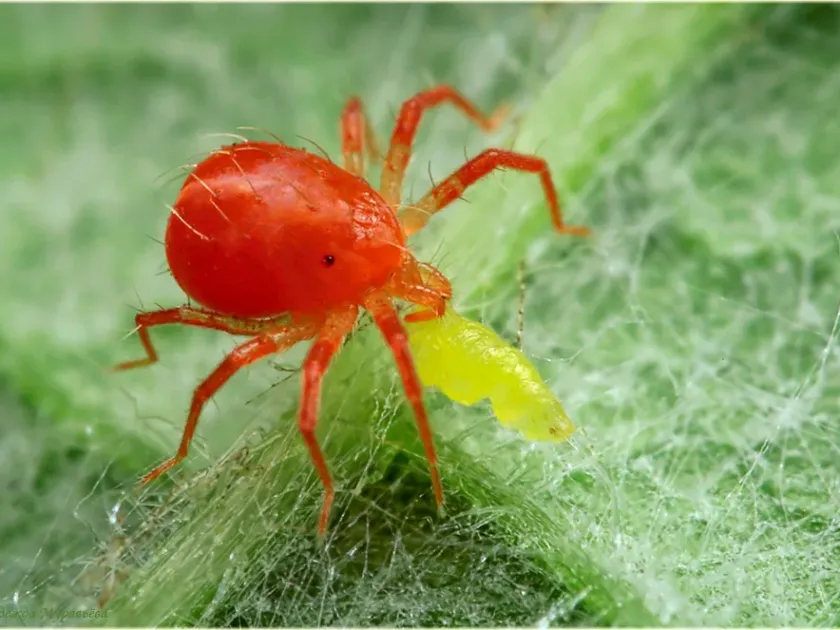
Anystis baccarum is a species of predatory mite belonging to the family Anystidae, order Trombidiformes. It is widely recognized for its vibrant red or orange-red coloration and highly active nature.
Adult mites are approximately 1 millimeter in size and possess a globular body with long, radially arranged legs. This morphology enables them to move rapidly across leaves and stems while searching for prey.
Unlike many other mite species, Anystis baccarum does not spin webs. They are solitary, free-ranging predators that rely on their speed and agility to capture other small arthropods.
The life cycle includes an egg stage, a larva, several nymphal instars, and an adult stage. During the molting process, these mites enter a period of quiescence, often aggregating in sheltered locations on the host plant.
This species is globally distributed, commonly found in temperate climates. Its presence is frequent in orchards, meadows, vineyards, and agricultural fields where diverse microhabitats exist.
What it damages
Anystis baccarum is not a plant pest; rather, it is a significant beneficial predator in agricultural and horticultural ecosystems. It feeds on various arthropods that damage crops.
Its diet consists primarily of spider mites, aphids, thrips, and eggs or larvae of numerous insect pests. By consuming these organisms, it acts as a natural biological control agent.
Due to its high mobility and predatory behavior, it can effectively suppress pest outbreaks, particularly at the early stages of infestation before they cause severe damage.
The role of this mite as a generalist predator helps maintain ecological balance, often reducing the need for chemical intervention in managed landscapes.
There is no economic harm associated with Anystis baccarum. Its presence is generally considered an indicator of a healthy, biodiverse environment that supports natural pest suppression.
When it appears
The activity of Anystis baccarum begins in early spring, as temperatures rise and the mites emerge from their overwintering sites to begin hunting for prey.
Peak population densities are usually reached during mid-summer, coinciding with the highest activity levels of common agricultural pests like spider mites and aphids.
As daylight hours decrease and temperatures drop in the autumn, the mites seek out sheltered sites for hibernation to survive the winter conditions.
Overwintering typically occurs in the adult stage, with individuals hiding in bark crevices, leaf litter, or the upper layers of the soil to escape harsh cold.
The number of generations per year is dictated by regional climatic conditions, but in favorable environments, multiple overlapping generations can occur throughout the growing season.
Control measures
As a beneficial predator, there is no need to control Anystis baccarum; the primary management objective is to conserve and support its populations within the farm.
The most crucial step is to avoid the unnecessary use of broad-spectrum insecticides, which can be highly toxic to predatory mites and disrupt natural biocontrol services.
Implementing Integrated Pest Management (IPM) strategies, which prioritize selective chemical applications, allows for the preservation of predatory populations while targeting specific pests.
Maintaining floral borders and avoiding complete removal of crop residues can provide necessary shelter and alternative resources for the mites during periods when primary prey is scarce.
Promoting a diversified agroecosystem is the best way to ensure the long-term presence of Anystis baccarum, ultimately contributing to more sustainable and cost-effective crop production.
Taxonomy
- Latin name
- Anystis baccarum
- Order
- Mites
- Family
- Anystidae
- EPPO code
- ANYSBA
Discussion
No discussions yet — be the first.