
Anystis
Anystis astripus
Description
How to identify
Anystis astripus is a member of the Anystidae family within the Trombidiformes order. These mites are well-known among agronomists for their rapid movement and predatory behavior.
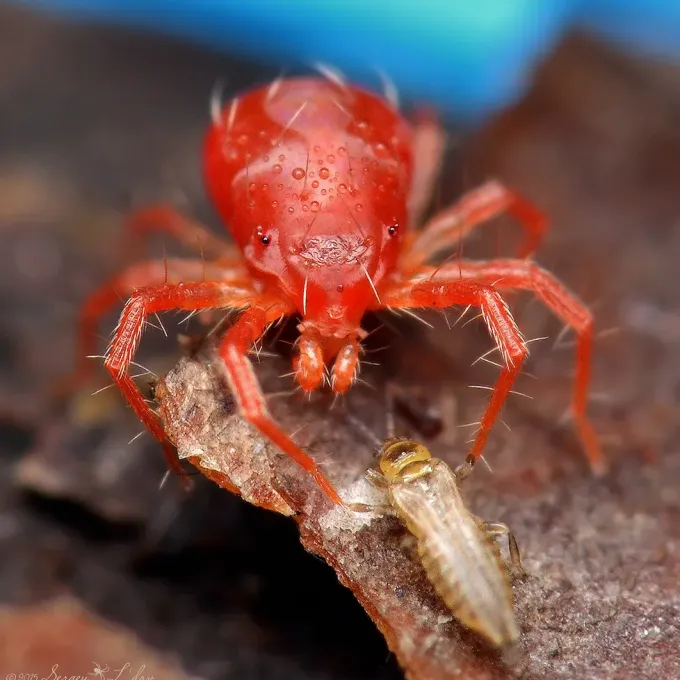
The adults are characterized by a distinct bright red or reddish-orange color, a globular body shape, and relatively long, radial legs that provide them with remarkable agility.
Typically, these mites measure about 0.5 to 1.0 mm in length. Their high speed and directional changes on leaf surfaces are key identifiers for this species.
They are exclusively predatory, meaning they do not consume plant material, making them an asset in any agricultural environment.
The development cycle follows several stages, including eggs and nymphs, all of which are predatory, constantly searching for food on the host plants.
What it damages
It is crucial to clarify that Anystis astripus is not a plant pest; it does not damage crops, foliage, or fruits in any way.
Instead, they act as highly efficient biocontrol agents, preying on a wide range of agricultural pests such as aphids, thrips, and spider mite nymphs.
By consuming these harmful pests, Anystis mites help maintain ecological balance, often preventing the need for chemical intervention.
Their predatory habit ensures they stay on the plant surfaces where pest populations are concentrated, providing localized and effective biological protection.
In modern integrated pest management (IPM), these mites are highly valued for their contribution to naturally limiting pest outbreaks without chemical residues.
When it appears
The activity of Anystis astripus generally spans from early spring through late autumn, depending on regional climatic conditions and ambient temperatures.
Populations tend to reach their peak in late spring and summer, correlating with the increase in pest activity that provides the necessary food supply.
These mites prefer humid microclimates often found on the undersides of leaves or in denser canopy areas where they can efficiently patrol for prey.
During the onset of winter or cold weather, they seek refuge in sheltered areas, such as bark crevices, soil debris, or leaf litter to survive until the next season.
Multiple generations can occur within a single growing season if the food source and temperature conditions remain favorable for their reproduction.
Signs of infestation
The presence of these mites is easily spotted by their characteristic rapid, erratic running on the surface of leaves, appearing as tiny, fast-moving red dots.
Observing a decline in aphid or spider mite colonies in the absence of chemical applications is a strong indicator of the activity of Anystis.
Unlike true pests, they do not cause wilting, yellowing, or web formation, as they are actively clearing the plant of harmful organisms.
The appearance of Anystis in the field is a sign of a healthy, biodiverse environment that supports beneficial predatory species.
Frequent field scouting with a hand lens can confirm the presence of these mites as they actively stalk and consume their prey on various vegetable and fruit crops.
Control measures
Control measures regarding Anystis astripus should focus entirely on conservation and encouraging their population growth within the farm.
The most important action is to avoid broad-spectrum insecticides, which can be detrimental to predatory mite populations and disrupt natural biological control.
Adopting an Integrated Pest Management (IPM) approach is recommended, favoring selective or bio-based pesticides that leave beneficial arthropods unharmed.
Maintaining floral strips or hedgerows around fields provides essential refuge and alternative food sources for these mites, especially when primary pest levels are low.
- Prioritize biological control over chemical pesticides.
- Avoid spraying in the vicinity of known beneficial habitats.
- Encourage biodiversity to support natural predator populations.
Taxonomy
- Latin name
- Anystis astripus
- Order
- Mites
- Family
- Anystidae
- EPPO code
- ANYSAS
Discussion
No discussions yet — be the first.