
Feather mite
Megninia ginglymura
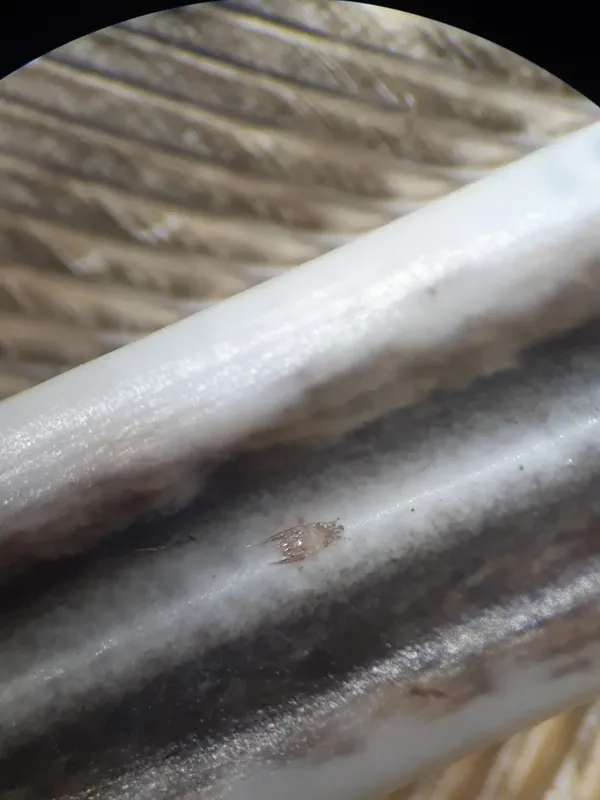
Description
How to identify
Megninia ginglymura belongs to the family Analgidae, order Sarcoptiformes. It is a microscopic mite inhabiting the feathers of birds, predominantly chickens.
Adult specimens have a flattened body shape, which is highly adapted for moving efficiently between feather barbs and shafts.
The life cycle of this mite takes place entirely on the host's body, making it a permanent ectoparasite that is well-adapted to the bird's environment.
These mites feed on skin secretions, epithelial scales, and feather debris, differentiating them from hematophagous (blood-sucking) parasites.
Proper identification requires professional microscopic examination of skin and feather samples to distinguish them from other mite species.
What it damages
The primary hosts for this mite are agricultural birds, especially chickens, though it may occasionally be found on other domestic avian species.
The parasite localizes on flight and tail feathers, causing structural damage and mechanical degradation of the vane area.
Infested birds show signs of agitation, decreased productivity, and poor plumage quality, which lowers the commercial value of the flock.
Severe infestations can disrupt the bird's thermoregulation because the insulating integrity of the feather layer is compromised.
In commercial poultry operations, these mites can lead to increased culling rates and a reduction in the overall immune status of the birds.
When it appears
In indoor poultry housing, the activity of these mites continues year-round due to the stable microclimate maintained in the facilities.
The most intense population growth occurs during periods of high humidity and moderate-to-warm temperatures, which are optimal for mite development.
Transmission of the parasite between birds occurs through direct contact, allowing for rapid spreading within a flock or across a facility.
External weather variations have less impact on the population compared to the internal hygiene management of the poultry house.
Changes in housing conditions or overcrowding can trigger outbreaks, as stressed or weakened birds become more susceptible to infestation.
Signs of infestation
The primary symptom is brittle feathers, along with the appearance of grooves and worn edges on primary feathers of adult birds.
Clusters of mites can often be seen at the base of the feathers, appearing as fine grayish dust or powdery deposits on the plumage.
Affected birds exhibit itching, frequently preen excessively, or peck at their own skin, leading to secondary bacterial skin infections.
When inspecting feathers against a light source, one can often observe damage to the barb structure and a lack of the characteristic feather sheen.
Reduced egg-laying performance and retarded growth in young stock are often indirect indicators of a significant mite infestation.
Control measures
Effective control is based on rigorous sanitary and hygienic practices within housing areas and regular disinfection of the premises.
Use of specialized acaricidal agents approved for use in poultry farming, applied through direct spraying or dust bathing treatments.
Providing dust baths treated with appropriate insecticidal powders allows birds to self-groom and remove mites effectively.
- Regular replacement and sanitation of poultry litter.
- Quarantine procedures for new birds before integrating into the flock.
- Deep cleaning of all equipment to remove organic buildup.
- Scheduled monitoring of plumage condition during routine health checks.
Prevention includes restricting contact between domestic flocks and wild birds, which can serve as reservoirs for various ectoparasites.
Taxonomy
- Latin name
- Megninia ginglymura
- Order
- Mites
- Family
- Analgidae
- EPPO code
- MGNIGI
Discussion
No discussions yet — be the first.