
Honey bee tracheal mite
Acarapis woodi
Description
How to identify
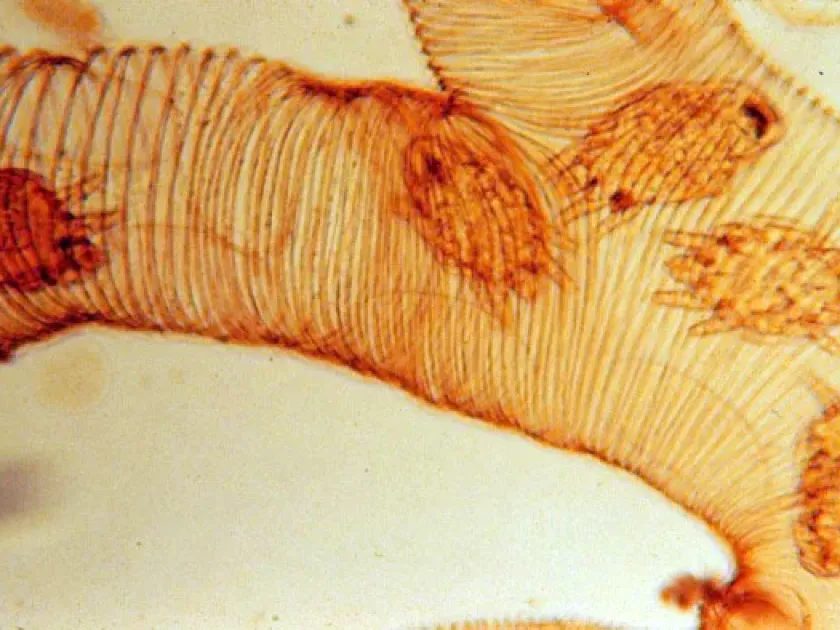
The honey bee tracheal mite (Acarapis woodi) belongs to the Tarsonemidae family, order Trombidiformes. It is a microscopic internal parasite that lives and reproduces exclusively inside the thoracic tracheae of adult honey bees.
The mite has an oval-shaped, whitish body and measures only 0.1–0.15 mm in length. Because of their tiny size, they are invisible to the naked eye, requiring laboratory microscopic examination of tracheal cross-sections for definitive diagnosis.
Female mites enter the respiratory system of young bees (under 3–5 days old), where they feed on the host's hemolymph. Inside the trachea, the parasite completes its full life cycle from egg to larva to adult.
A generation cycle takes approximately 14–21 days. Under optimal temperature and humidity conditions inside the hive, the mites multiply rapidly, moving from infected bees to young, healthy bees during physical contact.
Transmission occurs primarily through direct bee-to-bee contact, especially during wintering, robbing, or clustering. The mite dies quickly outside the host, making it strictly an obligate parasite of honey bees.
What it damages
This pest affects only honey bees (Apis mellifera), causing the disease known as acariosis. It does not damage other insects or agricultural crops.
The primary damage occurs in the bee's respiratory system. Mite infestation blocks the tracheae, hindering gas exchange and causing severe physiological stress, which compromises the bee's overall immunity and flight ability.
Heavy infestations lead to significant bee mortality, particularly during the winter and spring. This depletion weakens the colony and can ultimately lead to its collapse under stressful environmental conditions.
The level of harm is directly proportional to the mite burden: high numbers of parasites in the tracheae shorten the bee's lifespan, leading to colony decline as the number of active foragers decreases.
Indirect losses include reduced honey production and impaired brood development. Because the disease often remains asymptomatic in its early stages, it poses a significant threat to apiary productivity if not diagnosed early.
Signs of infestation
The most common clinical sign is the presence of "crawling" bees that are unable to fly. In severe cases, bees cluster near the hive entrance with their wings appearing asymmetrical or "K-wing" deformed.
Visual identification is unreliable as bees may appear healthy despite a high mite load. The only definitive diagnosis is a microscopic examination of the first pair of thoracic tracheae.
During analysis, infected tracheae exhibit dark brown or black discoloration, which is a result of parasite waste accumulation and secondary fungal infections within the respiratory system.
During winter, an infested colony may exhibit unusual restlessness and increased noise. Excessive worker bee death on the hive floor is common, which is often misdiagnosed as starvation or other common bee diseases.
Signs of infestation become more prominent in the spring, as the cumulative mite burden exceeds the bee's capacity to maintain normal physiological processes, leading to the collapse of the colony.
Control measures
Effective control of the tracheal mite involves the use of specialized acaricides. Products based on formic acid or thymol are currently the most effective treatments as they act through vapor exposure within the hive.
Regular monitoring of the apiary is crucial. It is highly recommended to perform diagnostic tests on bee samples during spring and autumn to track infestation levels and apply treatments if necessary.
Management practices should focus on maintaining strong, healthy colonies with young, vigorous queens. Proper colony preparation before winter is essential for increasing the bees' natural resistance to mite infestation.
Proactive management includes minimizing drift and preventing robbing between colonies. Hives should be spaced appropriately to reduce the risk of transmission between different bee families.
- Strict adherence to the manufacturer's instructions for veterinary medications.
- Regular culling of old brood combs that may harbor pathogen reservoirs.
- Maintaining optimal ventilation and microclimate conditions inside the hive during winter.
Taxonomy
- Latin name
- Acarapis woodi
- Order
- Mites
- Family
- Acarapidae
- EPPO code
- ACASWO
Discussion
No discussions yet — be the first.