
Marsh crane fly
Tipula subnodicornis
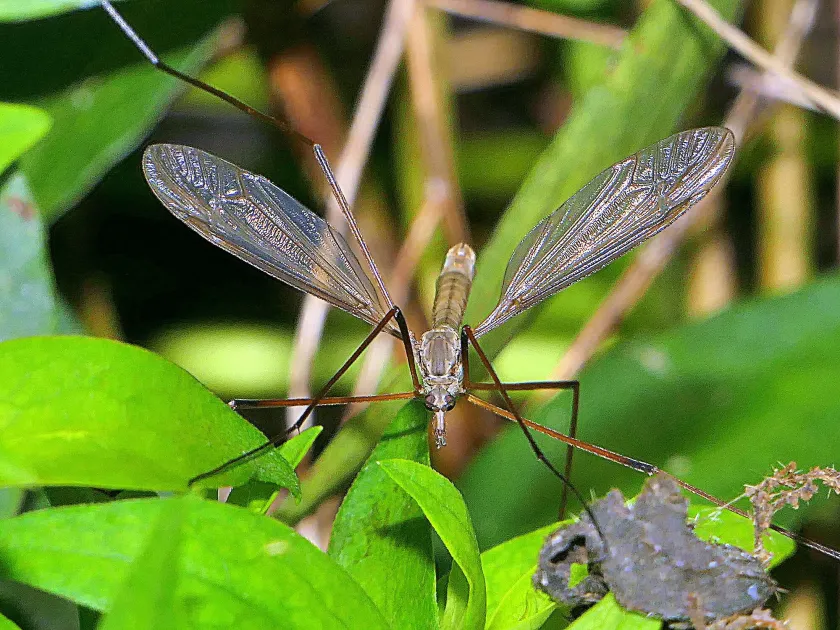
Description
How to identify
The marsh crane fly (Tipula subnodicornis) is a member of the order Diptera, family Tipulidae. Adult flies are characterized by their long, spindly legs and delicate appearance, often mistaken for oversized mosquitoes.
The body of the adult is slender and grey-brown, with a wingspan of approximately 20–25 mm. The species can be distinguished from other crane flies by specific antenna morphology and distinct wing venation patterns.
The larval stage, commonly known as a leatherjacket, is a legless, cylindrical grub reaching up to 40 mm in length. Its skin is tough and leathery, ranging in color from grey to dark brown, which provides excellent camouflage within the soil environment.
The head is partially retracted into the thorax and possesses strong, dark mandibles designed for cutting through plant roots and stems. The posterior end features respiratory spiracles surrounded by fleshy lobes, essential for surviving in moist soil conditions.
The life cycle encompasses an egg stage, four larval instars, a pupal stage, and the adult form. Typically, the species completes one generation per year, making it a persistent resident in favorable habitats.
What it damages
The larvae of the marsh crane fly are polyphagous pests that threaten a variety of agricultural crops. Cereal crops, particularly winter wheat, barley, and rye, are highly susceptible to damage during their early growth stages in spring.
In addition to cereals, leatherjackets feed on the roots, tubers, and basal stems of corn, sugar beets, and potatoes. Feeding results in stunted growth, yellowing, and often the total collapse of seedlings.
Wetland areas, peat soils, and poorly drained fields are particularly prone to infestation. Larvae can cause significant economic loss by destroying turf and pasture grasses, leading to patchiness and reduced forage quality.
Clover and lucerne (alfalfa) fields are also common hosts. By severing root systems, the larvae weaken the plants, making them more susceptible to secondary infections from soil-borne fungi and bacteria.
During outbreak years, infestations can reach levels capable of devastating more than half of the crop yield in affected areas, especially when fields have been left under grass for multiple seasons.
When it appears
Adults typically emerge in late spring or early summer to mate. They do not feed on crops during this stage; their primary objective is reproduction and the dispersal of eggs across suitable habitats.
Females deposit eggs in damp soil or amongst dense vegetation. High soil moisture is a critical environmental requirement for egg survival and the subsequent development of newly hatched larvae.
Larvae appear in the summer and begin feeding on organic matter and plant roots. As temperatures drop in late autumn, they move deeper into the soil profile to overwinter, entering a state of diapause.
When spring temperatures rise, the larvae migrate toward the surface to resume active feeding on the roots and underground stems of emerging agricultural crops, coinciding with the peak period of plant vulnerability.
Pupation occurs within the soil, usually inside a small cell. The emergence of new adults marks the conclusion of the annual development cycle.
Signs of infestation
The primary symptom of infestation is the appearance of thin, patchy crop stands. Affected plants often wilt rapidly and can be pulled out of the soil with little resistance due to their compromised root systems.
Careful excavation of the soil around affected plants will typically reveal the leatherjackets, often coiled in a characteristic 'C' shape. They are usually found just below the soil surface or hidden beneath plant debris.
Patches of yellowing or necrotic vegetation are common markers of localized high-density infestation zones. These areas often expand if left unmanaged, leading to widespread yield loss.
In winter cereals, damage may be visible in late autumn but often becomes more pronounced in spring as plants fail to recover from winter dormancy due to damaged root structures.
Observations of small, irregular holes in the soil surface during damp nights can also indicate the presence of larvae near the surface, allowing for early detection and assessment of population density.
Control measures
Agricultural management is the most effective approach for controlling the marsh crane fly. Deep plowing in autumn exposes larvae to desiccation and natural predators like birds, significantly reducing their population density.
Improving field drainage to remove excess moisture and controlling weed cover in and around fields makes the habitat less attractive for egg-laying females. Avoiding crop sequences that follow long-term pastures can minimize risk.
For high-risk areas, applying insecticidal seed treatments is recommended to protect crops during the germination and early seedling stages. This provides a crucial window of protection.
If population thresholds are exceeded during the growing season, systemic soil-applied insecticides or targeted foliar treatments may be necessary to manage larval feeding and mitigate potential losses.
- Crop rotation to break the pest's lifecycle.
- Monitoring soil larval counts before sowing susceptible crops.
- Maintaining clean fallows to prevent favorable conditions for oviposition.
Taxonomy
- Latin name
- Tipula subnodicornis
- Order
- Diptera (flies)
- Family
- Tipulidae
- EPPO code
- TIPUSU
Discussion
No discussions yet — be the first.