
Marsh crane fly
Tipula pabulina
Description
How to identify
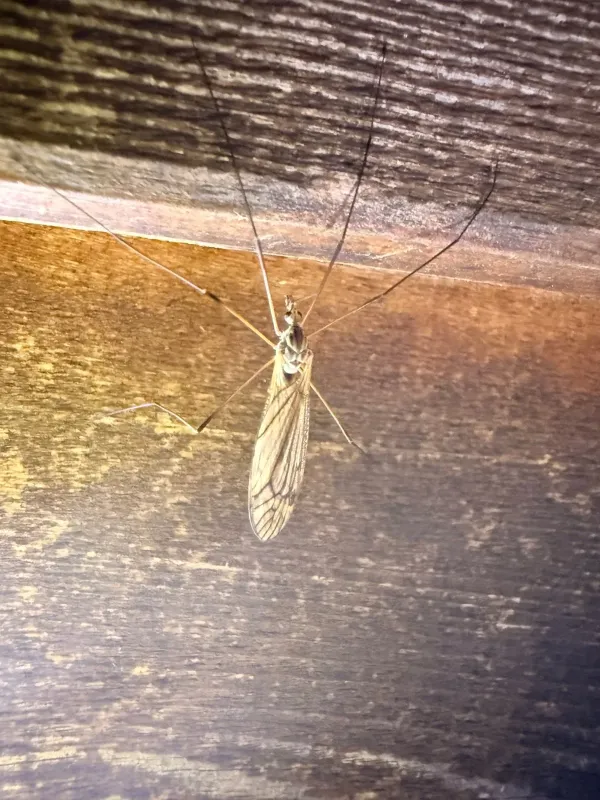
The Marsh crane fly (Tipula pabulina) belongs to the order Diptera and the family Tipulidae. Adult insects are large, mosquito-like creatures known for their extremely long and fragile legs.
The adults are yellowish-brown or greyish in appearance. Contrary to popular belief, these flies do not feed on human blood and are entirely harmless to mammals as their mouthparts are non-functional for piercing skin.
The larval stage, commonly referred to as a leatherjacket, is the damaging phase. These larvae are legless, cylindrical, and possess a tough, leathery grey-brown skin which makes them resilient in soil environments.
Larvae lack distinct eyes and have robust, chewing mouthparts designed for feeding on plant roots and crowns. They usually inhabit the upper layers of soil where they remain hidden from sunlight.
This species thrives in damp, humid environments such as poorly drained pastures, meadows, and areas with high organic matter content in the soil.
What it damages
Marsh crane fly larvae are generalist feeders that attack a wide variety of agricultural crops, including wheat, barley, oats, and various forage grasses used in livestock production.
The larvae feed primarily on the roots, underground stems, and emerging seedlings of plants. This feeding activity disrupts the plant's ability to take up water and nutrients, leading to rapid wilting and plant death.
In addition to cereals, they can devastate young vegetables and ornamental plants if these are planted in favorable damp soil conditions. Damage is often more severe in fields recently converted from permanent grassland.
Young larvae often tunnel into the base of the stems, causing the plant to turn yellow and eventually die. High larval populations can destroy entire patches of crops in a very short time.
The impact of this pest is most pronounced during cool, wet springs, which favor larval activity and increase the rate at which they consume plant material.
When it appears
The Marsh crane fly typically follows a one-year life cycle. Adult flies emerge during the summer months, usually between June and August, depending on the local climate and temperature.
After mating, females deposit their eggs directly into damp soil or surface vegetation. The eggs are highly susceptible to desiccation, which is why moist areas are essential for their survival.
Larvae hatch in late summer or early autumn and begin feeding on available vegetation. They continue to feed throughout the autumn, often causing significant damage to winter-sown crops.
Winter is spent as larvae in the soil, often deep enough to avoid freezing. As soon as temperatures rise in the spring, they return to the surface to resume heavy feeding before pupating.
Pupation takes place in the soil, and the adult flies emerge shortly after, completing the cycle. The timing of these stages is highly dependent on rainfall patterns.
Signs of infestation
The first sign of an infestation is the appearance of thin or bare patches in a field where crops have failed to establish or have withered away unexpectedly.
If you suspect an infestation, try pulling on the affected plants; if they come away easily with damaged or severed roots, it is a strong indicator of leatherjacket activity.
During damp nights or periods of high humidity, larvae may surface to feed on the above-ground portions of plants, leaving ragged edges on leaves and stems near the soil surface.
Digging into the soil around the edge of a damaged patch will usually reveal the presence of the grey, leathery larvae curled in the soil, particularly in the top few centimeters.
A large number of crane flies swarming or landing on field edges in late summer can serve as an early warning for potential larval problems in the coming autumn.
Control measures
Managing the Marsh crane fly requires a combination of cultural and chemical strategies designed to interrupt the life cycle and reduce larval populations.
- Improved drainage in fields to make the environment less hospitable for eggs and larvae.
- Deep autumn plowing to bring larvae to the surface, where they are exposed to predators and frost.
- Early sowing of crops to ensure plants are well-established before the peak larval feeding period.
- Crop rotation that moves susceptible plants away from fields with a history of infestation.
- Use of soil-applied insecticides if larval counts exceed the economic threshold during the seedling stage.
Chemical intervention is most effective when applied at the right time, usually when larvae are small and active near the surface, often during early autumn or spring.
Biological control methods, such as applying entomopathogenic nematodes, are becoming increasingly popular for organic and integrated pest management systems, as they target the larvae without leaving chemical residues.
Taxonomy
- Latin name
- Tipula pabulina
- Order
- Diptera (flies)
- Family
- Tipulidae
- EPPO code
- TIPUPB
Discussion
No discussions yet — be the first.