
Spotted crane fly
Nephrotoma appendiculata
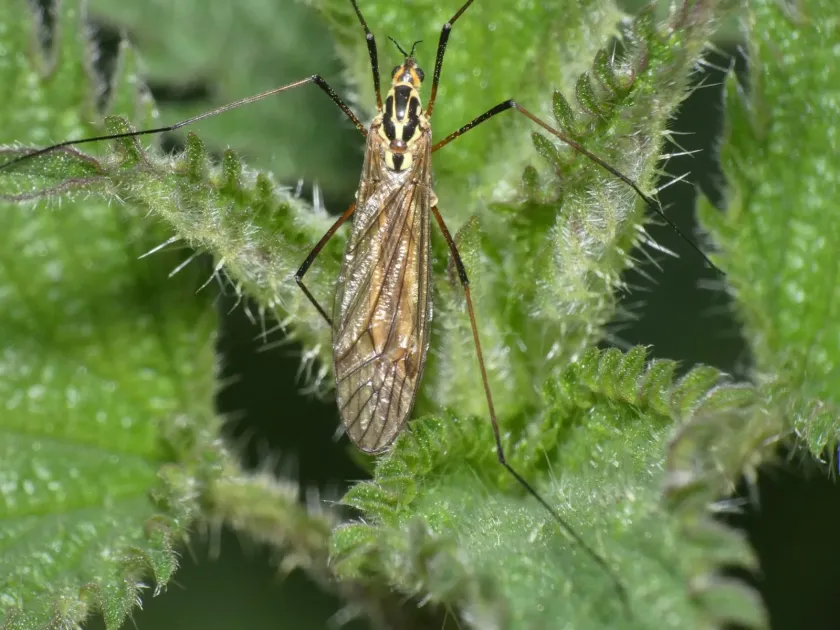
Description
How to identify
The spotted crane fly (Nephrotoma appendiculata) is a large insect belonging to the order Diptera and the family Tipulidae. Adults resemble giant mosquitoes with long, fragile legs that break off easily. Despite their appearance, they are harmless to humans as they do not feed on blood or bite.
The adult body features a distinctive yellow and black pattern, which helps distinguish it from other crane fly species. They have a wingspan of approximately 25-30 mm. The head includes prominent compound eyes and multi-segmented antennae, which are key features for correct species identification.
The larvae, known as "leatherjackets," are the destructive stage of the life cycle. They have cylindrical, greyish-brown bodies without true legs. Their skin is notably tough and leathery, giving them their common name. A set of fleshy appendages is found at the posterior end of the body.
Systematically, the species is part of the Tipulidae family, commonly found in temperate climates. Unlike the mobile adults, larvae live exclusively in the soil, inhabiting the root zone of plants, which makes them difficult to detect during early infestation stages.
The life cycle undergoes complete metamorphosis, including egg, four larval stages, pupa, and adult. There is generally one generation per year, though climatic conditions and soil moisture can significantly influence the speed and survival rate of each developmental stage.
##damage##The larvae cause significant agricultural damage by living in the topsoil. They possess strong, chewing mouthparts used to consume subterranean parts of plants, including roots, rhizomes, and the bases of stalks, which can lead to complete plant death.
A wide variety of crops are affected, ranging from cereals and legumes to various vegetables. Winter cereals are particularly vulnerable, as larvae destroy seedlings and young roots, causing large gaps in fields and significant thinning of the stands.
Vegetable crops such as potatoes, carrots, beets, and cabbage are frequently targeted. Larvae tunnel into roots, causing deep cavities. These wounds not only reduce yields but also facilitate secondary infections, making the produce unsuitable for storage.
Nurseries and young fruit tree saplings are also highly susceptible. Larval damage to the root system weakens the plants, stunts growth, and can result in the loss of entire batches of young plants, causing considerable economic impact for farmers and gardeners.
Damage severity increases in fields with high soil moisture or poor drainage. The larvae are hygrophilous, meaning they thrive in damp environments; thus, low-lying or waterlogged areas often become hotspots for mass outbreaks of the pest.
When it appears
Adult emergence typically begins in late spring or early summer. During this time, they engage in mating and egg-laying. Females deposit eggs directly into damp soil, often choosing sites rich in organic matter or near potential host plants.
Larvae feed throughout the growing season, with the most intensive feeding period occurring in autumn. During this time, they rapidly increase their body mass in preparation for overwintering, burying themselves 10-15 cm deep in the soil to escape freezing temperatures.
In spring, as soil temperatures rise, overwintered larvae resume feeding. This is the most dangerous period for winter crops, as the plants are already weakened, and larval damage to roots at this stage can easily prove fatal to young seedlings.
Pupation occurs in the soil towards the end of spring. The pupal stage lasts about two to three weeks, after which new adults emerge, completing the annual cycle and repeating the process in the following year.
Monitoring the adult population using light traps is essential for agronomists. This helps determine the peak flight period, allowing for timely assessment of the risk level and implementation of preventative measures before significant egg-laying occurs.
Signs of infestation
The first indicator of an infestation is the appearance of patchy dead zones within a field. Crops begin to yellow, wilt, and die for no apparent reason, as their root systems are severely compromised and unable to provide adequate nutrients to the plant.
Upon inspecting the soil around affected plants, one can observe tell-tale signs of gnawing on the root collars. Often, the larvae themselves can be found in the soil near the damage site, either coiled or resting motionless.
In vegetable patches, deep pits or cavities in roots are clear signs of leatherjacket activity. On some occasions, particularly at night, larvae may surface to consume tender leaves of young seedlings, leaving behind ragged leaf edges.
A high number of adult crane flies observed in fields during late spring serves as a strong signal of potential larval problems in the coming months, prompting a need for closer soil inspections and possible mitigation strategies.
- Irregular wilting and plant death in isolated patches.
- Gnawed roots discovered upon plant inspection.
- Presence of large grey leatherjacket larvae in the root zone.
- Unexpected loss of seedling density despite adequate irrigation.
Control measures
Good agricultural practices are the primary line of defense. Deep autumn plowing (tillage) helps reduce larvae populations by exposing them to the surface, where they are susceptible to desiccation and predation by birds.
Effective drainage is crucial for fields prone to waterlogging. Since the pest thrives in damp conditions, improving soil drainage makes the environment less suitable for larvae, significantly lowering the risk of infestation.
Crop rotation is a highly effective way to break the pest's cycle. Growers should avoid planting highly susceptible crops immediately after perennial grasses, which often serve as major breeding grounds for the spotted crane fly.
Chemical control is an option when economic damage thresholds are exceeded. Soil-applied insecticides can be used to target larvae in the root zone, preventing them from causing critical damage to developing crop plants.
Biological control methods, such as using entomopathogenic nematodes, are becoming increasingly popular. These natural parasites infect and kill leatherjackets in the soil, providing an environmentally friendly and sustainable solution within integrated pest management programs.
Taxonomy
- Latin name
- Nephrotoma appendiculata
- Order
- Diptera (flies)
- Family
- Tipulidae
- EPPO code
- PALEMA
Discussion
No discussions yet — be the first.