
Stiletto fly
Thereva nobilitata
Description
How to identify
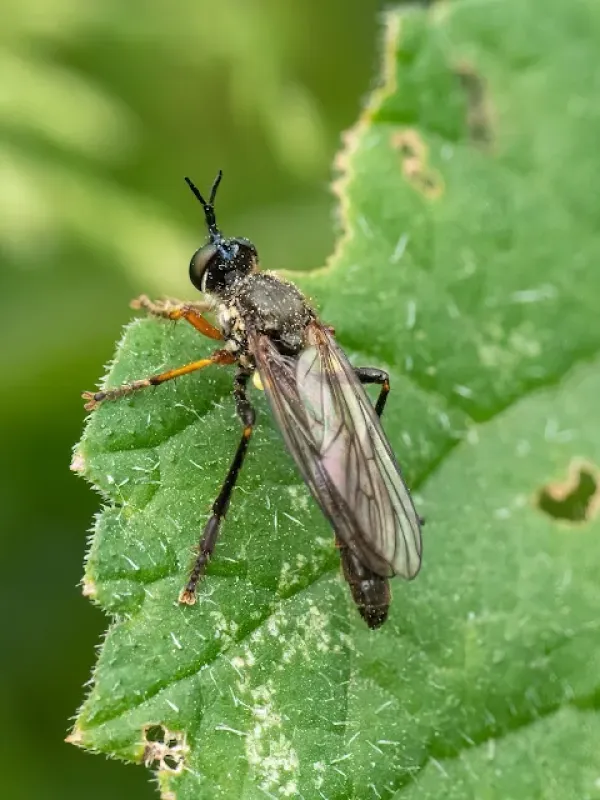
The Stiletto fly (Thereva nobilitata) is a member of the Therevidae family within the order Diptera. Adult flies typically measure between 10 and 12 mm in length and possess a characteristic appearance.
Their bodies are often covered in dense hairs, which aids in thermal regulation and camouflage. The coloration ranges from grey to brownish hues, allowing them to blend seamlessly with tree bark or soil surfaces.
The larvae of this species are distinctively thin and elongated, resembling small, pale threads. They lack a well-developed head capsule and live concealed within the soil profile, making them difficult to detect during standard field inspections.
The species undergoes complete metamorphosis, passing through egg, larval (several instars), pupal, and adult stages. The larval stage is notably the most prolonged and can have the most significant impact on the agricultural environment.
Adults are most active during warm, sunny weather, when they can be observed moving along the soil surface or resting on vegetation, often performing roles as scavengers or opportunistic predators.
What it damages
The larvae of the Stiletto fly primarily inhabit the soil, feeding largely on decaying organic matter. However, when food sources are scarce, they have been known to feed on the root systems of young crops.
Affected crops can include cereals and various vegetables. Root damage disrupts the plant's ability to take up water and nutrients, which frequently leads to wilting and, in severe cases, the death of the seedling.
Damage tends to be more pronounced in fields with high levels of crop residue or organic matter, which provide an ideal environment for larval survival and population growth.
In intensive agricultural settings, the resulting damage can appear as patchy stands, which complicates crop management and reduces the overall uniformity and yield potential of the field.
Furthermore, larval feeding creates entry points in plant tissues, which often facilitates the secondary colonization of roots by various pathogenic fungi and bacteria.
When it appears
Adult Thereva nobilitata activity is generally observed during the late spring and throughout the summer months, which provides optimal conditions for mating and oviposition.
The larvae remain active within the soil profile throughout the growing season, progressing through several growth instars depending on the availability of nutrients and soil moisture levels.
Winter is typically spent in the larval stage, deep within the soil profile, where they are protected from extreme freezing temperatures and other environmental stresses.
Emergence and increased larval activity in the upper soil layers begin as the ground warms in the spring, marking the transition from overwintering to the period of active feeding and development.
Climatic factors, particularly soil moisture, play a vital role in population dynamics. Moderate to high humidity generally favors larval survival, while excessive drought can impede their growth rate.
Signs of infestation
The most common sign of a Stiletto fly infestation is the sudden wilting of seedlings in specific patches, even when soil moisture levels appear to be adequate for plant growth.
A closer inspection of the root system of wilted plants often reveals fine grooves or partial gnawing, which are typical indicators of larval feeding activity below the surface.
The presence of significant numbers of adult flies in the field during the flowering period of weeds can serve as an early warning for potential infestation in the following seasons.
Soil sampling is the most reliable method for confirming the presence and density of larvae, as it allows agronomists to quantify the population per square meter of field area.
An increased presence of insectivorous birds foraging in freshly tilled fields can also act as an indirect sign, as they are often highly efficient at locating larvae exposed by cultivation equipment.
Control measures
Effective management begins with proper agronomic practices, such as crop rotation, which prevents the build-up of populations that occurs with continuous monocropping of susceptible species.
Deep autumn plowing is a critical control measure, as it disrupts the larval environment, exposing them to environmental extremes and increasing their vulnerability to avian predators.
Rigorous weed control throughout the growing season reduces potential oviposition sites and eliminates alternative food sources, thereby suppressing the population density of the pest.
Chemical control involving soil-applied insecticides is usually reserved for situations where population densities exceed economic injury levels as determined by soil monitoring.
- Utilize diverse crop rotations to interrupt the life cycle.
- Perform thorough soil cultivation to expose larvae to natural enemies.
- Monitor adult fly numbers using yellow sticky traps or light traps.
- Promote vigorous plant growth through balanced fertilization to help roots recover from feeding damage.
Taxonomy
- Latin name
- Thereva nobilitata
- Order
- Diptera (flies)
- Family
- Therevidae
- EPPO code
- THEVNO
Discussion
No discussions yet — be the first.