
Stiletto fly
Thereva aurata
Description
How to identify
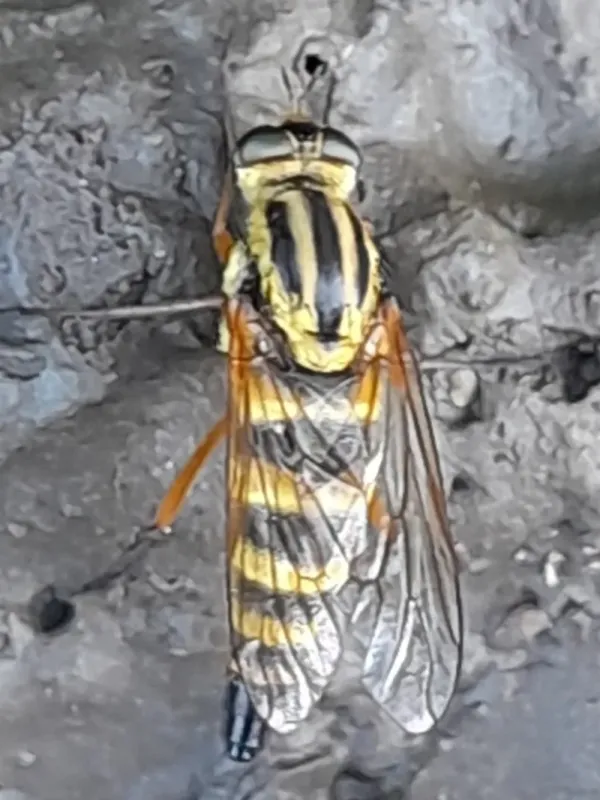
The Stiletto fly (Thereva aurata) belongs to the family Therevidae in the order Diptera. Adult flies have an elongated body, often featuring a golden or greyish metallic sheen, which gives them their distinctive appearance.
The larvae of this pest are slender, worm-like, and typically whitish or pale yellow in color. They can reach lengths of up to 20 mm and possess a highly segmented body, enabling efficient movement through soil layers.
The insect undergoes a complete metamorphosis. The life cycle consists of the egg, larval (multiple instars), pupal, and adult stages. Larvae can inhabit the soil for several years, making them persistent pests in agricultural ecosystems.
Adult flies are generally harmless as they feed on nectar from flowers. It is the soil-dwelling larvae that pose a significant threat to agricultural production by feeding on the subterranean parts of plants.
Identifying the presence of these larvae is challenging due to their cryptic lifestyle underground. They are usually discovered during soil sampling or when crops show signs of inexplicable damage.
What it damages
Stiletto fly larvae are polyphagous and can cause significant damage to various agricultural crops, including cereals, corn, and certain technical crops.
They damage plants by feeding on seeds during germination, as well as by gnawing on young roots and the base of the stems. This stunts growth and often results in the total death of the plant.
Large-scale infestation manifests as patchy or thinned plant stands in fields. This damage often requires costly replanting operations to restore the density of the crop.
When food sources are scarce, the larvae become more aggressive towards crops, leading to severe localized damage in fields with high population densities.
The physical wounds left by the larvae serve as entry points for soil-borne pathogens, leading to secondary infections such as root rot, which further exacerbates crop losses.
When it appears
Adult flies are most active from late spring to early summer, coinciding with the flowering of many local plants where they mate and deposit their eggs into the soil.
The larval stage is active throughout the growing season, particularly during spring and autumn when soil moisture levels are conducive to their movement and feeding activities.
During the winter, larvae migrate to deeper soil layers to avoid frost, remaining dormant until soil temperatures rise again in the following spring.
The germination period of spring-sown crops is the most critical time, as it is when the larvae are most active near the root zone, causing the most significant economic impact.
Overall, their activity pattern is highly dependent on environmental conditions, particularly soil moisture and temperature, which drive their metabolism and search for food.
Signs of infestation
The primary sign of infestation is the sudden yellowing or death of seedlings in patches, which cannot be attributed to drought or disease outbreaks.
Upon excavating affected plants, one can often find gnawed roots or missing sprouts, with the larvae typically located within the immediate vicinity of the root system.
The presence of fine, winding tunnels in the soil around the root zone is another indicator of recent larval activity and movement within the field.
Visible thinning of crops shortly after emergence, especially in areas with high organic matter, strongly suggests the presence of soil-dwelling pests like the Stiletto fly.
If adult flies are observed in large numbers on nearby weeds during the spring, it is a warning sign to monitor field plots for potential larval infestations in the future.
Control measures
Effective crop rotation is the cornerstone of control. Avoiding the planting of cereals immediately after long-term pastures or fallow fields significantly reduces the risk of mass infestation.
Deep autumn plowing with soil inversion is an effective mechanical method that exposes larvae to the surface, where they succumb to predation and environmental stressors.
Treating seeds with systemic insecticides is a vital practice to protect the crop during the vulnerable germination phase, preventing early larval damage.
Ensuring optimal soil fertility and managing plant nutrition helps crops develop a robust root system, allowing them to withstand minor pest pressure more effectively.
- Conducting pre-sowing soil surveys to determine the population density of larvae.
- Implementing integrated pest management (IPM) strategies to encourage natural predators.
- Keeping fields free of weeds to reduce alternative food sources for developing larvae.
Taxonomy
- Latin name
- Thereva aurata
- Order
- Diptera (flies)
- Family
- Therevidae
- EPPO code
- THEVAU
Discussion
No discussions yet — be the first.