
Black fly
Simulium vittatum
Description
How to identify
The Simulium vittatum is a small dipteran insect belonging to the family Simuliidae. Adult specimens have a stout body measuring 3–5 mm in length, broad wings, and short antennae. Their body color is typically dark, ranging from black to grey, with a characteristic silvery pattern on the thorax.
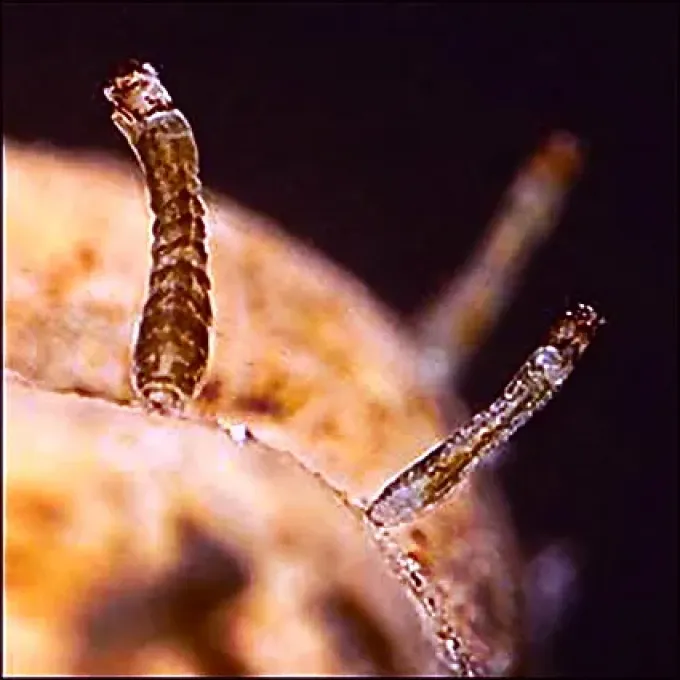
Larvae of this species develop exclusively in flowing water. They feature a cylindrical body with a prominent posterior sucker, which they use to anchor themselves to substrates in rivers, streams, or artificial hydraulic structures.
Black fly pupae are protected by a specific cocoon, the shape of which often serves as a key diagnostic feature. Development from egg to imago involves several molts, allowing the insect to adapt to the varying conditions of the aquatic environment.
Identification in the field is difficult due to their small size. Specialists rely on microscopic examination of the female mouthparts and larval skin structures for precise identification of the species.
Females of this species possess specialized piercing-sucking mouthparts. Unlike males, which feed on nectar, females require protein-rich food in the form of vertebrate blood to ensure proper egg maturation.
What it damages
The primary impact of Simulium vittatum is felt in the livestock industry. While they do not directly damage plant tissues, their mass presence makes grazing near water bodies impossible for farm animals.
Animals subjected to attacks by massive swarms of black flies experience severe stress. This leads to a sharp decline in productivity, including reduced milk yields in cows and stunted growth in young livestock.
Bites cause allergic reactions, dermatitis, and skin inflammation. The toxins in the insect's saliva, once introduced into the bloodstream, can cause systemic poisoning known as simulidotoxicosis.
In regions with high populations, livestock mortality can occur due to asphyxiation—caused by the insects blocking the respiratory tracts—or anaphylactic shock resulting from numerous bites.
Therefore, the economic damage to agriculture is primarily indirect, linked to the necessity of housing animals indoors during peak flight periods.
When it appears
The activity of Simulium vittatum is closely linked to water and air temperatures. Mass emergence of adults usually begins in late spring, as stream water temperatures reach levels favorable for larval development.
Population peaks typically occur during early to mid-summer. Depending on the geographic region, there may be two to four generations of insects per growing season.
Females are most active during the morning and evening hours under moderate humidity. In hot, dry weather, pest activity noticeably decreases as the insects seek shelter in dense vegetation.
Activity wanes in autumn, though in temperate climates, isolated generations can persist until the first frost. The insects overwinter primarily in the larval or egg stage on the beds of water bodies.
Population forecasts are based on monitoring water flow rates and water temperatures, allowing farmers to prepare protective measures in advance.
Signs of infestation
The first sign of pest infestation is restless behavior in livestock in pastures. Animals will actively swat at flies with their tails, rub against trees, or enter water bodies in an attempt to escape the swarms.
Upon inspection, animals show multiple red spots, swelling, and inflammation, especially in areas with thin skin: around the eyes, ears, nostrils, and the udder area.
The insects themselves are easily noticed in the air: they form dense swarms that follow herds over significant distances, attracted by the smell of sweat and carbon dioxide.
A characteristic sign is the specific buzzing sound of the swarm, which is audible even at a distance of several meters from the center of concentration.
In water bodies, aquatic vegetation or rocks may be covered with a "carpet" of larvae, which appears as a dark, moving film on the substrate.
Control measures
Controlling Simulium vittatum requires an integrated approach, involving both direct protection of livestock and the management of aquatic environments.
- Application of pyrethroid-based repellents to the hair coat of livestock.
- Use of insecticide-treated netting and curtains in animal housing during peak activity hours.
- Adjusting grazing schedules to nighttime or early morning hours when fly activity is minimal.
- Biological control methods for water bodies using Bacillus thuringiensis israelensis based products.
- Clearing riparian zones of excess aquatic vegetation, which serves as a substrate for larval attachment.
Taxonomy
- Latin name
- Simulium vittatum
- Order
- Diptera (flies)
- Family
- Simuliidae
- EPPO code
- SIMUVI
Discussion
No discussions yet — be the first.