
Fungus gnat
Bradysia pectoralis
Description
How to identify
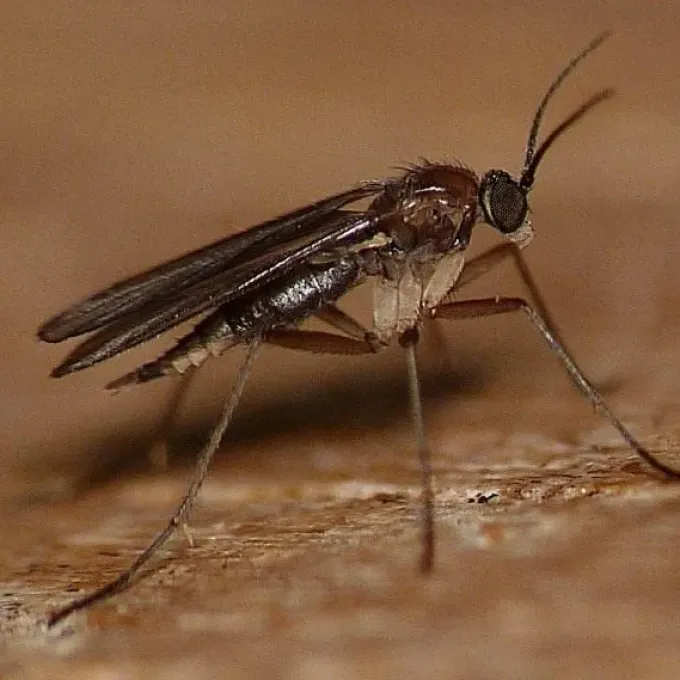
The fungus gnat (Bradysia pectoralis) is a small fly belonging to the family Sciaridae within the order Diptera. Adult gnats are dark-colored, slender insects typically measuring between 2 and 4 mm in length.
Adults are easily recognized by their long legs, clear wings, and long antennae. While they appear mosquito-like, they possess fragile mouthparts and do not feed on plant tissue during their adult stage.
The primary damage is caused by the larval stage, which develops in moist soil rich in organic matter. Larvae are white or translucent with a distinct shiny black head capsule.
The lifecycle is quite rapid, depending on temperature; in warm indoor or greenhouse conditions, a new generation can emerge within approximately three to four weeks.
Females are prolific, laying dozens of eggs into the upper layers of potting media, making populations difficult to control once established without specific management.
What it damages
These pests affect a vast range of indoor plants, seedlings, and nursery stock, particularly those grown in environments with high humidity and poor aeration.
Larvae feed primarily on organic matter, but when populations are high, they consume the delicate root hairs and epidermal cells of young plant roots, severely damaging root systems.
In addition to physical damage, the presence of larvae in the root zone can cause wilting and stunted growth, as the plant struggles to uptake water and nutrients effectively.
The burrowing action of larvae in the potting mix often leads to secondary infections by root rot pathogens such as Pythium, Phytophthora, or Fusarium.
Large infestations can lead to rapid decline and death of seedlings and cuttings, making them a major nuisance for plant propagators and indoor gardeners.
Signs of infestation
The most immediate indicator of an infestation is the presence of adult gnats flying in erratic, short bursts above the surface of the soil or near the foliage.
Plants may exhibit signs of nutrient deficiency, sudden drooping, or yellowing leaves, which often occur because the root system is unable to sustain the plant due to larval feeding.
A closer inspection of the top soil surface may reveal small, thread-like traces or the presence of larvae visible upon careful examination with a magnifying glass.
When lifting a plant from its pot, gardeners may notice a lack of fine, white, healthy root tips, indicating that they have been consumed by the developing larvae.
Using yellow sticky cards near the base of the plants acts as a monitoring tool, confirming the presence of adults and providing a general assessment of infestation severity.
Control measures
The most effective management strategy is to allow the growing medium to dry out sufficiently between waterings, as larvae require high moisture to survive and develop.
Place yellow sticky traps near the pots to catch adults, which prevents females from laying eggs and helps break the breeding cycle of the insect population.
Biological control methods, such as introducing predatory nematodes (e.g., Steinernema feltiae) or using microbial insecticides, are highly effective against larvae in the soil.
Ensure that all potting soil is sterilized or pasteurized before use, and avoid using organic fertilizers that are not fully composted, as these attract egg-laying females.
If chemical control is necessary, select products labeled for indoor use that target the root zone, ensuring proper application timing to coincide with the larval stage.
Taxonomy
- Latin name
- Bradysia pectoralis
- Order
- Diptera (flies)
- Family
- Sciaridae
- EPPO code
- SCIAPE
Discussion
No discussions yet — be the first.