
Fungus gnat
Bradysia ocellaris
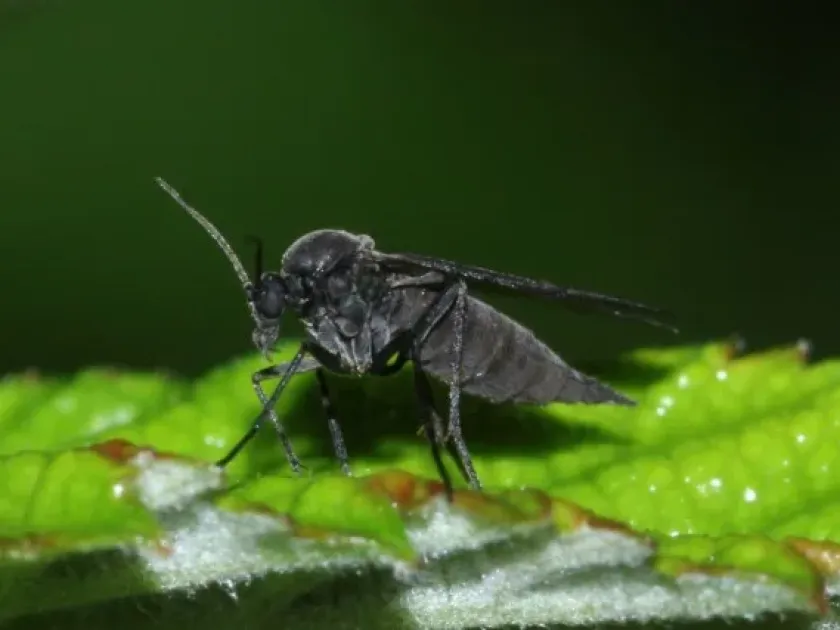
Description
How to identify
The fungus gnat (Bradysia ocellaris) belongs to the Sciaridae family, order Diptera. The adult fly is a small insect measuring 2–4 mm with a dark body and transparent wings.
Larvae are white and translucent with a distinct black head capsule. They grow up to 5–7 mm long and primarily inhabit the moist upper layer of the soil.
The lifecycle depends heavily on environmental conditions. At an optimal temperature of 24°C, the entire development from egg to adult takes approximately 3 to 4 weeks.
Females lay their eggs in moist soil rich in organic matter. A single female can produce up to 200 eggs, allowing the population to explode quickly in indoor environments.
Continuous reproduction occurs in greenhouses and homes where humidity remains consistently high, providing an ideal breeding ground for the entire year.
What it damages
Damage is primarily caused by larvae that feed on fungi, organic debris, and, when resources are scarce, on the tender roots and stems of young seedlings.
Seedlings of cucumbers, tomatoes, and ornamental flowers are highly susceptible to damage. Larvae often chew through the root collar, causing the seedling to wilt and die.
A damaged root system loses its ability to absorb water and nutrients, resulting in stunted growth, chlorosis, and reduced vigor of the plant.
The wounds left by feeding larvae act as entry points for pathogens, facilitating the development of root rots and various fungal or bacterial diseases.
Adult gnats do not feed on plant tissues, but they are notorious for carrying fungal spores, viruses, and mites, actively spreading diseases throughout the nursery.
When it appears
In greenhouses and indoor living spaces, fungus gnats can remain active throughout the year, as temperature and moisture are kept artificially stable.
Population surges are most common during late autumn and winter months due to increased indoor humidity and lower light levels, which slow soil drying.
In outdoor environments, their activity typically peaks from spring through late autumn, depending on soil temperature and moisture conditions.
Infestations are frequently introduced into new environments via contaminated commercial potting soil that has not been properly sterilized.
Overwatering is the primary environmental trigger that encourages the rapid development of larvae and the subsequent mass emergence of adult flies.
Signs of infestation
The first indicator is the presence of small, dark flies hovering around pots or near the soil surface, which become especially active during watering.
The second sign is a general decline in plant health: seedlings may appear wilted or yellow despite adequate watering, indicating root damage.
Close inspection of the topsoil may reveal active, worm-like larvae moving on the surface, particularly after the soil has been freshly watered.
The development of fungal growth or webs on the soil surface is a common secondary sign, as these fungi serve as a primary food source for the larvae.
Visible feeding damage at the base of the stem or on exposed roots, accompanied by rapid wilting, confirms the presence of a severe larval infestation.
Control measures
The most important control measure is to regulate irrigation: allow the top layer of soil to dry out completely between waterings to kill eggs and young larvae.
Yellow sticky traps are highly effective for monitoring populations and capturing adult flies, which helps prevent further egg-laying.
Biological control methods include the application of entomopathogenic nematodes (e.g., Steinernema feltiae) into the soil to predate and eliminate larvae.
Chemical control can be achieved by applying systemic insecticides to the soil, such as those containing imidacloprid or similar active ingredients.
- Sterilize potting media before starting new seeds.
- Remove any decaying plant matter from the area immediately.
- Ensure good drainage to prevent water stagnation in pots and trays.
Taxonomy
- Latin name
- Bradysia ocellaris
- Order
- Diptera (flies)
- Family
- Sciaridae
- EPPO code
- SCIAPR
Discussion
No discussions yet — be the first.