
Fungus gnat
Bradysia coprophila
Description
How to identify
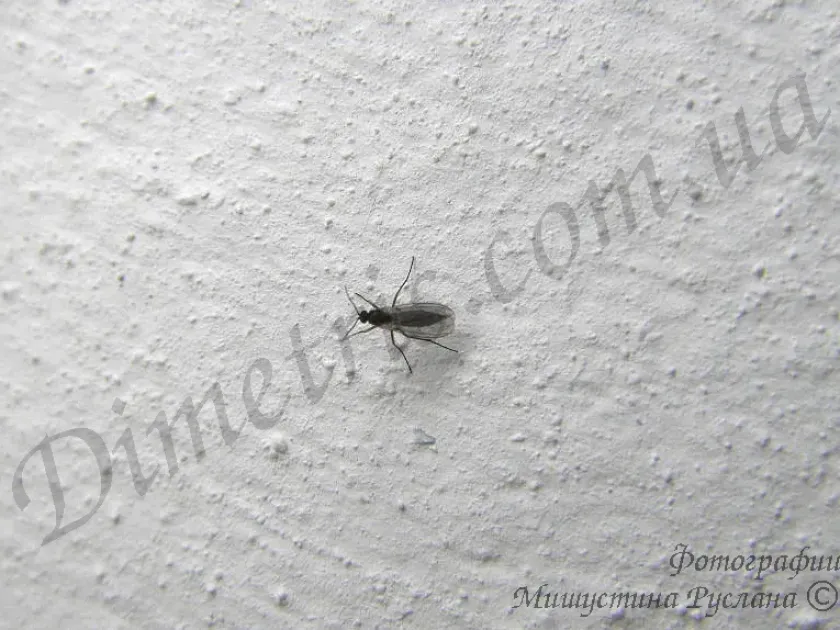
The fungus gnat (Bradysia coprophila) belongs to the order Diptera, family Sciaridae. Adults are small, delicate, black-bodied flies measuring about 2 to 4 mm in length.
Their life cycle consists of four stages: egg, larva, pupa, and adult. The lifecycle completion is highly dependent on environmental conditions, primarily soil moisture.
The larvae are the most distinctive stage, featuring translucent white bodies and a shiny black head capsule, growing up to 6 mm in length.
These insects thrive in moist, organic-rich environments, making potting soil and greenhouses their preferred habitats for development and reproduction.
Under optimal conditions, the fungus gnat can complete its life cycle in less than a month, leading to rapid and overlapping generations.
What it damages
Fungus gnats are a common problem for various plants, including houseplants, greenhouse seedlings, and ornamentals in propagation trays.
While adult gnats are primarily a nuisance, the larvae feed on the organic matter in the soil and, more importantly, on the fine root hairs of plants.
Damage to the root system disrupts the plant's ability to absorb water and nutrients, resulting in stunted growth, yellowing leaves, and reduced vitality.
Feeding wounds created by the larvae provide easy entry points for soil-borne pathogens, such as Pythium and Phytophthora, causing root rot.
Seedlings and cuttings are particularly vulnerable to infestations, as the destruction of their underdeveloped root systems can be fatal to the entire plant.
When it appears
Fungus gnats are active throughout the year in indoor environments, greenhouses, and homes where temperatures remain consistently mild.
Infestations often peak in winter months when indoor heating is on and plants are watered, but evaporation rates are low, keeping the soil moist.
In greenhouses, high humidity and constant irrigation cycles provide a continuous environment that supports gnat development regardless of the season.
The presence of adults flying near the soil surface indicates an established colony within the root zone or the potting substrate.
Regular surveillance is necessary, as there is no true dormant season for these pests in controlled indoor environments.
Signs of infestation
The most obvious sign of an infestation is the presence of small, dark flies hovering or crawling across the surface of the soil or around the plants.
Plants exhibiting unexplained wilting or failure to grow, especially in moist conditions, are strong indicators of potential larval feeding on roots.
Adults can be easily detected by placing yellow sticky traps near the base of the plants, which act as a monitoring tool for pest population density.
By inspecting the upper layer of soil, one may find the white, worm-like larvae if the population is significant and the soil is sufficiently moist.
A persistent, damp soil surface combined with the presence of fungus gnats is a clear signal that immediate corrective measures should be taken.
Control measures
The primary control strategy involves cultural management, specifically allowing the top few centimeters of soil to dry out completely between waterings.
Chemical control can be achieved by applying systemic insecticides to the soil to target and eliminate the larval stage within the substrate.
Biological solutions, such as the use of predatory nematodes or bacteria like Bacillus thuringiensis israelensis, are highly effective and safe options.
- Using yellow sticky traps to reduce the number of breeding adults.
- Ensuring proper drainage in pots to prevent water accumulation.
- Replacing or top-dressing the soil with a layer of sand or gravel.
Effective management requires a combination of monitoring, improved irrigation practices, and the strategic use of biological or chemical treatments.
Taxonomy
- Latin name
- Bradysia coprophila
- Order
- Diptera (flies)
- Family
- Sciaridae
- EPPO code
- SCIACO
Discussion
No discussions yet — be the first.