
Carrot rust fly
Psila
Description
How to identify
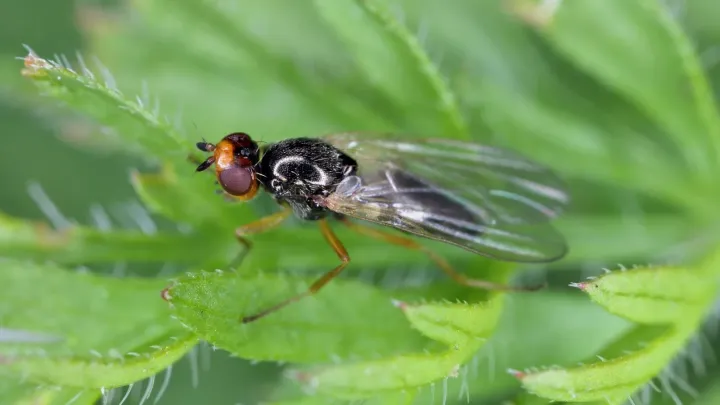
The carrot rust fly (Psila rosae) is a member of the Psilidae family. Adult flies are small, measuring approximately 4–5 mm in length, with a shiny black body and a yellowish head.
The larvae, which are the main cause of damage, are slender, creamy-yellow maggots that grow up to 7 mm long. They lack legs and have a distinct head region.
The life cycle involves four stages: egg, larva, pupa, and adult. The insect typically undergoes two generations per year in temperate climates.
Pupae usually overwinter in the soil at a depth of about 10 cm, though some larvae can survive winter inside unharvested roots left in the ground.
Development is highly influenced by temperature; larvae require warmth to thrive, making mid-to-late summer periods particularly risky for crops.
What it damages
The carrot rust fly primarily attacks plants in the Apiaceae family, including carrots, parsnips, celery, parsley, and fennel.
The larvae tunnel into the roots of the host plants, creating irregular, rust-colored channels throughout the taproot, which ruins the appearance and quality.
These damaged roots are highly susceptible to secondary infections, such as soft rot, which causes the vegetable to break down and become inedible.
When young seedlings are attacked, the larvae often sever the primary root, causing the entire plant to wilt and die, leading to patchy crop stands.
Severe infestations result in significant economic losses, rendering the harvest completely unsaleable and unsuitable for long-term storage.
When it appears
Adult flies of the first generation emerge in the spring, typically when hawthorn and rowan trees are in bloom, which usually occurs in late May or early June.
The second generation emerges in late summer, usually from July to August, and causes the most damage to maturing carrots intended for autumn harvest.
Adult females are attracted to the smell of host plants and lay their eggs in the soil crevices near the base of the carrot crown.
The incubation period for eggs is short, lasting only a few days, after which the larvae immediately begin searching for roots to infest.
The insect prefers humid and sheltered environments, often congregating near hedgerows or tall weeds where moisture levels remain high.
Signs of infestation
The earliest symptom of infestation is the discoloration of the foliage, where leaves turn a rusty-red or bronze color, followed by general wilting.
If you pull up an infested plant, you will see that the carrot root is stunted and shows clearly defined brown tunnels on the surface.
The tips of the roots are often destroyed first, and upon close inspection, small, legless maggots may be visible inside the galleries of the root tissue.
The overall growth of the carrot crop becomes irregular, with many plants showing stunted development compared to their neighbors.
- Reddish or bronze leaf discoloration
- Wilting of the carrot tops
- Presence of rusty tunnels in roots
- Rotting of root tips in the soil
Control measures
Crop rotation is a primary defense; avoid planting carrots or other apiaceous vegetables in the same site for at least three consecutive years.
Covering carrot beds with fine mesh row covers immediately after sowing is one of the most effective ways to prevent females from laying eggs.
Strategic timing of sowing — either very early or very late in the season — can help avoid the primary window of adult fly activity.
Intercropping with strong-scented plants like onions or leeks may help mask the host plant scent, potentially reducing the number of attracted flies.
Following harvest, remove all root debris from the field and perform deep plowing to expose pupae to frost and predators, reducing the next generation's survival.
Taxonomy
- Latin name
- Psila
- Order
- Diptera (flies)
- Family
- Psilidae
- EPPO code
- PSILSP
Discussion
No discussions yet — be the first.