
Carrot rust fly
Chamaepsila atra
Description
How to identify
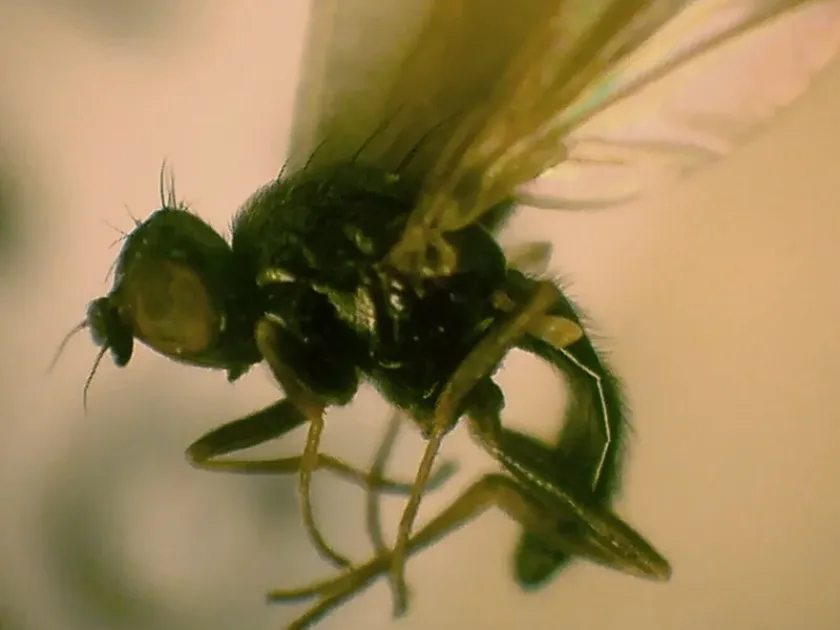
The carrot rust fly (Chamaepsila rosae) is a significant pest belonging to the Psilidae family. Adult flies are small, measuring approximately 4–5 mm in length, with shiny black bodies, yellow heads, and translucent wings.
The larval stage consists of legless, cylindrical, cream-colored maggots that grow up to 6–7 mm long. These larvae are responsible for the damage to the root systems of host plants.
The lifecycle generally involves two generations per year. Pupae overwinter in the soil at depths of 10–20 cm, emerging as adults in the spring when soil temperatures reach favorable levels.
Females lay their eggs in the soil near the base of carrot plants or other host species. High soil moisture is crucial for the survival of the neonate larvae after they emerge from the eggs.
Monitoring the flight of adults is best achieved using yellow sticky traps placed near the crops. These traps provide essential data for timing any necessary control interventions.
What it damages
The larvae primarily feed on the roots of carrots, parsnips, celery, and parsley. They tunnel into the root, creating narrow, meandering galleries that destroy the crop's internal structure.
Seedlings and young plants are particularly susceptible; an infestation at this stage can cause complete crop failure as the larvae sever the main root system.
Larger, mature roots riddled with tunnels become unmarketable. Furthermore, these tunnels serve as entry points for secondary pathogens, leading to bacterial and fungal rot that renders the vegetables inedible.
The damage is usually more severe in damp, heavy soils, which provide a more stable and protected environment for the larvae to move between roots.
Without proper management, this pest can cause substantial losses, affecting both the yield quantity and the storage capability of the harvested vegetables.
When it appears
The first adult emergence typically occurs during the blossoming of apple and rowan trees, usually in May. This timing serves as a critical indicator for growers to initiate preventive measures.
The second generation appears in mid-summer, typically between July and August. This generation is often more destructive as it coincides with the rapid expansion of the carrot roots.
Activity peaks on calm, warm, and humid days. Adults are most active during the twilight hours of the morning and evening, seeking shade in dense vegetation during the heat of the day.
The duration of each developmental stage is highly dependent on temperature. Warmer summer conditions can accelerate the development, potentially leading to overlapping generations in some regions.
As temperatures drop in the autumn, the larvae transform into pupae and enter the soil to overwinter, remaining dormant until the cycle restarts the following spring.
Signs of infestation
The first visible sign of an infestation is a distinct color change in the foliage, which turns a reddish-purple shade. As the attack progresses, the leaves yellow, wilt, and eventually die off.
Inspecting the roots will reveal tell-tale signs: small entry holes leading to extensive internal tunnels. In heavily infested roots, these tunnels are often filled with brownish frass.
Rot is a common secondary symptom. Infected roots may soften, develop a foul odor, and become discolored, making them prone to disintegration during harvesting.
Plants often become stunted and brittle, breaking easily when pulled from the soil. The presence of larvae themselves within the root tunnels is the most definitive sign of an active infestation.
Early-stage damage may remain hidden underground, meaning that by the time foliage symptoms appear, the root damage is often already advanced.
Control measures
Crop rotation is the primary line of defense. Avoid planting carrots or other apiaceous vegetables in the same site for at least 3–4 years to break the pest's reproductive cycle.
Physical barriers, such as fine-mesh row covers, are highly effective when installed before adult emergence, as they prevent females from reaching the soil to lay their eggs.
Regular cultivation and hoeing of the soil around the plants can disrupt the soil surface, making it less attractive for egg-laying and exposing larvae to natural predators.
Chemical control involving insecticides can be used during the peak flight of the adults. Always follow label directions regarding dosage and pre-harvest intervals to ensure safety.
- Thinning of carrots should be performed in the evening to minimize the release of scents that attract adult flies.
- Use resistant or early-maturing varieties to minimize the exposure time to the second generation.
- Deep autumn plowing helps expose pupae to frost and predators, reducing the overwintering population.
Taxonomy
- Latin name
- Chamaepsila atra
- Order
- Diptera (flies)
- Family
- Psilidae
- EPPO code
- CHPSAT
Discussion
No discussions yet — be the first.