
Hilara chorica
Hilara chorica
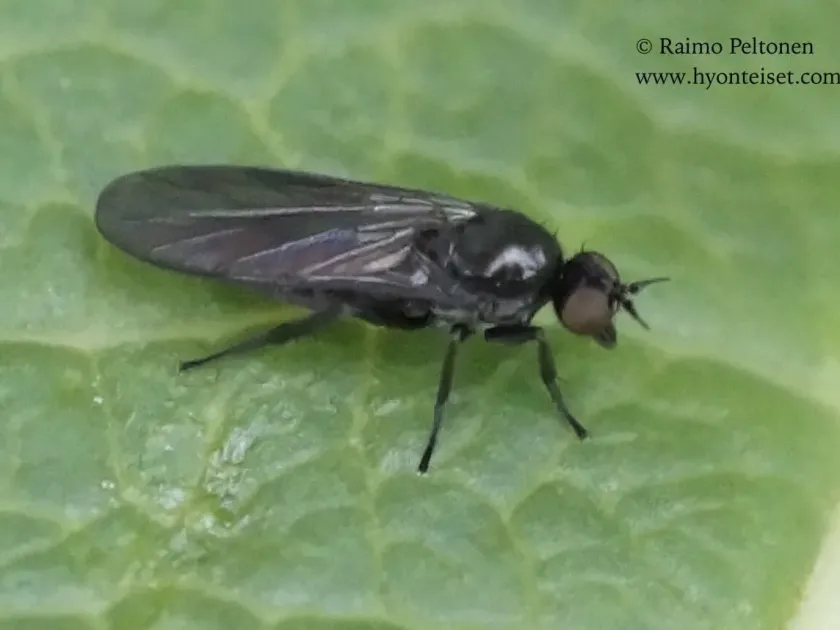
Description
How to identify
Hilara chorica is a species of dance fly belonging to the family Empididae, within the order Diptera. These small flies are commonly found in humid environments and near water sources.
Adult flies possess a body structure typical of the family, often appearing grey or black in color. They are well-known for their unique mating behavior, forming swarms above soil or water surfaces.
The larvae of this species are cryptic, living primarily in moist soil or decomposing organic matter, which provide the high humidity levels required for their successful development.
Identification of the species often requires careful examination of morphology, as the Empididae family includes numerous species that are visually similar to one another.
Adults possess specialized mouthparts that allow them to function both as nectar feeders and as predators on other small insects present in the agricultural ecosystem.
What it damages
The primary economic impact of Hilara chorica occurs during the early growth stages of crops. Larvae may feed on roots or germinating seeds in high-moisture soil conditions.
While adult flies are primarily predators, the larval stage may occasionally shift to feeding on plant tissues, turning into a facultative pest of the crop root system.
The highest risk of damage occurs when cultivating vegetable or grain crops in low-lying areas with poor drainage, where population density can reach significant levels.
Crops grown in protected environments, such as greenhouses, may also face attacks from these soil-dwelling larvae if humidity levels are not properly managed.
Damage is typically patchy and becomes most severe during seasons characterized by prolonged wet springs, which facilitate mass reproduction of the pest.
When it appears
Adult activity of Hilara chorica peaks during the spring and summer. Swarming typically occurs towards the end of spring, coinciding with the active growth period of young plants.
The life cycle is closely linked to climatic factors. Temperature and precipitation levels are the primary drivers determining the duration of each developmental stage.
Pupation occurs in the top layers of the soil, followed by the emergence of the next generation of flies, which continues the cycle within the favorable environmental window.
Multiple generations can occur throughout the growing season if the soil moisture remains consistently high, allowing for continuous population turnover.
Overwintering usually takes place in the larval stage, buried deep within the soil horizons to protect against freezing temperatures.
Signs of infestation
Symptoms of infestation include thinning stands and the yellowing or wilting of young plants without clear signs of fungal or bacterial pathogens on the foliage.
Inspecting the root system of affected plants often reveals signs of feeding or destruction of the root hairs, which is a direct indicator of larval activity in the soil.
The mass appearance of fly swarms above a field in the spring serves as an indirect indicator of high pest density and potential risk to future crops.
- Yellowing of cotyledons in seedlings.
- Stunted growth or death of the apical meristem.
- Presence of larvae in the rhizosphere during soil sampling.
Using yellow sticky traps is an effective way to monitor the emergence of adults and determine the timing of necessary control interventions.
Control measures
The primary control strategy is focused on sound agronomic practices, specifically improving field drainage to eliminate the moist conditions favored by the larvae.
Implementing crop rotation and regular soil tillage helps disrupt the life cycle by destroying pupation sites and reducing overall population density.
In cases of high infestation pressure, the use of registered systemic insecticides can be considered to protect sensitive crops during the vulnerable seedling stage.
Biological control options include the application of entomopathogenic nematodes or specialized fungal biopesticides that target the soil-dwelling larvae.
Consistent monitoring and integrated management strategies are essential to minimize the damage caused by Hilara chorica in agricultural systems.
Taxonomy
- Latin name
- Hilara chorica
- Order
- Diptera (flies)
- Family
- Empididae
- EPPO code
- HILACH
Discussion
No discussions yet — be the first.