
Dance fly
Empis livida
Description
How to identify
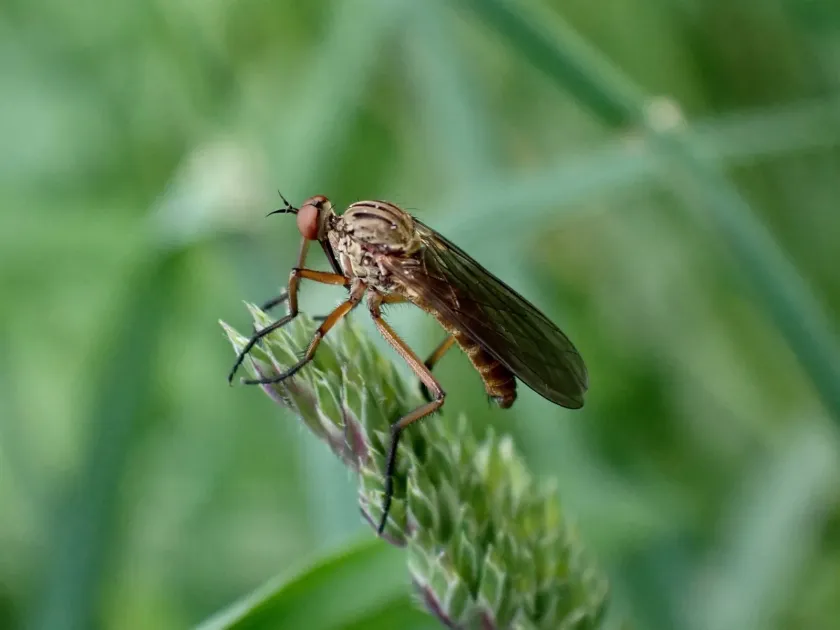
The dance fly (Empis livida) belongs to the family Empididae, within the order Diptera. These are medium-sized flies equipped with a characteristic proboscis adapted for predatory feeding.
The adult body is typically brownish in color and covered with short hairs. The wings are transparent or slightly yellowish with well-developed venation, which is a key diagnostic feature.
Adults exhibit pronounced sexual dimorphism; males are often larger than females and engage in complex mating dances, from which the family name is derived.
Larvae lead a cryptic lifestyle, inhabiting soil or decaying organic matter, making detection difficult before the mass emergence of adults in the spring and summer.
In natural ecosystems, these insects play a dual role, acting as both entomophagous predators and potential pests within certain agricultural environments.
What it damages
The primary damage is caused by the larval stage, which acts as a saprophage or facultative predator, damaging the young roots and seedlings of various agricultural crops.
Adult flies, although predatory, may damage the reproductive organs of plants during supplemental feeding on nectar and pollen, while simultaneously transferring fungal pathogen spores.
The most vulnerable crops include vegetable plants (potatoes, cabbage) and certain cereal crops during the early vegetation phases when their root systems are not yet fully established.
Root system damage caused by larvae leads to overall plant stress, reduced turgor, and increased susceptibility to soil-borne pathogens.
Mass reproduction of the species under high-humidity conditions can lead to localized thinning of crop stands, negatively impacting total farm yields.
When it appears
Adult emergence begins primarily in late spring and continues throughout the first half of summer, coinciding with the active growth phase of major crops.
The period of peak fly abundance correlates with warm and humid weather conditions, which accelerate the insect's development cycle.
Oviposition occurs in moist, humus-rich soil, determining the location of future pest infestations in subsequent seasons.
Larval development takes place in the soil, where they overwinter and become active as soon as temperatures rise in the early spring.
Agronomic measures implemented during critical development stages (autumn and spring) can significantly reduce the pest population density in the field.
Signs of infestation
The first sign of infestation is sudden wilting of seedlings, accompanied by visible damage to the underground part of the stem or root collar.
Upon inspection of the root system of affected plants, characteristic gnawed areas or fine tunnels created by larvae can be detected.
In areas where adults congregate, traces of supplemental feeding and excretions are noticeable on plants, which may serve as a substrate for saprophytic fungi growth.
The presence of large numbers of adult flies on flowering weeds near fields is an early warning sign for agronomists regarding potential future egg-laying in the soil.
An indirect sign is the overall stunted condition of the crop in specific areas of the field, which cannot be explained by water stress or nutrient deficiencies.
Control measures
The primary control measure is the implementation of crop rotation, which prevents the buildup of pests in the soil that often occurs with monoculture and excessive organic fertilization.
Deep autumn plowing helps destroy larvae and pupae residing in the upper soil layers by disrupting their natural development cycle.
The application of modern soil insecticides during early vegetation stages is effective against the larval stage if the economic threshold of damage is exceeded.
Thorough weed control is recommended, as weeds serve as reservoirs for adults and create favorable microclimates for egg-laying.
- Regular soil monitoring before sowing.
- Optimization of irrigation regimes.
- Use of high-quality certified seed material.
Taxonomy
- Latin name
- Empis livida
- Order
- Diptera (flies)
- Family
- Empididae
- EPPO code
- EMPSLI
Discussion
No discussions yet — be the first.