
Dance flies
Empis
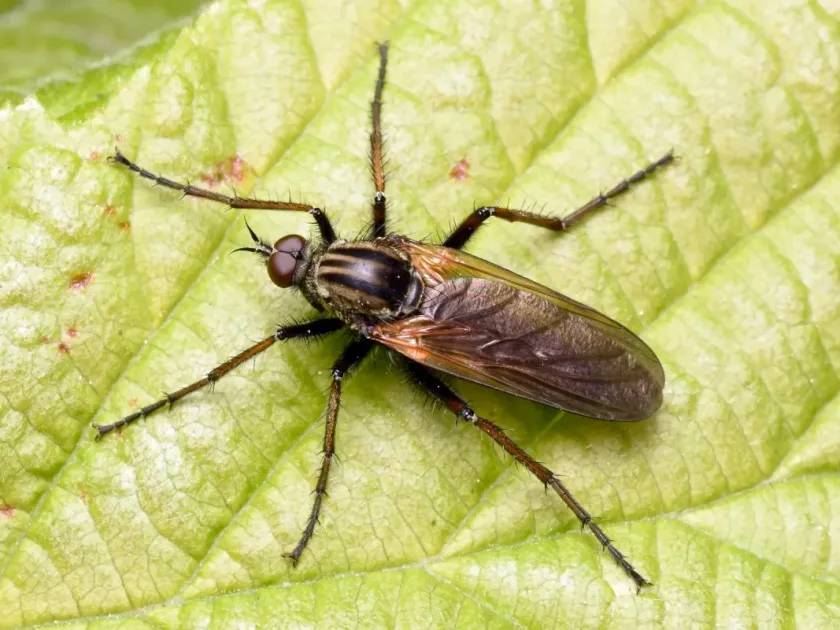
Description
How to identify
Dance flies, belonging to the family Empididae, are small to medium-sized flies often characterized by a long, piercing proboscis used to capture prey.
They are best known for their unique mating behavior, where males perform complex aerial displays or "dances" to attract females.
Adults typically have slender, brownish or blackish bodies, and their legs are often modified for grasping or specialized courtship displays.
The larvae are generally found in moist soil, leaf litter, or decaying wood, where they undergo their development over several months.
Taxonomically, they belong to the order Diptera and are considered essential components of many terrestrial ecosystems.
What it damages
Most adult dance flies are predatory, feeding on other small insects, and are not considered significant pests of agricultural crops.
Larvae primarily consume decaying organic matter, though some species may occasionally feed on roots if other food sources are scarce.
The economic damage caused by these flies is negligible, as they do not attack healthy plant tissues on a mass scale.
Instead of being pests, they act as natural predators of smaller insects and as incidental pollinators for various flowering plants.
Gardeners rarely need to worry about dance flies, as their impact on crop health is usually positive or entirely neutral.
When it appears
The peak activity of adult dance flies usually occurs in late spring and early summer when temperatures are optimal for their swarming behavior.
During this time, the flies congregate in large groups, particularly near shrubs and tall grasses, to engage in mating rituals.
The life cycle is largely dependent on environmental moisture, as larvae require damp soil conditions to thrive.
Winter is typically spent in the larval or pupal stage buried deep within the soil or protected under debris.
As the soil warms in spring, the adults emerge to begin the cycle again, often coinciding with the first major flushes of vegetation.
Signs of infestation
The most obvious sign of their presence is the characteristic swarming flight pattern observed above vegetation during calm weather.
Visual identification of larvae is uncommon due to their subterranean habitat and small size within the soil column.
There are no specific plant injuries associated with dance flies, which helps distinguish them from true agricultural pests.
The lack of visible feeding damage on leaves or stems is a reliable indicator that they are not causing harm to your plants.
Monitoring using sticky traps can help detect the presence of adults, but usually confirms that their populations are well-balanced.
Control measures
Direct control measures are rarely necessary for dance flies, as they are not classified as agricultural threats.
Cultural practices, such as regular soil cultivation and the removal of excessive leaf litter, naturally manage their population density.
Crop rotation helps maintain soil health and prevents any potential buildup of soil-dwelling larvae.
Avoiding the unnecessary use of broad-spectrum insecticides is crucial to preserve the natural predatory balance in the garden.
Promoting a healthy, diverse garden environment will keep all insect populations, including dance flies, at stable levels.
Taxonomy
- Latin name
- Empis
- Order
- Diptera (flies)
- Family
- Empididae
- EPPO code
- EMPSSP
Discussion
No discussions yet — be the first.