
Uranotaenia
Uranotaenia
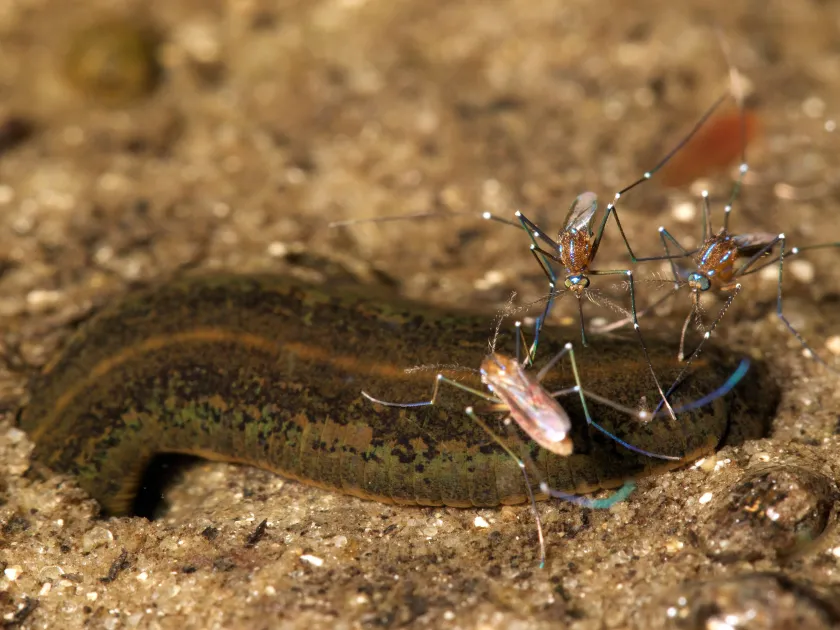
Description
How to identify
The genus Uranotaenia belongs to the order Diptera and the family Culicidae. These are small mosquitoes often characterized by iridescent blue scales on their thorax and wings, distinguishing them from other mosquito genera.
Morphologically, adults possess a short proboscis and unique wing venation patterns. They are primarily crepuscular or nocturnal and are often found in habitats with high moisture levels.
The life cycle involves a complete metamorphosis including the egg, four larval stages, pupa, and adult. Larvae are typically found in standing water, where they graze on microorganisms and detritus.
Crucially, Uranotaenia is not a plant pest. These insects are classified as being of medical or veterinary interest because the adult females feed on blood, not plant tissues.
They do not pose a risk to crops, orchards, or vegetable gardens. Any classification of this genus as an agricultural pest is biologically incorrect.
What it damages
Insects of the genus Uranotaenia cause no damage to agricultural crops. They are not phytophagous and do not interact with plant physiological processes in a detrimental way.
Adult females seek blood meals from vertebrates, while males feed on flower nectar. This nectar-feeding behavior makes them incidental pollinators rather than pests.
The aquatic larvae do not consume plant roots or stems. Their presence in water bodies near fields has zero negative impact on crop production or plant health.
Since they do not feed on crops, they cannot cause yield reduction, plant diseases, or quality degradation of agricultural products.
Farmers should not consider Uranotaenia as a target for pest management programs. They are ecologically distinct from the insects that threaten harvest security.
Control measures
No agricultural control measures are recommended for Uranotaenia because they are not pests of crops. Pest management strategies should be reserved for actual threats.
Applying broad-spectrum insecticides on crops to target mosquitoes is detrimental to the ecosystem, as it harms pollinators and natural predators that manage real crop pests.
If population control is necessary for public health or animal welfare reasons, it should be managed through site-specific sanitation rather than field spraying.
Sanitation practices such as removing standing water and clearing debris from irrigation ditches are sufficient to manage local mosquito populations.
Agronomists are advised to disregard this genus in their pest monitoring protocols, as it does not require any chemical or biological intervention in the agricultural context.
Taxonomy
- Latin name
- Uranotaenia
- Order
- Diptera (flies)
- Family
- Culicidae
- EPPO code
- URATSP
Discussion
No discussions yet — be the first.