
Mansonia
Mansonia
Description
How to identify
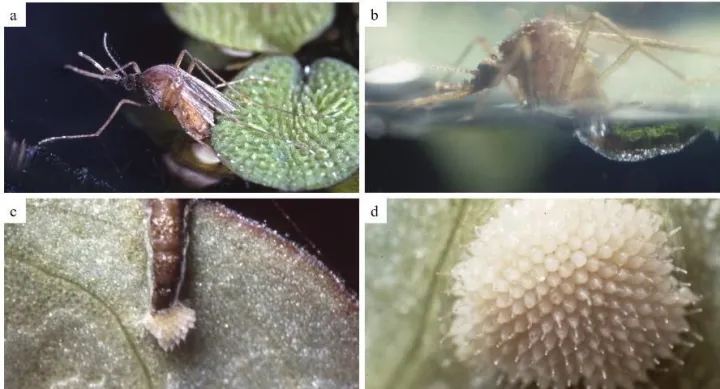
The Mansonia genus belongs to the Culicidae family (blood-feeding mosquitoes). Adults are distinguished from other mosquitoes by their robust body and distinct wing patterns featuring alternating dark and light scales.
The most unique characteristic of this genus is the larval respiration method. Unlike most mosquitoes, their siphon is modified into a sharp spine, evolved to pierce the tissues of aquatic plants to obtain oxygen.
Females deposit eggs in compact clusters on the undersides of leaves of aquatic or semi-aquatic plants, providing protection for the developing offspring.
Pupae also develop underwater, remaining securely attached to the vegetation until the adult (imago) emerges on the surface.
These mosquitoes are primarily found in tropical and subtropical regions, favoring water bodies with dense vegetation, which defines their ecological niche.
What it damages
These mosquitoes do not cause direct damage to agricultural crops as they do not feed on plant tissues, but rather use them as a source of oxygen.
However, mass development of Mansonia indicates heavily silted and overgrown water bodies, which can hinder irrigation systems and aquaculture operations.
Larvae attaching to the roots and stems of aquatic plants, such as water lilies or cattails, may occasionally cause localized tissue damage.
The primary concern is the public health risk, as Mansonia mosquitoes are known vectors for various viruses and filariasis affecting animals and humans.
Their presence creates an unfavorable environment for workers operating near irrigation canals, ponds, and drainage systems.
When it appears
The activity period of these mosquitoes is directly dependent on water and air temperatures, allowing for year-round breeding in tropical climates.
Mass emergence of adults typically occurs during periods of high humidity and when standing water bodies warm up, peaking in summer months.
Larvae are permanently present in water bodies, living in a submerged state attached to aquatic vegetation regardless of the season, provided temperatures are stable.
Adults are most aggressive during twilight hours and at night, following the typical behavior patterns of many blood-feeding mosquito families.
Population dynamics are strongly correlated with the growth stages of aquatic plants, as the larvae rely entirely on this vegetation for their life cycle.
Signs of infestation
A primary sign of Mansonia presence is finding larvae attached to the underwater parts of aquatic plants during visual inspection.
High levels of mosquito activity and audible humming near overgrown water bodies during evening hours indicate an established colony.
The water body appears heavily overgrown with floating vegetation, which provides the necessary substrate for larval attachment and survival.
If larvae are observed detaching rapidly when an aquatic plant is removed from the water, it confirms the presence of this specific genus.
Plants may show microscopic punctures or small necrotic spots where larval siphons have penetrated the vascular tissues to reach air channels.
Control measures
The most effective management method is the mechanical removal of excess aquatic vegetation, which serves as the primary substrate for larval development.
The use of biological control agents based on specific bacteria that target mosquito larvae is a highly efficient way to reduce population numbers.
Regulating water levels in irrigation channels can lead to the desiccation of egg clusters deposited on emergent parts of plants, disrupting the cycle.
Deploying fine-mesh nets to clear floating weeds during peak egg-laying periods serves as a critical preventative measure.
Chemical control via insecticides is rarely used due to significant risks to aquatic biodiversity and surrounding agricultural land health.
Taxonomy
- Latin name
- Mansonia
- Order
- Diptera (flies)
- Family
- Culicidae
- EPPO code
- MANSSP
Discussion
No discussions yet — be the first.