
Common house mosquito
Culex pipiens
Description
How to identify
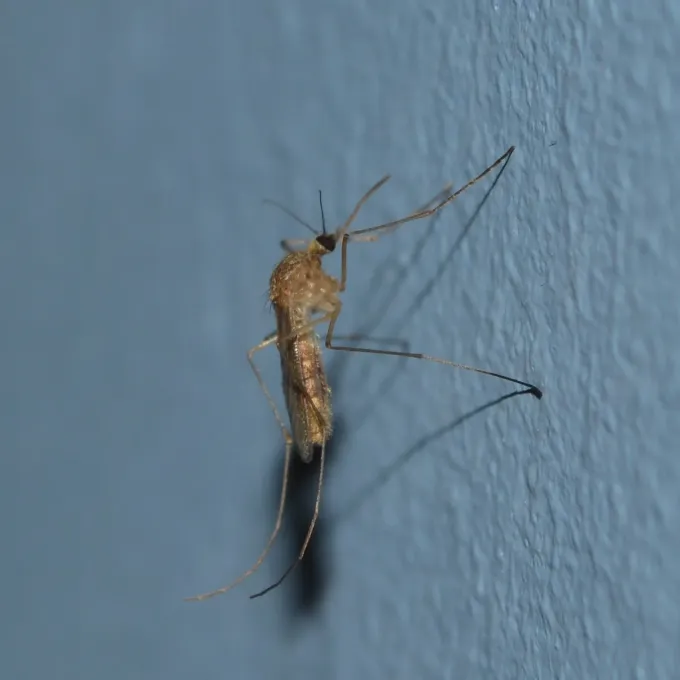
The common house mosquito, Culex pipiens, belongs to the order Diptera and the family Culicidae. Adults are small, slender insects measuring 3–7 mm in length.
They are characterized by a light brown body with faint transverse white bands on the abdomen. Their wings are transparent and covered with fine scales.
The life cycle consists of four stages: egg, larva, pupa, and adult. Eggs are laid in clusters, often referred to as 'rafts', on the surface of standing water.
Larvae develop in aquatic environments, breathing through a siphon at the surface, and feeding on organic matter, bacteria, and microscopic algae.
Males are easily distinguished from females by their bushy, plumose antennae, while females possess slender, less conspicuous antennae.
What it damages
Although Culex pipiens does not directly consume plant crops, it is a significant nuisance and biological stressor in agricultural settings.
High populations of mosquitoes cause significant stress in livestock, leading to reduced milk yields, lower weight gain, and general health decline in herds.
They act as vectors for various pathogens that can affect animals and humans, potentially spreading diseases within and around agricultural facilities.
Worker productivity in greenhouses or stables can be negatively impacted by persistent mosquito attacks, leading to compromised care for crops and animals.
In certain contexts, the larvae of these mosquitoes can contaminate water reservoirs intended for irrigation if not managed properly.
When it appears
Activity typically begins in late spring, as soon as temperatures consistently stay above 10–12°C, which triggers the development of overwintering populations.
The peak density of the mosquito population occurs during mid-summer, when warm, stagnant water sources facilitate rapid development cycles.
Mosquitoes are primarily nocturnal or crepuscular, showing maximum activity during dusk and dawn when humidity levels are optimal for flight.
As autumn approaches, mated females enter diapause, seeking humid and sheltered locations such as basements, warehouses, or animal shelters to survive the winter.
The number of generations per season is determined by local climatic conditions, with multiple cycles possible in warmer southern regions.
Signs of infestation
The presence of larvae in stagnant water containers, barrels, or clogged gutters is a primary indicator of a nearby breeding site.
The high-pitched buzzing sound characteristic of flying females during evening hours is a clear signal of high mosquito density in the immediate area.
Observed distress in livestock, such as continuous tail flicking, stomping, or grouping behaviors, serves as a strong indicator of mosquito pressure.
Direct sightings of resting adults on walls, under foliage near water sources, or in darkened, humid corners of agricultural buildings.
An increased frequency of bites on personnel working in the fields or near water bodies confirms the presence and activity of this species.
Control measures
The most effective strategy is the elimination of breeding sites by draining stagnant water, covering barrels, and cleaning irrigation ditches.
Biological control using formulations based on Bacillus thuringiensis israelensis effectively targets larvae without harming the environment.
Residual insecticide applications in livestock housing and farm buildings can significantly reduce the adult mosquito population.
Installation of fine-mesh screening on ventilation openings and windows helps restrict the movement of mosquitoes into sensitive production areas.
- Regular monitoring of water reservoirs for larval presence.
- Encouraging natural predators such as dragonflies, bats, and insectivorous birds.
- Implementation of light traps for monitoring and population suppression.
Taxonomy
- Latin name
- Culex pipiens
- Order
- Diptera (flies)
- Family
- Culicidae
- EPPO code
- CULXPI
Discussion
No discussions yet — be the first.