
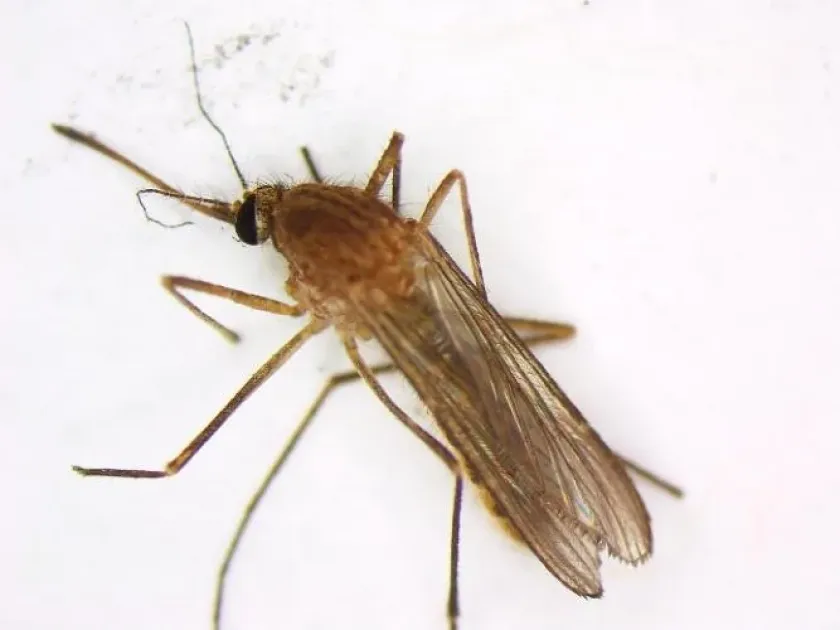
Culex erythrothorax mosquito
Culex erythrothorax
Description
How to identify
Culex erythrothorax is a mosquito species within the Culicidae family, recognized for its distinct reddish-brown thorax which gives it its specific scientific name.
The adults generally range from 4 to 6 millimeters in length, possessing morphology consistent with the Culex genus, which necessitates expert examination of male genitalia for definitive classification.
Larval stages are exclusively aquatic, typically found in stagnant, organic-rich water bodies that are often associated with irrigation infrastructure in agricultural landscapes.
These mosquitoes are well-adapted to environments where human agriculture meets wetland habitats, allowing them to thrive in various temperate and warm climates.
Identification in the field is difficult due to the presence of many similar-looking Culex species, making professional entomological surveillance essential for correct monitoring.
What it damages
While Culex erythrothorax does not cause physical damage to plant tissues, it acts as a significant indirect pest within agricultural ecosystems, particularly for livestock sectors.
Feeding behavior causes extreme annoyance and stress to farm animals, which directly impacts their health, weight gain, and milk production levels, leading to economic losses.
As a vector, this species can transmit various arboviruses that threaten the health of both livestock and human workers, posing a serious veterinary and public health concern.
The need for frequent pesticide applications to mitigate these populations can lead to increased operational costs and potential disruption of integrated pest management programs.
Furthermore, the presence of high densities of these insects can hinder field operations and labor efficiency, complicating the management of agricultural properties.
When it appears
The seasonal activity of Culex erythrothorax is heavily influenced by moisture availability and seasonal temperature increases during the warmer months.
Peak populations are usually observed in mid-to-late summer, when the temperature of stagnant water bodies reaches optimal levels for the rapid development of larvae.
As autumn approaches, activity levels begin to decline, though adults may remain active until the onset of consistently cold weather, preparing for their overwintering stage.
Adult females survive the winter by finding sheltered areas such as structures or dense vegetation, allowing them to emerge and start new generations early in the spring.
Multiple generations can occur throughout the season, with the speed of each cycle dependent on the availability of nutrients in the aquatic breeding sites.
Signs of infestation
A primary indicator of a Culex erythrothorax presence is the noticeable increase in mosquito swarming behavior around livestock and agricultural fields during dusk and dawn.
The presence of water management structures, including irrigation ponds, drainage ditches, and water storage tanks, indicates a high risk of local infestation.
Signs of irritation in livestock, such as excessive swatting, restlessness, and grouping behavior to minimize exposure, are key indicators of high mosquito pressure.
Water samples taken from suspected breeding sites may reveal the presence of Culex larvae, which are identified by their characteristic position hanging at an angle from the water surface.
The occurrence of vector-borne disease outbreaks in the vicinity serves as a critical sign that urgent mosquito management protocols must be implemented.
Control measures
The most sustainable control strategy involves environmental management, specifically the draining or cleaning of stagnant water sources to eliminate breeding grounds.
Biological control using formulations of Bacillus thuringiensis israelensis is highly effective against larvae and poses minimal risk to the surrounding ecosystem.
Protecting livestock through the use of repellents, insecticidal netting, and proper sanitation of animal housing is essential for maintaining production levels.
Integrated monitoring programs using light and CO2-baited traps allow farmers to track population densities and intervene before swarming becomes unmanageable.
- Eliminate stagnant water sources
- Use Bti biological larvicides
- Apply livestock-safe repellents
- Install barrier netting in housing
Taxonomy
- Latin name
- Culex erythrothorax
- Order
- Diptera (flies)
- Family
- Culicidae
- EPPO code
- CULXET
Discussion
No discussions yet — be the first.