
Phantom midge
Corethra plumicornis
Description
How to identify
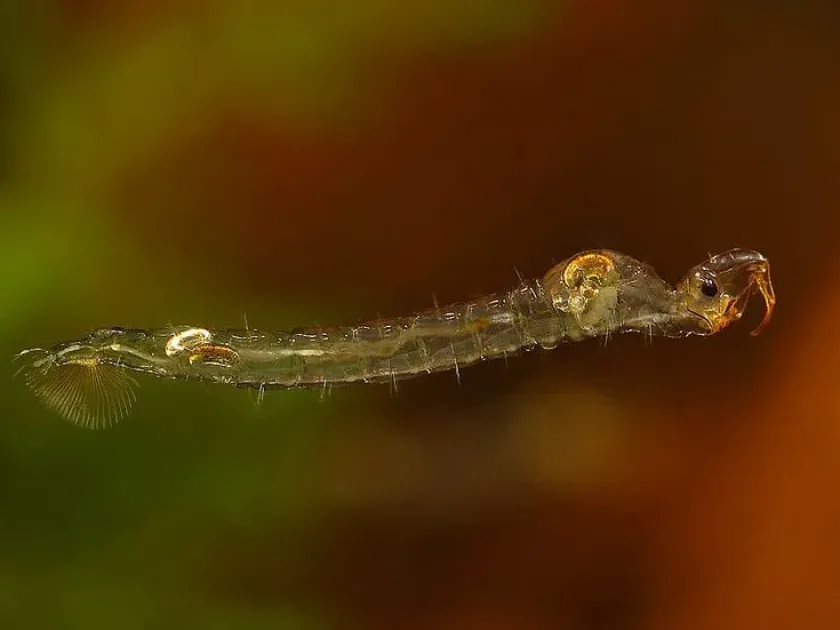
The phantom midge (Corethra plumicornis), currently classified as Chaoborus crystallinus, belongs to the family Chaoboridae. The larvae are aquatic and famous for their transparency, which makes them nearly invisible.
The larvae possess specialized air sacs that allow them to maintain a precise vertical position in the water column while hunting for prey.
The head is equipped with complex mouthparts designed for grasping and eating small organisms, including zooplankton and larval fish.
Adult midges do not feed on blood. Unlike common mosquitoes, they are harmless to humans and plants, possessing non-functional or nectar-feeding mouthparts.
The lifecycle includes four stages: egg, four larval instars, pupa, and adult. They predominantly inhabit stagnant or slow-moving water bodies.
What it damages
The damage caused by the phantom midge is restricted to fish farming and aquaculture, where the larvae act as predators against fish fry.
High densities of larvae in nursery ponds can significantly reduce the yield of commercial fish by competing for food and consuming the young fish directly.
These insects do not cause any harm to field crops, vegetables, or ornamental plants; therefore, standard crop protection methods are not applied.
Economic losses in agribusiness occur only when integrated systems (agriculture and aquaculture) are affected by the disruption of the pond's biological balance.
The predation pressure is most significant during the early growth stages of fish, when the fry are small enough to be captured by the midge larvae.
When it appears
The population reaches its peak during the spring and summer months when water temperatures are optimal for rapid development and reproduction.
Adults are crepuscular, meaning they are most active during dusk, when mating and egg-laying on the water surface occur.
Depending on the climate, the midge can complete several generations per year, ensuring high population density throughout the warm season.
Overwintering occurs in the form of larvae, which bury themselves into the bottom sediments and can survive in hypoxic conditions.
The critical period for control is before the introduction of fish fry into the ponds to ensure the safety of the young stock.
Control measures
Management of the phantom midge focuses on pond maintenance, such as draining and drying the pond bed during the off-season to eliminate overwintering larvae.
Physical barriers like fine-mesh filters on water intake channels are effective in preventing the entry of larvae into managed ponds.
Biological control methods involving the introduction of specific fish species that feed on the larvae are preferred over chemical treatments.
Chemical control is generally avoided due to the sensitivity of the fish stock and the risk of damaging the pond's overall ecosystem.
- Draining and disinfecting the pond bottom.
- Using fine-mesh water filters.
- Biological control using predator fish.
- Strategic timing of fish stocking.
Taxonomy
- Latin name
- Corethra plumicornis
- Order
- Diptera (flies)
- Family
- Culicidae
- EPPO code
- COREPL
Discussion
No discussions yet — be the first.