
Cattail mosquito
Coquillettidia perturbans
Description
How to identify
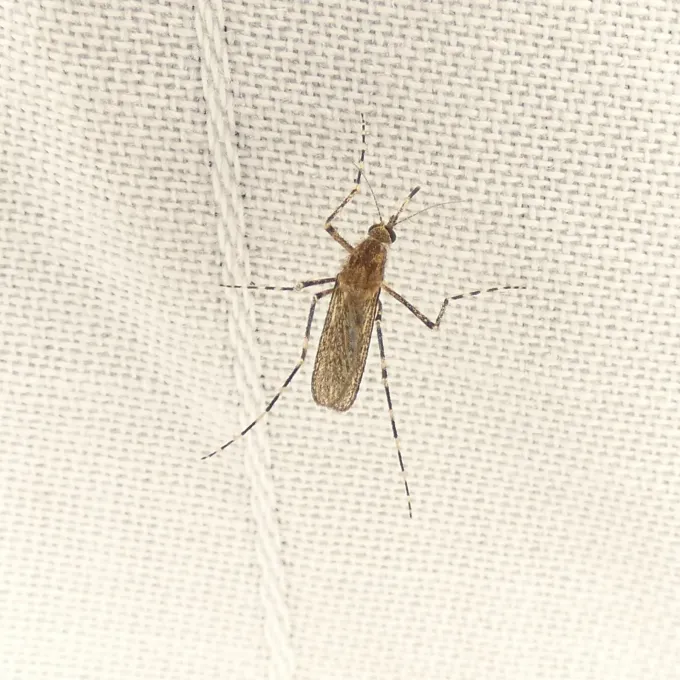
The Cattail mosquito (Coquillettidia perturbans) belongs to the Culicidae family. It is easily recognized by its dark, mottled appearance and the presence of pale scales on the wings and legs.
The biology of its larvae is unique; they do not surface to breathe air but instead pierce the roots and stems of aquatic plants such as cattails to obtain oxygen.
These insects are well-known for their aggressive biting behavior toward both humans and livestock, making them a major pest in rural areas.
Taxonomically, they are members of the order Diptera, characterized by a complex life cycle that depends heavily on the presence of specific wetland vegetation.
Adults are medium-sized and possess a strong flight capacity, which allows them to migrate significant distances from their breeding grounds to nearby farms.
What it damages
This mosquito species causes significant economic losses in the livestock industry by severely disturbing grazing animals during peak activity periods.
Constant biting induces physical stress in cattle and sheep, leading to reduced milk yield, weight loss, and general health deterioration.
They serve as potential vectors for various pathogens, including viruses, which poses a continuous threat to animal health and productivity in agricultural regions.
The disruption of pasture grazing schedules due to heavy mosquito pressure forces farmers to change management practices, increasing operational costs.
Skin irritation and secondary infections caused by excessive biting can necessitate additional veterinary care and expenditure for livestock owners.
When it appears
Adult populations typically emerge and peak during the summer months, from June through August, coinciding with the growing season of host aquatic plants.
Larvae overwinter at the bottom of ponds or marshes, remaining attached to the root systems of submerged plants throughout the coldest months.
Development is tightly linked to water temperature and the phenology of aquatic vegetation; as temperatures rise, the rate of development increases rapidly.
There is generally one major generation per year, although favorable environmental conditions can lead to sustained high activity levels throughout the summer season.
Monitoring should focus on the timing of adult emergence, which is essential for initiating control measures before the population reaches critical levels.
Control measures
The most effective strategy for population management is the physical removal of aquatic weeds, such as cattails, which are necessary for larval survival.
Biological control agents, specifically larvicides containing Bacillus thuringiensis israelensis (Bti), are highly effective and environmentally safe for treating water bodies.
For livestock protection, the use of topical repellents and insecticidal ear tags can help reduce the frequency of mosquito attacks on grazing animals.
Water management techniques, including the modification of water levels in ponds, can disrupt the larval environment and prevent successful adult emergence.
Integrated pest management (IPM) programs that combine larval monitoring with targeted adult control methods provide the most sustainable long-term solution.
Taxonomy
- Latin name
- Coquillettidia perturbans
- Order
- Diptera (flies)
- Family
- Culicidae
- EPPO code
- MANSPE
Discussion
No discussions yet — be the first.