
Malaria mosquito
Anopheles subpictus
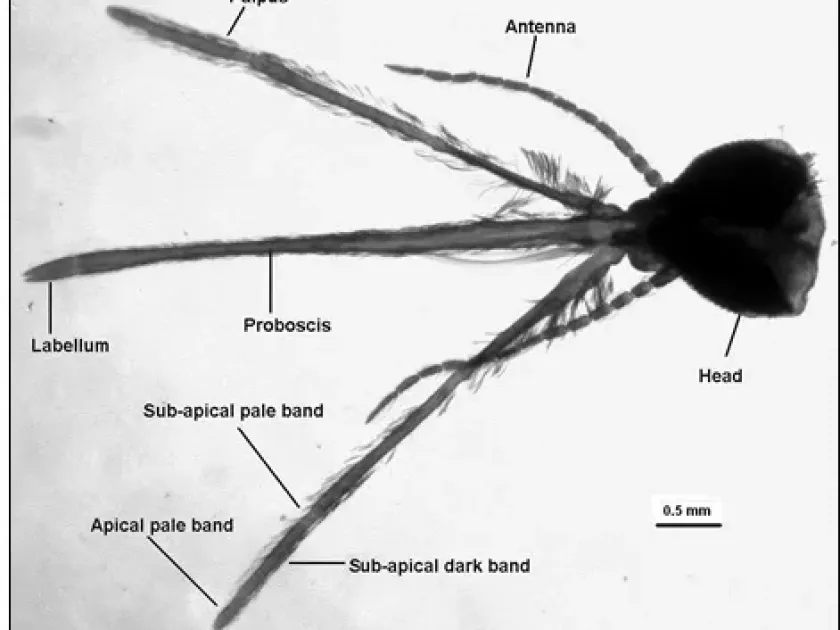
Description
How to identify
The malaria mosquito, Anopheles subpictus, belongs to the order Diptera and the family Culicidae. Adult mosquitoes are recognized by their slender bodies and long legs, typically resting at an angle to the surface.
The wings display a distinctive pattern of dark and light scales, a morphological feature that differentiates the Anopheles genus from common mosquito species.
Larvae develop in stagnant or slow-moving water bodies. Unlike many other mosquitoes, Anopheles larvae lie parallel to the water surface to facilitate atmospheric breathing.
The life cycle undergoes four stages: egg, larva, pupa, and imago. Development speed is highly dependent on ambient temperature and the availability of moist habitats.
Adult mosquitoes are primarily nocturnal or crepuscular, seeking humid environments to ensure survival and reproduction throughout the season.
What it damages
While Anopheles subpictus does not feed on plant tissues, it acts as a significant operational disturbance in agricultural systems, particularly in tropical regions.
Large mosquito populations severely disrupt manual labor during evening hours, which is critical for irrigation management or harvesting operations.
The presence of these mosquitoes requires consistent maintenance and sanitation of irrigation networks, leading to increased operational costs for farmers.
As a potential vector for pathogens, the species may trigger sanitary restrictions, potentially affecting the trade and export status of agricultural products from the region.
In rice-growing areas, the mosquito thrives in flooded fields, creating a challenging environment that necessitates careful coordination between plant protection and public health protocols.
When it appears
The abundance of Anopheles subpictus is closely linked to the rainy season and periods of high humidity when temporary water bodies are abundant.
The species prefers temperatures ranging from +25°C to +30°C. In such optimal conditions, the life cycle duration shortens, leading to rapid population surges.
Seasonal dynamics are often synchronized with the agricultural calendar, especially where rice cultivation provides persistent breeding grounds throughout the season.
During the dry season, population density drops significantly as suitable breeding habitats disappear, though some adults may survive in sheltered microclimates.
Peak population levels typically follow the first heavy rains, which create numerous small pools essential for egg-laying and larval development.
Signs of infestation
The primary indicator of an infestation is the presence of larvae in irrigation ditches, drainage systems, or any stagnant water near the crops.
Adult sightings inside barns, storage facilities, or near cattle pens indicate the presence of local breeding sites in the immediate vicinity.
A high-pitched humming sound during the dusk hours is a standard behavioral cue indicating active swarming of the mosquito population.
Water bodies choked with floating vegetation often serve as optimal nurseries for Anopheles larvae, requiring inspection by agricultural staff.
Increased human-mosquito contact reported by field personnel during evening shifts serves as a clear warning to implement pest control measures.
Control measures
Effective management begins with landscape engineering, such as draining unnecessary pools and maintaining proper water flow in irrigation canals.
Biological control using Bacillus thuringiensis israelensis is a highly effective, eco-friendly method to eliminate larvae without harming the ecosystem.
Providing protective clothing for workers and using mosquito netting on storage and housing structures helps minimize the impact of adult mosquito activity.
Encouraging the presence of natural predators, such as insectivorous fish (e.g., Gambusia) in irrigation reservoirs, significantly reduces larval numbers.
Chemical intervention should be considered as a last resort, ensuring that selected insecticides comply with agricultural safety standards to protect both workers and crops.
Taxonomy
- Latin name
- Anopheles subpictus
- Order
- Diptera (flies)
- Family
- Culicidae
- EPPO code
- ANPHSU
Discussion
No discussions yet — be the first.