
Common malaria mosquito
Anopheles quadrimaculatus
Description
How to identify
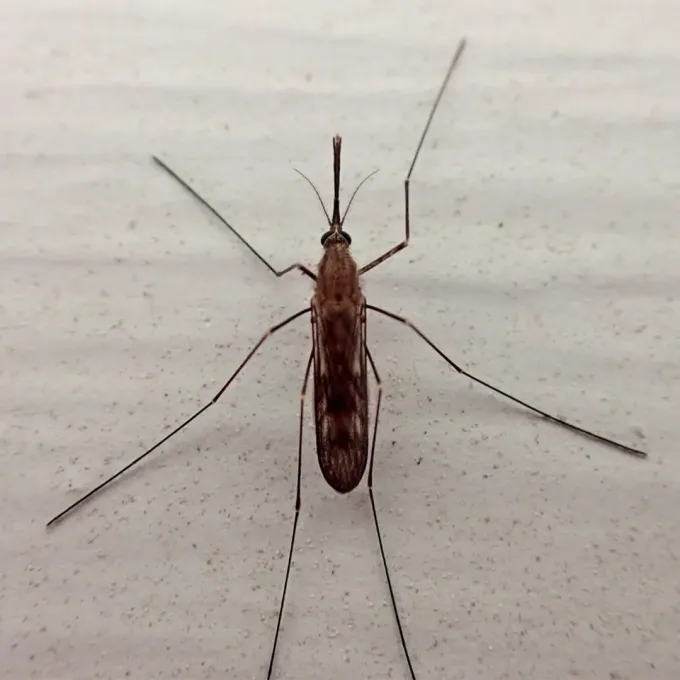
The common malaria mosquito (Anopheles quadrimaculatus) belongs to the family Culicidae, order Diptera. Adults are identified by four distinct dark patches on their wings, which is their most recognizable feature.
When resting, this mosquito displays a unique posture where the abdomen is pointed away from the surface at an angle, distinguishing it from the parallel posture of common house mosquitoes.
The life cycle encompasses four stages: egg, larva, pupa, and adult. Females deposit eggs individually directly onto the water surface, where they float due to specialized air-filled floats on their sides.
Larvae develop in stagnant or slow-moving water, feeding on microorganisms. They remain horizontal to the water surface, which is a key diagnostic indicator for identifying the genus.
The entire developmental period is highly temperature-dependent, usually ranging from two to four weeks under optimal summer conditions in temperate climates.
What it damages
While Anopheles quadrimaculatus is not a direct phytophagous pest of crops, it poses a severe nuisance and health risk to livestock and agricultural workers.
Heavy infestations of these mosquitoes lead to significant stress in cattle, often resulting in reduced milk yields, decreased weight gain, and lower overall livestock health.
As a vector for various pathogens, their presence necessitates stringent biosecurity measures on farms to protect both animal and human personnel health.
The presence of mosquito breeding sites in irrigation networks often requires additional maintenance to clear debris and organic matter that accumulates due to larval activity.
Agricultural operations can be severely disrupted by high mosquito activity, forcing changes to work schedules and increasing costs for protective equipment and fly control.
When it appears
Adult activity initiates in early spring as water temperatures rise, allowing overwintered females to emerge and seek blood meals for egg production.
Peak population densities are typically observed in mid-to-late summer, coinciding with peak temperatures that accelerate the development of subsequent generations.
Daily activity patterns are strongest during dusk and dawn, as these mosquitoes prefer humid, shaded environments and avoid the intense heat of direct midday sun.
As autumn approaches and temperatures drop, mosquito activity levels decline, and they prepare for diapause, seeking shelter in barns, tree hollows, or dark crevices.
Understanding the seasonal lifecycle is vital for proactive management, as targeting the early season generations significantly reduces the magnitude of later summer outbreaks.
Control measures
Primary control revolves around environmental management, specifically eliminating stagnant water and maintaining proper flow in irrigation and drainage channels.
Biological control agents, particularly formulations containing Bacillus thuringiensis israelensis, are highly effective at targeting larvae without damaging the broader aquatic ecosystem.
- Removing excessive vegetation along pond edges to expose larvae to natural predators.
- Installing fine-mesh screening on all animal housing to reduce exposure to biting mosquitoes.
- Using light or carbon dioxide-baited traps to monitor population levels and determine the timing of interventions.
Chemical control should be used sparingly and as a last resort, prioritizing environmentally friendly compounds that pose minimal risks to beneficial insects and water quality.
Promoting a balanced ecosystem by encouraging local populations of dragonflies, amphibians, and insectivorous birds provides sustainable long-term population suppression.
Taxonomy
- Latin name
- Anopheles quadrimaculatus
- Order
- Diptera (flies)
- Family
- Culicidae
- EPPO code
- ANPHQM
Discussion
No discussions yet — be the first.