
African malaria mosquito
Anopheles gambiae
Description
How to identify
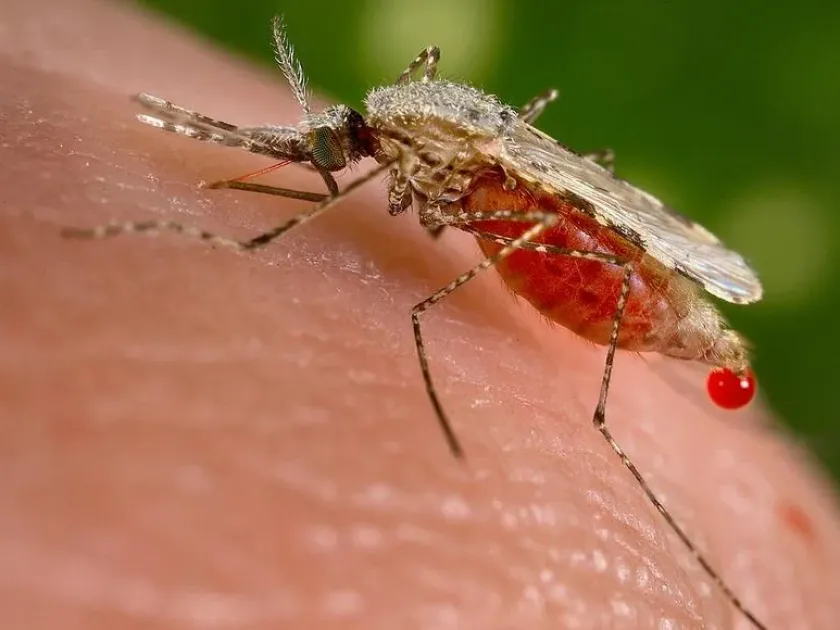
Anopheles gambiae is a small dipteran insect belonging to the family Culicidae. Adults have a slender body, 5–7 mm long, narrow wings with dark scales, and delicate long legs.
The primary diagnostic feature is its resting posture: unlike common mosquitoes, the Anopheles rests with its abdomen angled sharply upwards away from the surface.
They are generally greyish-brown in color, which provides camouflage against vegetation and shadows within human structures. Females possess a specialized proboscis for blood-feeding.
Larvae develop exclusively in stagnant or slow-moving water, often found in rain pools or irrigation ditches. Lacking a respiratory siphon, they must float parallel to the water surface to breathe.
Taxonomically, this species is classified under the order Diptera, family Culicidae, genus Anopheles, and is highly adapted to human environments.
What it damages
While Anopheles gambiae does not consume crop tissues directly, its impact on agriculture is profound due to its status as a vector for serious diseases.
In endemic regions, agricultural productivity declines significantly because human labor is hindered by the high prevalence of malaria among workers.
This mosquito poses a specific threat to irrigation-intensive agriculture, such as rice farming, where vast areas of standing water facilitate rapid breeding cycles.
The indirect economic damage includes the high cost of large-scale vector control programs and the need for public health interventions in rural communities.
Therefore, the species acts as a socioeconomic pest that limits the potential for sustainable and efficient farming in highly infested geographical areas.
When it appears
The activity of Anopheles gambiae is strictly governed by climatic factors, primarily temperature and humidity, which determine the rate of larval development.
In tropical climates, the species remains active throughout the year, with peak population densities coinciding with rainy seasons when breeding sites are abundant.
The thermal optimum for the species ranges from +25°C to +30°C. If temperatures drop below +15°C, larval development slows down, and adult activity is significantly reduced.
The life cycle from egg to adult takes approximately 7–10 days, allowing the population to recover and expand rapidly following periods of environmental stress.
Mosquitoes exhibit peak activity during the night and at twilight, which is when females actively seek hosts for blood meals.
Control measures
The primary management strategy involves environmental management, specifically draining or filling small, temporary bodies of standing water.
Biological control using Bacillus thuringiensis israelensis (Bti) is a highly effective and environmentally friendly method for managing mosquito larvae in agricultural water sources.
Protective equipment, bed nets, and insect repellents are essential for personnel working in areas where this species is present to ensure occupational health.
- Drainage of wetlands and stagnant pools.
- Application of bio-larvicides in breeding hotspots.
- Introduction of natural predators, such as gambusia fish.
- Removal of man-made containers that accumulate rainwater.
Integrated vector management requires a systematic approach to water resource planning and continuous monitoring to minimize the risk to rural workers.
Taxonomy
- Latin name
- Anopheles gambiae
- Order
- Diptera (flies)
- Family
- Culicidae
- EPPO code
- ANPHGB
Discussion
No discussions yet — be the first.