
Franciscan malaria mosquito
Anopheles franciscanus
Description
How to identify
Anopheles franciscanus is a species of mosquito belonging to the family Culicidae and the order Diptera. While not a direct pest to plant tissues, its presence in agricultural areas is a significant concern for health and safety, necessitating integrated management practices.
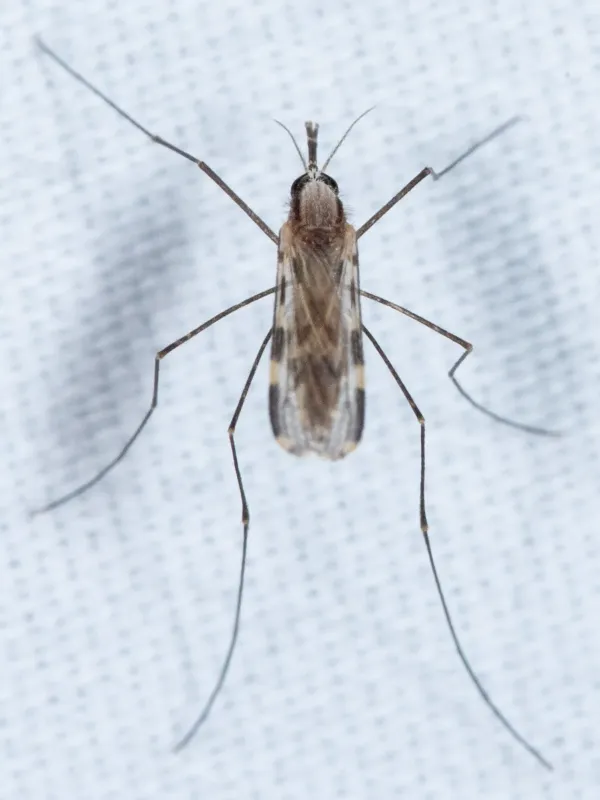
Adult mosquitoes are distinguished by their specific resting posture, where the abdomen is held at a distinct angle to the surface, and their elongated legs. The wings display a dark, mottled pattern of scales, which is a key physical trait for identifying this species in the field.
The larval stage is strictly aquatic. Unlike common house mosquitoes, these larvae lack a breathing siphon and therefore rest parallel to the water surface. This unique behavior makes it easy to identify them in irrigation ditches or stagnant water reservoirs on farmland.
Female mosquitoes are hematophagous, seeking blood meals to support egg production, which poses a nuisance to field workers and livestock. Males, conversely, are nectar feeders, contributing minimally to pollination while avoiding blood-feeding entirely.
Preferred habitats include shallow, slow-moving or stagnant waters often found in agricultural irrigation systems, wetlands, or roadside drainage areas, which require regular maintenance to prevent large-scale colonization by the mosquitoes.
When it appears
The life cycle of Anopheles franciscanus is heavily dependent on ambient temperature and moisture. Development accelerates significantly during warmer months, resulting in multiple overlapping generations that reach peak abundance in mid-to-late summer.
Activity levels are highest during dusk and dawn, as well as during night hours. During the heat of the day, adults typically seek shelter in dense vegetation, shaded structures, or dark corners of farm buildings to avoid desiccation.
Spring activity commences as temperatures rise, signaling the end of the adult diapause phase. The first generation of females begins searching for suitable oviposition sites in moist, stagnant habitats immediately after emerging from overwintering.
As autumn approaches and temperatures drop, the metabolic rate of the population slows down. Surviving adults enter a state of hibernation, gathering in protected, cool areas to withstand the winter months until the next season.
Monitoring for the onset of the season involves trapping programs to determine population density, helping farmers prepare necessary mitigation steps before the mosquito population peaks during the most intense agricultural activities.
Control measures
Effective management focuses on environmental control. The most sustainable approach is to eliminate stagnant water sites, clear irrigation channels of excess vegetation, and ensure proper drainage of fields, which destroys the essential habitat for the larvae.
Biological control agents, such as Bacillus thuringiensis israelensis, are highly effective against larval stages in water bodies where drainage is not feasible. This method is safe for crops and surrounding livestock, providing a target-specific solution to population growth.
Personal protection remains essential for personnel working in high-risk areas. This includes wearing long-sleeved clothing, utilizing EPA-approved repellents, and ensuring that temporary living or break areas are properly screened to prevent insect entry.
Chemical control is generally reserved for targeted indoor or structural applications rather than field-wide spraying, due to environmental regulations and the potential impact on beneficial agricultural insects like bees.
- Drain stagnant water sources and irrigation puddles.
- Clear drainage ditches of debris and heavy weed growth.
- Utilize biological larvicides (Bti) in standing water.
- Implement screening and protective gear for workers.
- Conduct regular monitoring of larval populations in agricultural water systems.
Taxonomy
- Latin name
- Anopheles franciscanus
- Order
- Diptera (flies)
- Family
- Culicidae
- EPPO code
- ANPHFC
Discussion
No discussions yet — be the first.