
Anopheles crucians
Anopheles crucians
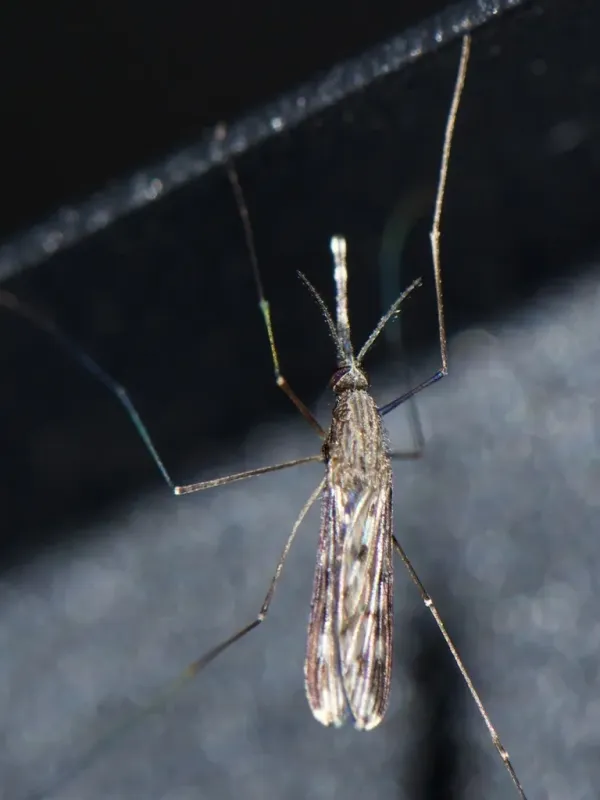
Description
How to identify
Anopheles crucians belongs to the order Diptera and the family Culicidae. This mosquito is distinguished by its characteristic body shape and resting posture, where the abdomen is held at an angle away from the resting surface.
Adults are identified by dark wings featuring three distinct pale spots. The average body size is approximately 5–6 mm. They are well-adapted to environments with stagnant or slow-moving water.
The life cycle includes four stages: egg, larva, pupa, and adult. Females typically deposit eggs in acidic wetlands or shallow, stagnant water bodies common in many agricultural landscapes.
The species is highly adaptable, capable of colonizing various types of freshwater habitats, including drainage ditches and temporary pools formed by rainfall.
Entomological monitoring shows that populations can fluctuate significantly based on water availability and temperature, influencing their presence in rural areas.
What it damages
Although Anopheles crucians is not a direct phytophage that feeds on plant tissues, it poses significant operational risks to agricultural activities and livestock health.
A dense population of these insects in fields can severely disrupt manual field work and harvesting processes by harassing workers and reducing labor productivity.
In livestock farming, high mosquito densities cause distress to animals, leading to decreased growth rates, lower milk production, and overall health decline.
The requirement for systematic insect control and environmental management adds to the operational costs for farms, particularly those near irrigation systems.
Indirect damage occurs when pest control measures are poorly managed, potentially affecting the biodiversity of beneficial predatory insects within the agroecosystem.
When it appears
Adult activity begins in the spring as temperatures rise, signaling the transition from hibernation to active development for the new generation.
Population density typically peaks in mid-to-late summer, corresponding with peak irrigation and agricultural maintenance activities in many regions.
The insects are primarily nocturnal and crepuscular, but they often remain active during the day if humidity levels are high or vegetation cover is dense.
Overwintering is achieved by fertilized females who seek shelter in farm outbuildings, sheds, or natural cavities with relatively stable microclimates.
The seasonal development is heavily dependent on rainfall patterns, which create the necessary water bodies for larval development and population growth.
Signs of infestation
The primary indicator of presence is the detection of large swarms of adults in the vicinity of irrigation canals, drainage ditches, and marshy field margins.
A distinct buzzing sound during dawn and dusk indicates high population density, particularly in areas near standing water sources.
The detection of larvae in irrigation water is a key sign; unlike other mosquito species, Anopheles larvae typically rest horizontally at the water surface.
Signs of distress in grazing livestock, such as excessive tail-swishing or moving to higher ground, often correlate with high local populations of these mosquitoes.
An increase in human complaints regarding bites while performing fieldwork serves as an urgent alert for monitoring and applying protective measures.
Control measures
The primary method of control is environmental management: draining temporary puddles, clearing drainage ditches, and ensuring proper water flow in irrigation networks.
Biological control agents, such as formulations containing Bacillus thuringiensis israelensis (Bti), are highly effective at targeting larvae in water without harming crops.
Physical protection, including the installation of mesh screens on agricultural buildings and the use of insect repellents, is essential for worker safety.
Proper maintenance of water management systems prevents the formation of standing water, which serves as a primary breeding ground for the mosquito.
- Clearing dense weeds along irrigation canal banks.
- Using light traps to monitor population density.
- Applying environmentally friendly surface films to breeding water bodies.
Taxonomy
- Latin name
- Anopheles crucians
- Order
- Diptera (flies)
- Family
- Culicidae
- EPPO code
- ANPHCR
Discussion
No discussions yet — be the first.