
Black salt marsh mosquito
Aedes taeniorhynchus
Description
How to identify
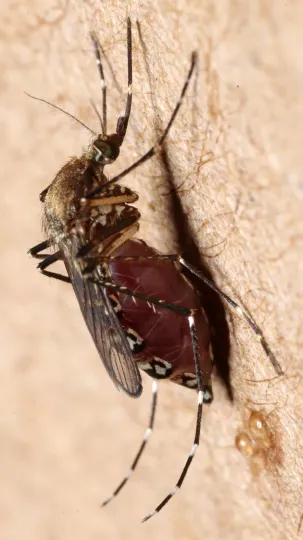
The black salt marsh mosquito (Aedes taeniorhynchus) is a dipteran insect belonging to the Culicidae family. Adult females are distinguished by their dark color and characteristic white bands on their tarsi.
The species possesses highly efficient piercing-sucking mouthparts, specifically evolved to facilitate blood-feeding on warm-blooded hosts. They are known for their strong flight capabilities, allowing them to migrate long distances from their breeding sites.
Larvae develop primarily in brackish water found in coastal marshes, salt ponds, or temporary pools created by tidal flooding or heavy rainfall.
Identification often requires careful examination of microscopic features, such as the male genitalia and the scaling patterns on the wings and legs of females.
While not a direct agricultural pest of plants, this species is considered a nuisance and a veterinary pest due to the significant stress it imposes on livestock and humans working in agricultural fields.
What it damages
Aedes taeniorhynchus does not damage crops by feeding on plant tissues. It does not cause physical degradation to the harvest or vegetative plant parts.
However, it inflicts significant economic losses on the livestock industry. Persistent biting causes extreme restlessness and agitation in cattle, leading to reduced grazing time and energy expenditure.
This stress response in animals results in decreased milk production in dairy herds and slower weight gain in beef cattle, impacting overall farm profitability.
The mosquito serves as a vector for various viral diseases, including Eastern Equine Encephalitis (EEE) and West Nile Virus, posing a serious health risk to domestic animals.
Field labor productivity is negatively impacted as farm workers are forced to limit their time outdoors or deal with the allergic reactions and fatigue caused by intense mosquito biting pressure.
When it appears
The life cycle of the black salt marsh mosquito is highly dependent on environmental triggers, specifically the timing of flood events that hydrate drought-resistant eggs.
The duration from egg to adult can be as short as one week under optimal warm conditions, allowing the species to produce numerous generations throughout the summer season.
The eggs have an extraordinary ability to remain dormant in dried soil for months, only hatching when favorable conditions of high humidity or inundation return.
Adult activity is primarily nocturnal and crepuscular, though they may become aggressive during the day if disturbed or when humidity levels are high.
Seasonal outbreaks often correlate with extreme weather events, such as heavy rain or storm-driven tidal surges, which inundate vast coastal breeding habitats simultaneously.
Control measures
Effective management begins with source reduction, which involves water management techniques such as ditching or draining potential breeding habitats to eliminate stagnant water.
Biological control agents, specifically the bacterium Bacillus thuringiensis israelensis, are widely used to target mosquito larvae in their breeding sites without harming other wildlife.
Livestock protection is achieved through the strategic application of insecticides in barns, the use of mosquito netting, and the application of veterinary-approved repellents.
Adulticiding through space spraying or fogging with pyrethroid insecticides is employed as a last resort to manage sudden, high-density infestations near farm facilities.
- Mowing vegetation around farms to reduce daytime resting sites.
- Utilizing light traps to monitor population spikes.
- Implementing personal protective equipment (PPE) for field workers.
Taxonomy
- Latin name
- Aedes taeniorhynchus
- Order
- Diptera (flies)
- Family
- Culicidae
- EPPO code
- AEDSTR
Discussion
No discussions yet — be the first.