
Salt marsh mosquito
Aedes sollicitans
Description
How to identify
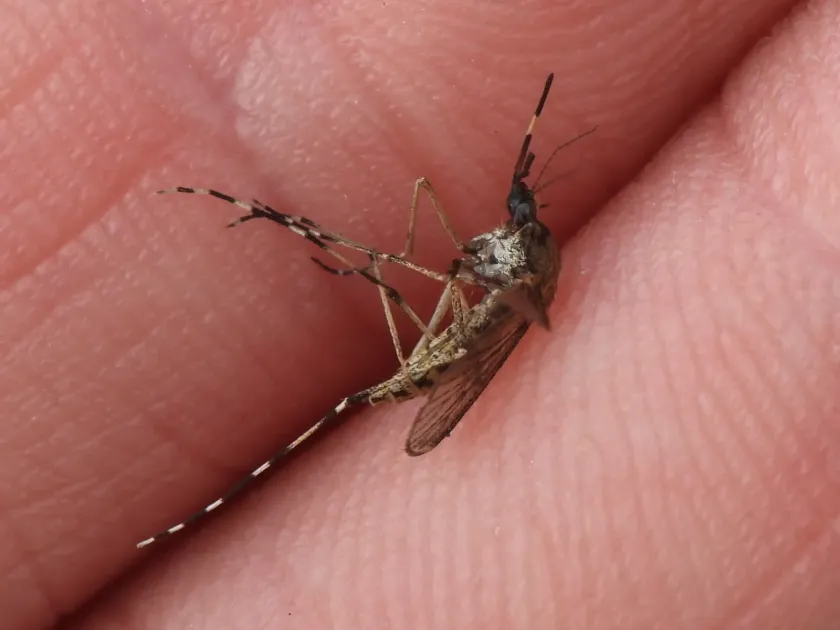
The Salt marsh mosquito (Aedes sollicitans) is a member of the order Diptera and the family Culicidae. This species is distinguished by its golden-yellow coloration on the dorsal side and prominent white bands on its legs, making it visually identifiable in the field.
Adult females are aggressive biters and are known for their exceptional flight range, often traveling long distances from their breeding sites to find blood meals. Their mouthparts are highly adapted for piercing the skin of mammals, including livestock.
The biological cycle is strictly tied to salt marshes and brackish water habitats. The eggs are laid in moist soil and can undergo a long diapause, remaining viable through dry periods until flooding triggers hatching.
Development includes four distinct life stages: egg, larva, pupa, and adult. The speed of the life cycle is highly dependent on temperature, often allowing for rapid population explosions within a single week after sufficient rainfall.
While not a direct pest to plants, the Salt marsh mosquito is a critical target for agricultural management due to its severe impact on animal health and farm operations in coastal and saline environments.
What it damages
The primary economic impact of the Salt marsh mosquito is its harassment of livestock. Constant attacks cause significant agitation, resulting in reduced grazing time, loss of appetite, and significant drops in milk production.
Livestock exposed to massive mosquito swarms suffer from stress-induced weight loss and are prone to skin inflammation and secondary infections due to constant biting. This necessitates additional veterinary care and expenditure.
These mosquitoes can act as vectors for various diseases, including Eastern Equine Encephalitis (EEE), which poses a lethal threat to horses and carries substantial risk for farm biosecurity and livestock welfare.
Farmers often experience increased labor costs as animals require closer monitoring and protective measures. Furthermore, the productivity of pastured animals is hindered by their instinctual need to protect themselves by moving constantly or bunching together.
In regions with high populations, the cost of chemical control and the purchase of repellents significantly impact the financial margins of livestock operations, requiring a strategic approach to pest management.
When it appears
Activity typically begins during the warmer months, triggered by environmental factors such as tidal flooding or heavy rainfall that inundates breeding grounds. The species can remain active until the first frost in late autumn.
Summer months often see the highest population density, particularly after storms when temporary pools of water are formed. Rapid evaporation cycles in these habitats keep the mosquito population dynamic and highly responsive to weather changes.
Adult females are most active during dawn and dusk, although they can be aggressive throughout the day in shaded or overcast conditions. These are the peak periods when they seek blood hosts to ensure the survival of the next generation.
Long-term population stability is highly dependent on humidity levels and the availability of saline soil, which is essential for egg survival. An experienced manager monitors rainfall records to predict potential waves of adult mosquitoes.
Proactive monitoring during the peak season is essential for agricultural operations, as understanding the local cycle allows for targeted timing of control applications before the infestation peaks.
Signs of infestation
The most immediate sign of an infestation is restless behavior in livestock, such as stamping, tail flicking, and bunching in open areas. Increased mosquito bites on farm workers are also a reliable indicator of high population density.
Entomological monitoring using light traps or CO2-baited traps allows for the quantification of adult populations. Detecting these adults in the field confirms the need to investigate potential breeding sites nearby.
Larval surveys in brackish pools are the most accurate way to detect the early stages of an outbreak. Larvae can be observed moving in the water column, particularly in areas with high salinity that are often neglected by standard mosquito surveys.
A decline in livestock performance, not attributable to diet or disease, often serves as a late-stage signal that the mosquito population has reached an economic threshold of harm, requiring immediate intervention.
Finding the source of the infestation is crucial. Once breeding sites are identified, they can be managed to suppress the entire local population, reducing the reliance on broad-spectrum insecticide sprays across the entire farm.
Control measures
Integrated Pest Management (IPM) is the most effective approach. This includes water management, such as ditching or leveling salt marsh areas to eliminate temporary water pools where larvae develop.
Biological control, specifically the use of Bacillus thuringiensis israelensis (Bti), is highly recommended for treating larvae. This method is environmentally friendly, targeting the mosquitoes without harming other aquatic wildlife.
For livestock protection, the use of topical veterinary-grade repellents and physical barriers, such as screened enclosures, helps reduce the immediate stress on animals. Targeted insecticide applications may be necessary in extreme cases.
Monitoring programs using traps provide the data needed to apply treatments only when necessary. This reduces the overuse of pesticides and minimizes the impact on non-target insect species within the farm ecosystem.
- Elimination of temporary standing water.
- Application of Bti-based larvicides.
- Use of veterinary-approved repellents.
- Strategic grazing to minimize exposure.
Taxonomy
- Latin name
- Aedes sollicitans
- Order
- Diptera (flies)
- Family
- Culicidae
- EPPO code
- AEDSSO
Discussion
No discussions yet — be the first.