
Zagrammosoma multilineatum
Zagrammosoma multilineatum
Description
How to identify
Zagrammosoma multilineatum belongs to the Eulophidae family within the order Hymenoptera. These tiny parasitic wasps are significant players in the ecological regulation of various plant-feeding insects.
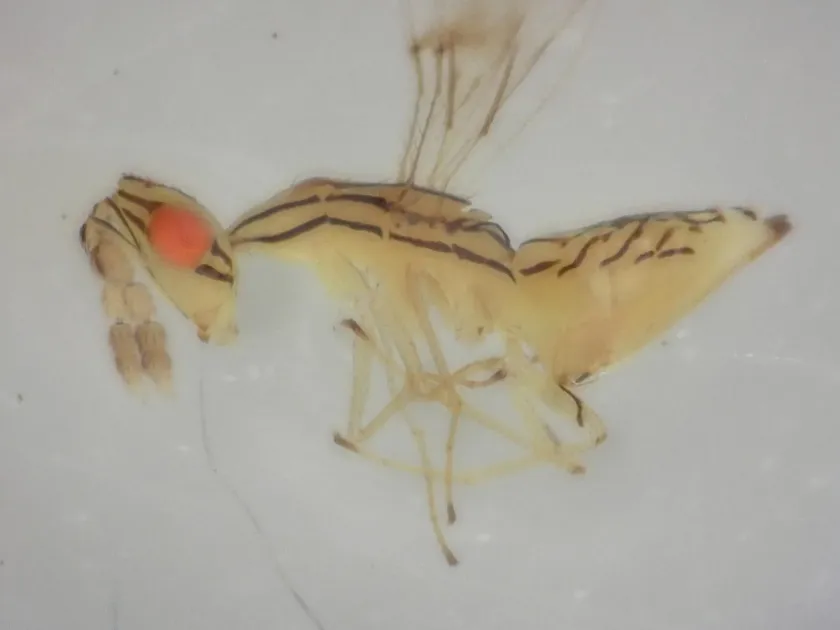
The adult wasps are characterized by a yellow body with distinct black stripes. Their morphology, including specific antennal segments and wing venation, is typical for the Chalcidoidea superfamily.
The larval stages are endoparasitic, completing their development within the tissues of host plants, frequently occupying mines created by leaf-mining larvae.
Due to their minute size, often only a few millimeters long, these wasps are difficult to detect during standard field scouting without specialized tools.
Accurate species determination often requires microscopic analysis of genitalia and wing structures, usually performed by professional entomologists.
What it damages
While many species within this genus act as beneficial biocontrol agents, Z. multilineatum can impact various ornamental and vegetable crops through its parasitic activity.
It is predominantly associated with crops affected by leaf-mining flies (Agromyzidae family), where it targets the larvae of the primary pest.
The damage manifests as a disruption of plant physiology, as the parasite consumes tissues within the leaf, hindering the plant's ability to conduct photosynthesis.
Such damage results in weakened plant vitality, reduced growth rates, and a decrease in the overall quality and marketability of the agricultural produce.
In greenhouse environments, high populations of this wasp can lead to significant aesthetic damage, especially on ornamental flower crops.
When it appears
The activity of these wasps peaks during warm months when high temperatures accelerate their metabolic processes and reproductive cycles.
Population density typically correlates with the abundance of primary leaf-mining pests, which are necessary as hosts for the wasps' progeny.
In protected cultivation systems, such as greenhouses or nurseries, the insect can remain active year-round if temperatures are kept consistently favorable.
Reproduction depends heavily on optimal humidity levels and the availability of sufficient host larvae to sustain the next generation.
Winter dormancy typically occurs at the pupal or adult stage, with the insects overwintering in plant debris, soil, or sheltered structures.
Signs of infestation
Evidence of infestation often appears as secondary damage to existing leaf mines, with noticeable alterations in the color and integrity of the leaf tissue.
Affected leaves may show chlorosis or premature yellowing and necrosis in areas where internal parasitic activity has compromised the plant cell structure.
Under close inspection, minute oviposition punctures, created by female wasps, can be observed on the surface of the infested leaves.
The deformation of the leaf blade and stunted development of apical shoots serve as indicators of heavy parasitic pressure within the crop.
An uneven or patchy appearance on the leaves, combined with the presence of exit holes from which the adult wasps have emerged, confirms a past infestation.
Control measures
Integrated Pest Management (IPM) strategies are the most effective way to manage these populations, prioritizing biological equilibrium over chemical intervention.
The use of natural predators and entomopathogenic fungi can help maintain the wasp population at a level that does not cause economic damage.
Chemical applications should be restricted to highly selective insecticides that minimize the impact on non-target beneficial insect populations.
Good agricultural practices, such as the removal and destruction of crop residues, are crucial to prevent the survival of pupae between growing seasons.
- Use yellow sticky traps for population monitoring.
- Maintain weed-free environments to eliminate alternative host reservoirs.
- Implement quarantine protocols for incoming plant materials.
Taxonomy
- Latin name
- Zagrammosoma multilineatum
- Order
- Hymenoptera
- Family
- Eulophidae
- EPPO code
- ZAGRMU
Discussion
No discussions yet — be the first.