
Yellow-line Quaker
Xanthia togata
Description
How to identify
The Yellow-line Quaker (Xanthia togata) is a moth species belonging to the family Noctuidae, order Lepidoptera. It is recognized as a potential pest in forest and garden environments.
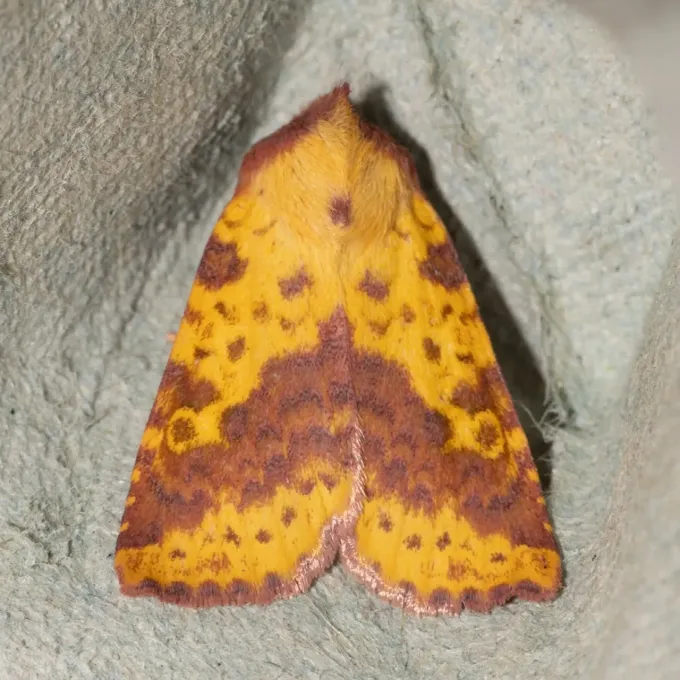
Adult moths typically have a wingspan of 35–40 mm. The forewings display a vibrant yellow-orange to golden-ochre coloration with reddish-brown transverse markings.
The larvae, or caterpillars, are relatively stout, growing up to 40 mm in length. They exhibit a variegated pattern of grey, brown, and violet shades, providing excellent camouflage on woody plants.
The pupal stage occurs in the soil, protected by a cocoon made of silk and debris. This stage is crucial for the insect to survive the summer months in a diapause state.
As part of the Noctuidae family, the life cycle involves four distinct stages: egg, larva, pupa, and adult. The species typically completes one generation per year.
What it damages
This species is polyphagous, meaning it feeds on a variety of plants. It is particularly noted for causing damage to the buds and young foliage of various trees and shrubs.
Preferred hosts often include species such as Salix (willow), Populus (poplar), and various members of the Rosaceae family, including some fruit-bearing trees.
Caterpillars cause the most severe damage in early spring. They feed internally on swelling buds, effectively destroying the plant's ability to produce leaves or flowers for that season.
Once the buds are consumed, larvae transition to feeding on newly formed leaves, often tying them together with silk threads to create shelters.
In ornamental settings and nurseries, heavy infestations can lead to significant aesthetic damage and reduced plant vitality due to the loss of photosynthetic area.
When it appears
The flight period for adult moths occurs in the autumn months, typically from August through October, when they seek mates and suitable sites for egg-laying.
The insect overwinters in the egg stage. Eggs are laid on the twigs and branches of host plants, where they remain dormant throughout the winter season.
Larval emergence happens in early spring, synchronized with the warming temperatures and the initial stages of bud development on host trees.
The caterpillar feeding phase is concentrated in the spring months (April and May). This period is critical for monitoring and implementing protective measures.
By late spring or early summer, the larvae finish their development and burrow into the soil to pupate, completing the cycle until the moths emerge in late summer.
Signs of infestation
The presence of the pest is often first identified by the appearance of damaged, hollowed-out buds in early spring. These buds may look shriveled or fail to open correctly.
Caterpillars are nocturnal and hide during the day, making them difficult to spot directly. Their presence is often betrayed by the accumulation of frass near the base of buds.
Webbing between adjacent leaves is a common indicator of larval activity. This silk serves as a protective housing for the growing caterpillar as it feeds.
Visible thinning of the canopy on specific branches is a later sign of infestation, resulting from the cumulative damage of numerous caterpillars feeding simultaneously.
Adult moths can be detected at night using light traps, as they are strongly attracted to artificial light sources during their autumn flight season.
Control measures
Effective management begins with cultural practices. Cultivating the soil under host trees in the late summer or autumn can destroy pupae located in the ground.
Targeted chemical applications should be timed for the early spring, immediately after bud break, to intercept young larvae before they cause extensive damage.
- Utilize biological insecticides containing Bacillus thuringiensis (Bt) for environmentally friendly control.
- Encourage local bird populations, which naturally predate on moth larvae in garden settings.
- Use pheromone traps in the autumn to monitor adult moth populations and estimate the risk for the following season.
- Physically remove heavily infested branches where caterpillars and their nests are clearly visible.
- Ensure adequate plant nutrition to help host trees recover from early-season foliage loss.
Always consult local agricultural guidelines before applying pesticides to ensure they are safe for non-target species, such as beneficial pollinators.
Taxonomy
- Latin name
- Xanthia togata
- Order
- Lepidoptera (butterflies)
- Family
- Noctuidae
- EPPO code
- COSILU
Discussion
No discussions yet — be the first.