
Xanthia icterictia
Xanthia icterictia
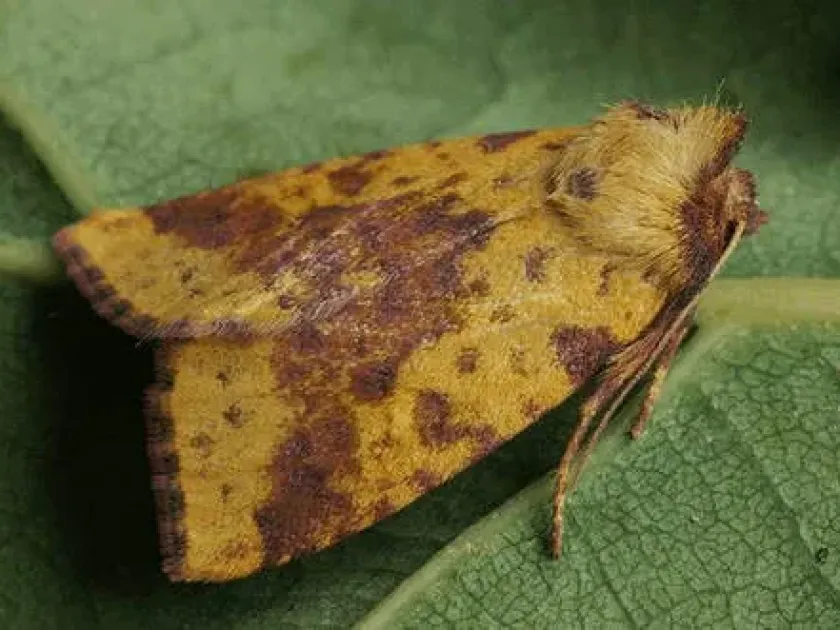
Description
How to identify
Xanthia icterictia is a species of moth belonging to the Noctuidae family. The adult moth has a wingspan of approximately 30–35 mm, with forewings that display vibrant ochre-yellow to golden patterns, often accompanied by darker markings and faint cross-lines.
The larvae, or caterpillars, grow to about 35–40 mm in length. Their bodies are typically brownish-grey or tan, providing excellent camouflage against the bark and foliage of their host plants, which is a key survival strategy.
Pupation occurs within the soil or amongst leaf litter. The pupae are reddish-brown, allowing them to blend into the substrate where they remain dormant during the colder seasons until the adult emergence.
These moths are strictly nocturnal, spending the daylight hours concealed within dense foliage or crevices in the bark of shrubs. Their secretive behavior often leads to infestations going unnoticed until damage becomes visible.
Understanding the biology of this species is essential for orchard management, as their lifecycle is closely tied to the humidity levels and the phenology of their primary host plants, such as raspberries and willows.
What it damages
The primary host plants for Xanthia icterictia include raspberries (Rubus idaeus), blackberries, and various species of willow. The larvae are the stage responsible for the economic damage inflicted on these crops.
Early in the spring, the caterpillars feed on developing buds. This activity is particularly destructive, as it can cause the loss of significant portions of the crop before the flowering stage even begins.
Later in the season, as the larvae grow, they consume leaves, creating irregular holes and ragged edges. Heavy infestations can lead to partial or total defoliation, which severely limits the plant's photosynthetic capacity.
Damage to the growth tips and buds also compromises the plant's overall health, leaving it vulnerable to secondary infections from fungi and bacteria that often enter through the wounds caused by larval feeding.
The combined effect of bud loss and leaf tissue removal can lead to stunted growth, reduced vigor, and a substantial decrease in fruit yield, especially in commercial berry plantations.
When it appears
Adult moths typically emerge in late summer and early autumn, specifically during August and September. This is when mating takes place, followed by the deposition of eggs on host plant bark or leaf litter.
The eggs serve as the overwintering stage of the species. Larval hatching occurs in the following spring, typically in April, once temperatures become conducive to insect activity and host plant growth.
The feeding phase of the caterpillars lasts throughout May and into early June. This period is critical for monitoring, as the larvae are most active and visible during these weeks.
By mid-June, the larvae descend to the soil to pupate. The pupal stage lasts approximately one month, concluding the summer developmental cycle before the emergence of the next generation of adults.
Tracking the phenological stages of Xanthia icterictia is vital for precision agriculture, allowing growers to time their intervention strategies for maximum efficiency and minimal chemical use.
Signs of infestation
The earliest signs of an infestation are visible in early spring, characterized by damaged or hollowed-out buds that fail to bloom properly. These buds often appear withered or chewed at the base.
As the season progresses, leaf damage becomes more apparent. The caterpillars create distinct holes in the leaf blades, often leaving behind dark frass, which is a telltale sign of their presence on the plant.
- Premature bud drop or failure to open.
- Ragged or skeletonized leaves on new growth.
- Presence of caterpillar excrement on foliage near feeding sites.
Nighttime inspections using a flashlight are the most effective method for detecting larvae. During the day, they are often hidden near the base of the plant or in the dense canopy.
The presence of large numbers of adult moths near a berry field in the fall suggests a high risk of larval infestation in the coming spring, necessitating proactive management efforts.
Control measures
Cultural control methods, such as deep tilling or cultivation of the soil around the base of bushes in the summer, can mechanically destroy pupae, significantly reducing the next generation's population.
Removing plant debris and weeds in the autumn is a key preventative measure, as it eliminates essential overwintering sites for the eggs and larvae near the host plants.
Biological controls are highly recommended, specifically the use of Bacillus thuringiensis-based products. These are effective against early larval stages while remaining safe for beneficial insects and pollinators.
Chemical intervention should be reserved for cases where economic thresholds are exceeded. Use selective, low-toxicity insecticides during the early larval stage to minimize impact on non-target species.
Integrated Pest Management (IPM) programs involving the use of pheromone traps can help monitor moth activity levels, ensuring that any control measures are applied only when and where they are truly needed.
Taxonomy
- Latin name
- Xanthia icterictia
- Order
- Lepidoptera (butterflies)
- Family
- Noctuidae
- EPPO code
- COSIFU
Discussion
No discussions yet — be the first.