
Uranotaenia sapphirina
Uranotaenia sapphirina
Description
How to identify
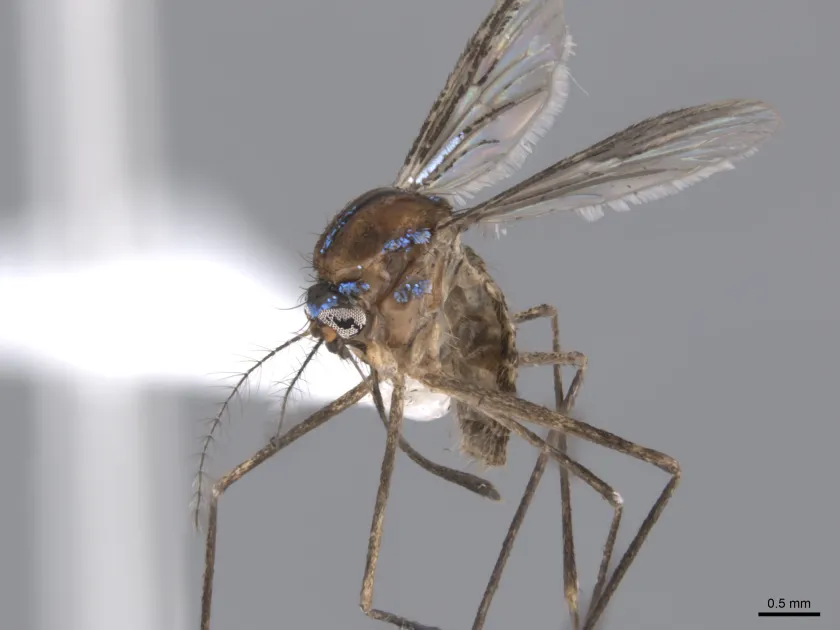
Uranotaenia sapphirina is a small mosquito species belonging to the family Culicidae. It is distinctive due to the iridescent blue or sapphire-colored scales present on its body, which provide its scientific name.
The adults exhibit typical dipteran characteristics: slender bodies, long legs, and a specialized thorax pattern. This specific coloring allows experts to identify the species among other mosquitoes found in damp agricultural environments.
The larval stages develop in standing water, such as stagnant pools or overgrown drainage ditches. They are often found hanging from the water surface, a behavior typical for many mosquitoes in the Culicidae family.
While this insect is not considered a pest that damages crops directly, it is a significant part of the ecosystem in water-rich agricultural zones. Its presence is often used as an indicator of the state of drainage systems.
Field identification can be challenging for non-experts, as many small mosquito species share similar physical characteristics. Taxonomic keys are required to confirm the species accurately.
What it damages
It is important to clarify that Uranotaenia sapphirina is not a phytophagous insect. It does not feed on plant foliage, stems, roots, or fruits, meaning it causes zero direct damage to agricultural yields.
The primary concern regarding this species in agriculture is the nuisance caused to farm workers. A high population density can interfere with field activities, reducing the efficiency and comfort of manual labor.
Indirect impact may occur through ecological interactions within a field’s micro-environment. While minimal, there is potential for competition with beneficial aquatic organisms in irrigation reservoirs.
In most professional agricultural settings, this species is not listed as an economic pest. Damage assessment reports usually exclude this insect, as it does not negatively impact crop physiological development.
Control of this species is largely an issue of occupational hygiene rather than crop protection. Proper maintenance of irrigation systems remains the key to managing its population effectively.
When it appears
The activity of Uranotaenia sapphirina follows a seasonal pattern dictated by temperature and water availability. Adults become active as spring temperatures rise, marking the beginning of their reproductive cycle.
Summer months, particularly July and August, represent the peak of their population density. Warm weather accelerates the lifecycle, allowing for multiple generations to emerge within a single agricultural season.
As autumn arrives and temperatures drop, the metabolic rate of the insects decreases. Females enter a dormant state, seeking overwintering sites that offer protection from freezing temperatures.
The availability of stagnant water is the limiting factor for their distribution. Drought conditions can drastically reduce their numbers, as they are strictly dependent on water for larval development.
For agricultural management, monitoring during the warmest months is recommended to ensure that staff working near water bodies are adequately protected and that water management practices remain efficient.
Control measures
The most effective strategy for population management is environmental modification. Regular maintenance of drainage pipes and the removal of standing water eliminate the breeding grounds for the mosquitoes.
Biological control methods are highly encouraged, as they minimize environmental impact. Introducing predators such as larvivorous fish into irrigation ponds is a sustainable way to keep larval populations in check.
The use of chemical insecticides should be avoided, as it can inadvertently kill beneficial pollinators and natural predators of real agricultural pests, leading to further issues in crop management.
To ensure worker comfort and health, personal protective equipment and the use of approved repellents are recommended for field staff operating in areas where mosquito populations are dense.
- Drainage system maintenance
- Elimination of stagnant water pools
- Introduction of biological predators
- Use of protective gear for personnel
Taxonomy
- Latin name
- Uranotaenia sapphirina
- Order
- Diptera (flies)
- Family
- Culicidae
- EPPO code
- URATSA
Discussion
No discussions yet — be the first.