
New Zealand flax mealybug
Trionymus diminutus
Description
How to identify
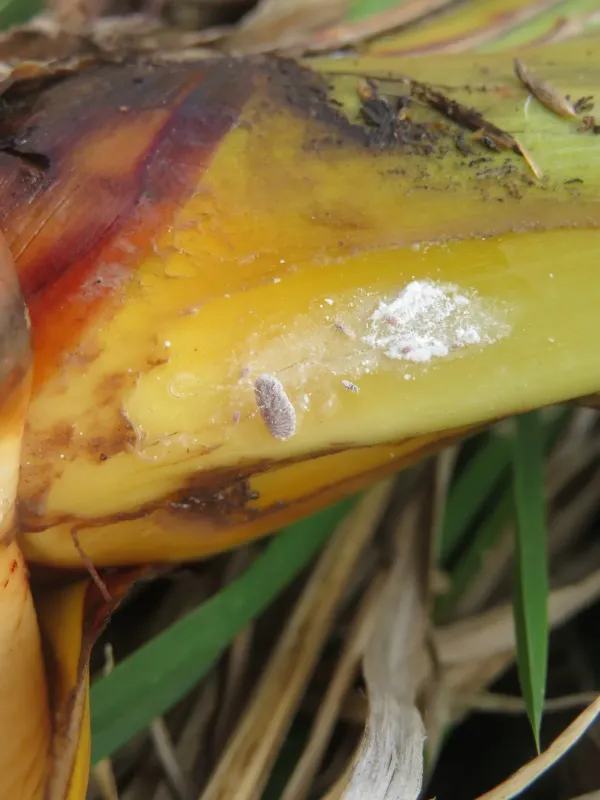
The New Zealand flax mealybug (Trionymus diminutus) belongs to the Pseudococcidae family, within the order Hemiptera. Adult females are oval-shaped and coated in a white, powdery wax layer that serves as a protective shield against environmental stressors.
The insect possesses characteristic waxy filaments along its margins, giving it the appearance of small cotton-like tufts. Their coloration typically ranges from pale yellow to pinkish or light grey.
Males are rarely encountered in this species; they are winged and structurally different from females, resembling small gnats. The species predominantly reproduces parthenogenetically, which allows for rapid population growth.
This pest is a major concern in greenhouse and botanical garden settings, showing a strong preference for Phormium tenax and related plant species.
Precise field identification is often difficult due to the similarity of this species to other mealybugs; laboratory verification of morphological traits, such as dorsal ducts and cerarii, is often necessary.
What it damages
The New Zealand flax mealybug primarily infests plants in the Xanthorrhoeaceae family, specifically targeting New Zealand flax and various succulent ornamental species.
Both adults and nymphs cause damage by inserting their stylets into plant tissues to suck out sap, which severely depletes the plant's nutrient reserves and weakens its overall vigor.
As they feed, they excrete honeydew, a sticky substance that accumulates on leaves and stems. This substance is an ideal substrate for the colonization of sooty mold fungus.
Symptoms of infestation include leaf discoloration, wilting, stunting, and in severe cases, the premature drop of foliage. Heavy infestations can significantly disrupt photosynthesis and lead to plant death.
The pest is particularly damaging to young, developing tissues and the basal areas of plants, where it forms dense, hidden colonies that are difficult to reach with topical sprays.
When it appears
In greenhouses and interior landscapes, the New Zealand flax mealybug is active throughout the year, as controlled temperatures favor continuous breeding cycles.
Developmental rates are accelerated during the warmer months (spring and summer), when increased light levels and ambient temperatures boost the metabolic activity of the insects.
Optimal environmental conditions include moderate to high humidity and temperatures ranging between 22°C and 28°C, which maximize the survival rate of the nymphs.
During the winter, populations may slow down but do not enter a state of true dormancy, continuing to threaten nursery stock and imported ornamental plants.
Movement between host plants occurs primarily through the accidental spread of nymphs via human contact, contaminated tools, or the movement of infested nursery stock.
Signs of infestation
The most prominent sign of an infestation is the presence of white, cottony masses concentrated in leaf axils, bases, and along the undersides of foliage.
Sticky honeydew secretions on the plant surface or surrounding pots are a clear indicator of active feeding colonies nearby.
The appearance of black sooty mold on leaves indicates that the mealybug population has been established for an extended period, requiring immediate remedial action.
Yellowing, curling, or distortion of young growth suggests that the insect is extracting excessive sap and potentially injecting salivary toxins into the plant tissue.
Regular inspection of the basal foliage of flax plants is essential, as the mealybugs often hide deep within the dense leaf bases where they are protected from observation.
Control measures
Effective management of this pest requires an integrated approach that combines cultural practices, physical removal, and chemical intervention.
Systemic insecticides, particularly those containing neonicotinoids, are the gold standard for control, as they translocate within the plant to kill the sap-feeding pests.
- Strict quarantine of all new plant material before introducing it into existing collections.
- Manual removal of colonies using cotton swabs dipped in isopropyl alcohol.
- Regular washing of infested plants to mechanically dislodge nymphs and adults.
- Application of horticultural oils or insecticidal soaps to suffocate the insects.
- Use of biological control agents, such as specific ladybeetle species, in large greenhouse operations.
Consistency is key; follow-up treatments spaced 10–14 days apart are necessary to break the lifecycle and eliminate newly hatched nymphs that may have survived the first application.
Taxonomy
- Latin name
- Trionymus diminutus
- Order
- Hemiptera (bugs, aphids, leafhoppers)
- Family
- Pseudococcidae
- EPPO code
- TRINDI
Discussion
No discussions yet — be the first.