
Striped garden caterpillar
Trichordestra legitima
Description
How to identify
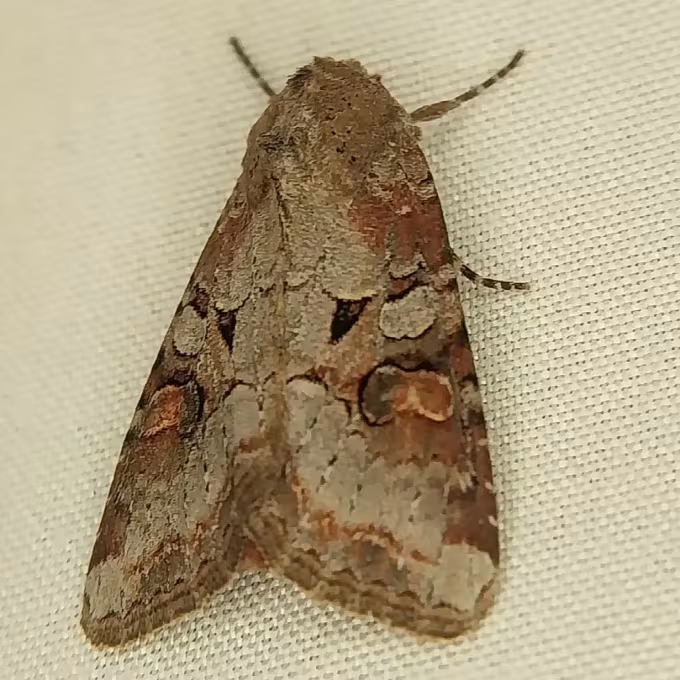
The Striped garden caterpillar (Trichordestra legitima) belongs to the order Lepidoptera and the Noctuidae family. The adult moth is a medium-sized insect with distinct markings.
The forewings of the moth exhibit a complex pattern consisting of gray, brown, and white shades, which provides excellent camouflage against tree bark or foliage.
Larvae go through several stages of development, changing their color pattern from greenish to brownish with longitudinal pale stripes on their sides.
The overwintering stage is usually the pupa, which is hidden in the soil or in a dense cocoon among plant debris, protecting it from winter frosts.
Eggs are hemispherical and laid in clusters on the underside of leaves, often covered with scales from the female to ensure protection during the incubation period.
What it damages
This pest is a polyphage, meaning it attacks a wide range of horticultural and vegetable crops, including legumes, brassicas, and various ornamental plants.
Larvae feed on leaf tissues, causing irregular holes and skeletonizing the foliage, which significantly reduces the photosynthetic capacity of the plant.
In cases of heavy infestation, the Striped garden caterpillar can defoliate plants, drastically reducing yield in peas, cabbage, and various salad greens.
Beyond leaf consumption, larvae may damage flower buds and young fruit, causing deformation or failure of the reproductive parts of the plant.
Younger larvae start by feeding on the soft epidermis, while older, more voracious larvae consume the entire leaf lamina, leaving only the main veins.
When it appears
The moth flight typically begins in late spring, triggered by the accumulation of heat units and favorable average daily temperatures for insect activity.
The flight season continues throughout the summer months, with the pest capable of completing multiple generations if environmental conditions remain optimal.
Larval activity is most noticeable during June and July, coinciding with the peak vegetative growth phase of many agricultural crops that require protection.
As temperatures drop in autumn, larvae move into the soil to pupate, preparing for overwintering, which marks the end of the annual population cycle.
Weather conditions such as heavy rainfall can influence flight patterns, but the species is generally well-adapted to moderate climatic zones.
Signs of infestation
The first sign of an infestation is the appearance of characteristic holes or notched edges on leaves, which is typical for many noctuid moth larvae.
The presence of frass (larval droppings) that resembles small dark granules on the leaves is a clear indicator of active feeding in the immediate vicinity.
Inspecting the underside of leaves often reveals egg clusters, and early detection of these clusters allows for targeted removal before the eggs hatch.
Curled leaves or light webbing near the damaged areas often indicate where the larvae hide during the day to avoid heat and natural predators.
- Damaged buds and reproductive structures that fail to bloom.
- Evidence of larval movement between adjacent healthy plants.
- Wilting or yellowing of foliage due to stem damage near the base.
Control measures
Preventive measures include effective weed management, as non-crop plants often serve as reservoirs for moths to lay eggs before they move to crops.
The use of pheromone traps is recommended to monitor moth flight and determine the precise timing for intervention, optimizing the efficacy of treatments.
Biological control methods, including the use of entomopathogenic bacteria like Bacillus thuringiensis, are highly effective against larvae while being eco-friendly.
Fall plowing or soil cultivation is essential to expose pupae to birds and harsh weather conditions, significantly reducing the overwintering population.
When chemical control is necessary, select insecticides that are specifically approved for the crop and apply them according to label instructions during early larval stages.
Taxonomy
- Latin name
- Trichordestra legitima
- Order
- Lepidoptera (butterflies)
- Family
- Noctuidae
- EPPO code
- POLILE
Discussion
No discussions yet — be the first.