
Cabbage looper
Trichoplusia ni
Description
How to identify
The Cabbage looper (Trichoplusia ni) is a nocturnal moth belonging to the Erebidae family, widely recognized for the distinct loop-like motion of its larvae.
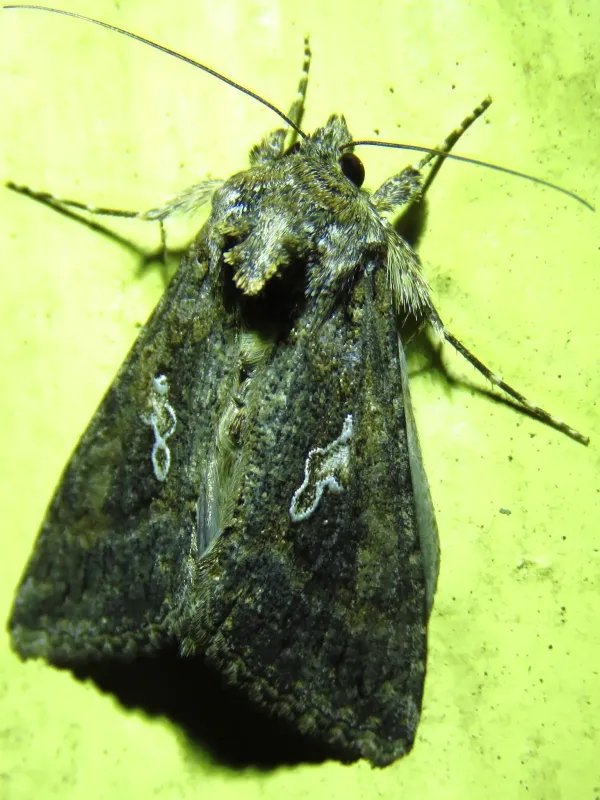
Adult moths have a wingspan of approximately 30 to 40 millimeters and are primarily brown or grayish in color with mottled patterns on their forewings.
The most distinctive feature of the adult is a small, silvery, Y-shaped or gamma-shaped mark located in the center of each forewing, which serves as a key identifier.
The larvae are light green with thin white lines running along their bodies; they are easily identified by having only three pairs of prolegs, forcing them to arch their backs when moving.
Pupation occurs within a fragile, white, silk-like cocoon that the larva spins, typically attached to the underside of leaves or in sheltered areas on the plant.
What it damages
As a highly polyphagous pest, the Cabbage looper feeds on a wide range of host plants, causing significant economic losses in both vegetable and field crops.
Cruciferous vegetables such as cabbage, broccoli, cauliflower, kale, and mustard are the primary targets, often suffering severe defoliation during outbreaks.
The pest also causes significant damage to other economically important crops including tomatoes, lettuce, potatoes, celery, cucumbers, and several ornamental flower species.
Larvae consume large amounts of leaf tissue, significantly reducing the photosynthetic capacity of the plant and hindering the development of fruit or heads.
Direct damage to the marketability of crops occurs when larvae burrow into developing cabbage or lettuce heads, contaminating the produce with frass and decaying tissue.
When it appears
Cabbage loopers typically emerge in the spring once temperatures are consistently warm, with adult moths becoming active at dusk to lay their eggs.
Eggs are laid individually on the underside of leaves, and the larvae emerge within a few days, immediately beginning to feed on the leaf surface.
The life cycle from egg to adult takes between three to six weeks depending on ambient temperature, allowing for multiple overlapping generations per growing season.
Population levels generally peak during the mid-to-late summer, coinciding with the rapid growth phase of many vegetable crops, which makes them highly vulnerable.
In warmer climates, the Cabbage looper can remain active throughout the year, while in colder regions, they may overwinter as pupae in soil or crop debris.
Signs of infestation
The presence of Cabbage loopers is first indicated by small, irregular holes eaten into the leaves, which expand as the larvae grow larger and feed more voraciously.
Early-stage larvae often skeletonize the leaf by feeding on the soft tissue between veins, leaving behind a fine, lace-like appearance of the leaf structure.
A clear sign of an active infestation is the accumulation of dark, pellet-like frass (excrement) scattered on the leaves and around the base of the plant.
Severe infestations often result in massive defoliation, where entire sections of the leaf lamina disappear, leaving only thick veins remaining.
In heading crops, the presence of larvae inside the heart of the vegetable is a major quality issue that often leads to secondary bacterial or fungal rots.
Control measures
Integrated Pest Management (IPM) is essential for controlling the Cabbage looper, starting with cultural practices such as removing crop residues and weeds.
Biological control agents, particularly the use of Bacillus thuringiensis (Bt) sprays, are highly effective against larvae and pose minimal risk to beneficial insects.
Chemical control using selective insecticides should be reserved for periods when monitoring indicates that larval populations have exceeded economic thresholds.
- Utilize pheromone traps to monitor adult moth activity and predict potential larval emergence.
- Encourage natural predators and parasitoids, such as Trichogramma wasps, that naturally suppress looper populations.
- Regular field scouting to detect egg clusters and young larvae before they cause significant damage.
By combining monitoring, biological suppression, and targeted chemical applications, growers can manage Cabbage looper populations effectively throughout the season.
Taxonomy
- Latin name
- Trichoplusia ni
- Order
- Lepidoptera (butterflies)
- Family
- Noctuidae
- EPPO code
- TRIPNI
Discussion
No discussions yet — be the first.