
West Indian manatee
Trichechus manatus
Description
How to identify
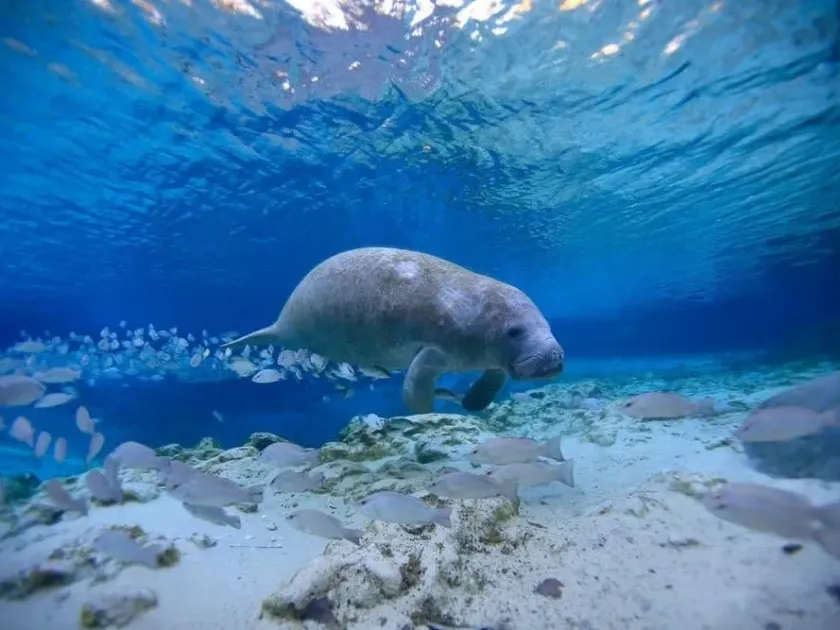
The West Indian manatee is a large, fully aquatic marine mammal belonging to the order Sirenia. They are characterized by their massive, torpedo-shaped bodies and paddle-like tails.
Adult manatees typically grow to 3 meters in length and weigh between 400 to 600 kilograms. Their skin is thick, gray in color, and sparse sensory hairs are distributed across the body.
The manatee has two paddle-shaped flippers, each containing several small, vestigial nails. They lack hind limbs entirely, a key anatomical feature of their evolutionary path.
Their head is small with a flexible upper lip, which they use to grasp and manipulate aquatic vegetation. They possess keen hearing despite lacking external ear structures.
These animals are native to the shallow coastal waters, estuaries, and river systems of the tropical and subtropical regions of the Atlantic Ocean and Gulf of Mexico.
What it damages
The West Indian manatee is not an agricultural pest. It is a strictly herbivorous species that feeds on a variety of submerged, emergent, and floating aquatic plants.
In certain natural water bodies, their grazing habits help maintain water flow by preventing the excessive accumulation of weeds and invasive aquatic plants.
While they might occasionally enter irrigation canals or drainage ditches, any resulting blockage is accidental and not indicative of malicious or pest-like behavior towards crops.
They pose no threat to terrestrial crops, livestock, or agricultural infrastructure. Their primary interaction with humans is often through unintended collisions with watercraft.
The economic impact of manatees is generally positive, as they serve as a flagship species for the conservation and health of the aquatic ecosystems they inhabit.
Control measures
The West Indian manatee is a federally protected species under various wildlife protection laws. Any form of harassment, hunting, or direct interference is strictly illegal.
Management strategies focus on habitat protection rather than population control. This includes establishing slow-speed zones for boats and creating manatee sanctuaries in wintering areas.
To prevent manatees from entering sensitive irrigation or industrial water systems, non-lethal barriers such as acoustic deterrents or physical gates are used by environmental agencies.
Agricultural managers are encouraged to adopt best practices that minimize nutrient runoff, which keeps water quality high and prevents invasive plant blooms that might attract manatees.
Collaboration with wildlife biologists is the standard procedure if a manatee becomes trapped or enters a managed water system that could jeopardize its safety.
Taxonomy
- Latin name
- Trichechus manatus
- Family
- Trichechidae
- EPPO code
- TRKDMA
Discussion
No discussions yet — be the first.