
Orache moth
Trachea
Description
How to identify
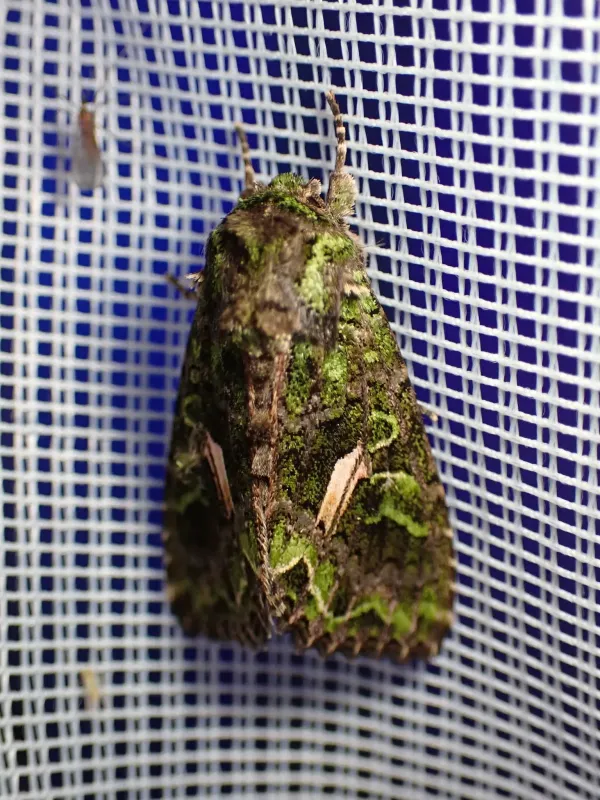
The Orache moth (Trachea atriplicis) belongs to the Noctuidae family. The adult moth has a wingspan of approximately 35–45 mm. Its forewings are brownish-grey, featuring a distinct, bright white mark shaped like the letter 'Y' or 'V', which serves as a primary diagnostic feature.
The larvae (caterpillars) grow up to 45 mm in length. Their coloration is highly variable, ranging from light green to brownish, often with a pale dorsal stripe and dark diagonal markings along the sides of the body.
The insect undergoes a complete metamorphosis involving four stages: egg, larva, pupa, and adult. The species typically overwinters in the pupal stage buried 10–15 cm deep in the soil, which provides excellent protection against cold temperatures.
Depending on the climatic zone, the Orache moth can produce one or two generations per year. The adult moths are nocturnal, spending the daylight hours in secluded areas, making their detection difficult without specialized tools.
Agronomists often use pheromone traps or light traps to monitor population levels and determine the precise timing for chemical or biological treatments, especially in large-scale vegetable farming.
What it damages
This species is a polyphagous pest, meaning it feeds on a wide variety of plant species. It frequently attacks key agricultural crops such as potatoes, cabbages, sugar beets, carrots, and various nightshade crops like tomatoes.
The presence of common weeds, particularly those from the Chenopodium genus, often facilitates the establishment of the pest in agricultural fields. These weeds serve as ideal sites for early-season oviposition.
Young larvae initially feed on the undersides of leaves, creating a skeletonized appearance. This feeding pattern drastically reduces the plant's photosynthetic efficiency and stunts overall development.
As larvae mature, they consume entire leaf sections and may also bore into fruit or tubers. This behavior renders the produce unmarketable and creates entry points for secondary bacterial and fungal pathogens, leading to rot.
High population densities can result in severe foliage loss, which is particularly devastating for young crops. In extreme cases, total crop failure can occur if protective measures are not implemented in time.
When it appears
Adult moth activity typically begins in late May or early June, depending on local temperatures. The peak flight period usually occurs during the warmest weeks of summer, when females begin laying eggs on host plants.
Larvae hatch after about a week or two, depending on environmental conditions, and begin an active feeding phase that lasts approximately one month before pupation in the soil.
In regions with longer growing seasons, a second generation can emerge in late summer. This generation is often more destructive to late-maturing crops, as larvae are active during the critical harvest preparation phase.
Weather conditions, such as high humidity or heat waves, can influence the duration of each lifecycle stage. Monitoring programs are essential to predict these spikes in pest activity accurately.
After the final larval stage in autumn, the pupae enter diapause, remaining dormant in the soil until the environmental cues of the following spring trigger emergence.
Signs of infestation
The first signs of infestation are small holes or "windows" in the leaf surface. A close inspection of the leaf undersides often reveals clusters of eggs or newly hatched larvae.
The presence of frass (caterpillar droppings) on the soil surface beneath the plants is a clear indicator that feeding is occurring. This is especially noticeable in the morning.
Damage to fruits, such as irregular holes or excavated cavities, is a late-stage symptom of larval presence. These areas may appear wet or decaying due to secondary infections common in damaged tissues.
During night patrols with a light source, larvae can be easily spotted resting on leaves or stems. This is the most effective way to confirm an infestation in a home garden or small plot.
General plant stress, characterized by wilting or premature yellowing of lower leaves, often suggests that the root or foliage system is under pressure from pest feeding.
Control measures
Cultural control is a primary management strategy. Deep autumn ploughing is highly effective for exposing pupae to predators and harsh winter weather, significantly reducing the overwintering population.
Sanitation practices, such as removing weeds and crop residues after harvest, eliminate potential overwintering sites and larval food sources, effectively breaking the pest's life cycle.
Biological control options include applying microbial insecticides based on Bacillus thuringiensis, which is effective against young larvae and has a minimal impact on beneficial insect populations.
Chemical control should be used as a last resort, targeted at the most vulnerable larval stages. Various registered insecticides, including synthetic pyrethroids and neonicotinoids, can be used while strictly observing pre-harvest intervals.
- Monitor populations with light traps.
- Practice deep soil cultivation to disrupt pupae.
- Remove weeds to prevent early colonization.
- Use selective bio-insecticides early in the season.
- Rotate crops to discourage population buildup.
Taxonomy
- Latin name
- Trachea
- Order
- Lepidoptera (butterflies)
- Family
- Noctuidae
- EPPO code
- TRAESP
Discussion
No discussions yet — be the first.