
Crane fly
Tipula
Description
How to identify
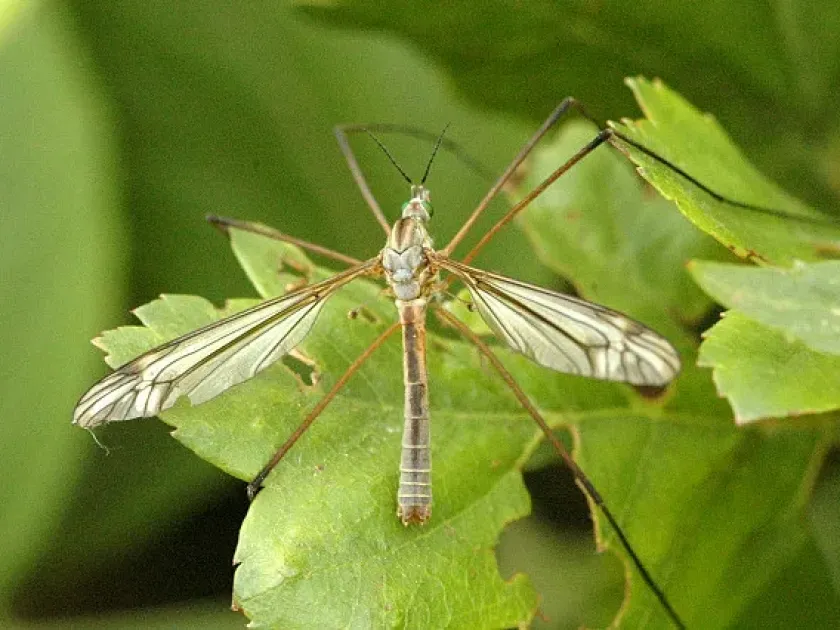
Crane flies (genus Tipula) belong to the family Tipulidae, order Diptera. While the adults look like giant mosquitoes, they are harmless to plants and feed mostly on nectar or not at all.
The agricultural damage is caused by the larvae, commonly known as leatherjackets. They have a cylindrical, legless body, usually grey-brown in color, and can grow up to 45 mm in length.
Their head capsule is well-developed and heavily sclerotized, allowing them to chew through tough plant tissues, including roots and buried stems.
The skin of the leatherjacket is tough and wrinkled, which helps protect them in their soil environment and facilitates movement through subterranean tunnels.
Pupation occurs within the soil, and the pupae possess small, spine-like structures that allow them to move towards the surface before the adult fly emerges.
What it damages
Crane fly larvae are polyphagous pests that target a wide range of agricultural crops, including cereals, maize, and sugar beets.
They are particularly destructive to young vegetable transplants, damaging roots and stems, which often leads to the death of the plant.
In turfgrass management, they are considered a major pest as they feed on the root systems of grass, causing large patches of dead, brown lawn.
The damage is most severe during cool, wet springs when the larvae are actively feeding on the root crowns and roots of emerging plants.
Infested crops often show signs of stunted growth, chlorosis, and patchy distribution within the field, leading to significant yield losses.
When it appears
The life cycle of the crane fly typically spans one year, but development can vary based on soil moisture and ambient temperature conditions.
Adult flies emerge in late summer to early autumn, focusing their activity on mating and egg-laying in moist, vegetation-covered soil.
Eggs are deposited just below the surface of the soil, often near the base of grasses or where decaying organic matter is abundant.
Larvae remain in the soil throughout the winter, continuing to feed whenever the soil temperature remains above freezing.
The most active feeding stage occurs in spring as the larvae grow rapidly and prepare for pupation before the summer months.
Signs of infestation
The primary sign of an infestation is the appearance of wilting plants that fail to thrive in the early spring, often concentrated in specific areas.
Close inspection of the soil near damaged plants usually reveals severed stems or roots that have been eaten away by the larvae.
Leatherjackets are often found on the soil surface at night or after irrigation when the soil is saturated and oxygen levels are low.
Increased bird activity, particularly starlings or rooks foraging on the ground, often indicates a high population density of larvae beneath the soil.
Professional monitoring can be performed using soil core sampling to count the number of larvae per square meter in suspected areas.
Control measures
Effective cultural control includes proper tillage, which physically injures the larvae and exposes them to natural predators and desiccation.
Improving soil drainage is essential for infested areas, as high moisture levels create the ideal environment for leatherjacket survival.
Weed management is a crucial preventative measure, as dense weed cover provides excellent shelter for egg-laying females in the autumn.
In severe cases, chemical control using soil-applied insecticides or seed treatments may be necessary to protect high-value crops.
- Deep autumn plowing.
- Drainage of wet soil areas.
- Seed treatment with insecticides.
- Timely monitoring of larval density.
Taxonomy
- Latin name
- Tipula
- Order
- Diptera (flies)
- Family
- Tipulidae
- EPPO code
- TIPUSP
Discussion
No discussions yet — be the first.