
Tiliacea aurago
Tiliacea aurago
Description
How to identify
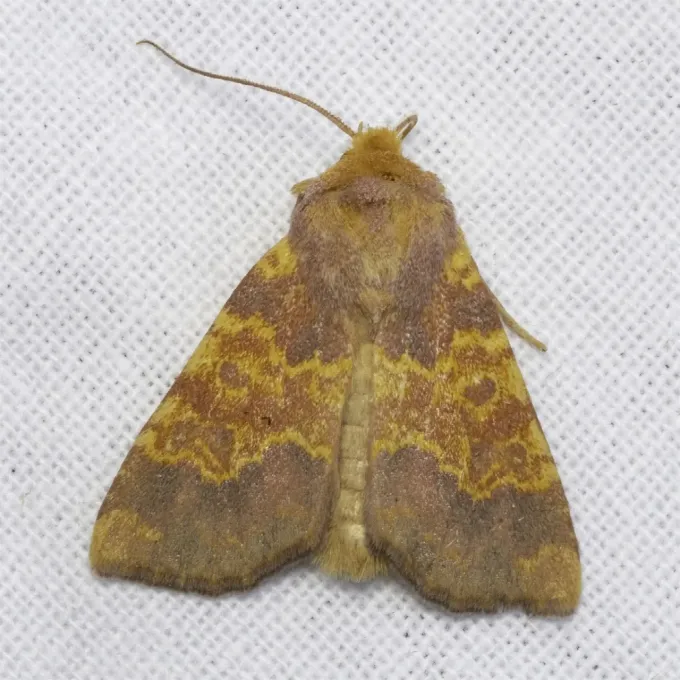
Tiliacea aurago, commonly known as the Barred Sallow, is a moth belonging to the Noctuidae family within the order Lepidoptera. It is recognized for its vibrant golden-yellow forewings, often marked with distinctive reddish or purple bands.
The wingspan of an adult moth typically ranges from 30 to 35 mm. Like most species in the Noctuidae family, it has a robust, hairy body that helps with thermal regulation and provides a classic appearance for this moth group.
The larvae, or caterpillars, are typically brownish or greenish, featuring light longitudinal lines that assist in camouflage among the leaves and twigs of their host plants during the day.
The pupal stage occurs in the soil or under leaf litter, where the moth spends the summer in a state of diapause. The pupae are dark brown, smooth, and well-protected from environmental changes.
Adult moths are late-season fliers, with activity peaking in September and October. This behavior distinguishes them from many other moth species that complete their life cycle earlier in the year.
What it damages
The caterpillars of Tiliacea aurago feed primarily on the foliage of deciduous trees. They show a strong preference for Beech (Fagus) and Maple (Acer) species as their primary food sources.
Secondary host plants include Lime (Tilia) and Hornbeam (Carpinus). While they rarely cause massive forest destruction, their feeding activity can impact the health of trees in shelterbelts and orchard peripheries.
Damage is characterized by the consumption of leaf tissue. In cases of high larval density, the caterpillars can cause significant defoliation, leaving only the primary veins of the leaves intact.
The loss of foliage leads to reduced photosynthetic capacity, which weakens the tree's vigor and makes it more susceptible to secondary pathogens, such as fungi or bark beetles.
Young trees in nurseries are particularly vulnerable to larval feeding, as damage to the developing canopy can significantly stunt their growth and ornamental value during the critical spring period.
When it appears
The life cycle of the Barred Sallow is adapted to autumn activity. Adult moths emerge in autumn, mate, and deposit eggs on the branches of the host trees to overwinter.
The egg is the overwintering stage. Eggs remain on the bark throughout the winter, surviving freezing temperatures until the spring season initiates the hatching process.
Larvae appear in April, coinciding with bud burst. This is a critical period when they feed voraciously on opening buds and young leaves, causing the most noticeable damage to the canopy.
By June, the larvae have typically completed their development and drop to the ground. They burrow into the soil to pupate, entering a summer diapause that lasts until autumn.
The emergence of the next generation of adults completes the annual cycle, ready to repeat the process when autumn temperatures arrive.
Signs of infestation
The most prominent sign of an infestation is the presence of eaten or ragged leaf margins. Careful inspection often reveals the caterpillars hiding on the underside of leaves or along stems.
The presence of frass (caterpillar excrement) on leaves or on the ground beneath the canopy is a strong indicator of an active feeding population above.
Early spring observations may show damaged or hollowed-out buds that fail to open properly. This is caused by early-instar larvae feeding on the developing tissues inside the buds.
During the autumn, the presence of adult moths near artificial light sources can indicate a nearby population, as they are strongly attracted to light.
- Ragged and skeletonized leaves
- Stunted growth of new shoots
- Accumulation of frass on the leaves
- Visible larval activity during spring
Control measures
Biological control methods are highly recommended, specifically the use of Bacillus thuringiensis sprays, which target the caterpillars without harming beneficial pollinators or natural predators.
In cases of severe infestation on valuable landscape trees, chemical insecticides applied in early spring (April-May) are effective at controlling the larvae before they reach maturity.
Cultural control, such as cultivating the soil under the tree canopy in the autumn or spring, can destroy pupae located in the ground, effectively reducing the next generation's population.
Encouraging insectivorous birds, such as tits and warblers, in the garden or orchard provides a natural defense against larvae, as these birds consume large quantities of caterpillars during the spring.
Monitoring the population using light traps in the autumn allows for a better understanding of the population size, enabling foresters and gardeners to prepare appropriate management plans for the following year.
Taxonomy
- Latin name
- Tiliacea aurago
- Order
- Lepidoptera (butterflies)
- Family
- Noctuidae
- EPPO code
- XNTAAU
Discussion
No discussions yet — be the first.